After more than a decade of defining modern digital asset trading, the BitMEX shutdown 2026 is officially underway. HDR Global Trading Limited, the parent company of the pioneering cryptocurrency derivatives exchange, has announced that all platform operations will permanently cease on September 23, 2026. The sudden news marks the definitive end of an 11-year run that fundamentally reshaped how traders interact with global digital markets.
For traders and industry veterans alike, the announcement is a sobering reminder of how rapidly the financial technology landscape evolves. The platform immediately halted new user registrations on July 23, 2026, signaling the beginning of a heavily structured wind-down phase. If you currently hold assets on the exchange, navigating this transition period is critical to avoid forced liquidations and steep maintenance fees.
HDR Global Trading Details the Wind-Down Timeline
The board of HDR Global Trading initiated the closure following a comprehensive strategic review of their internal business operations and the broader digital asset sector. Rather than a sudden collapse or insolvency event, the company is executing a highly orchestrated exit. Management guarantees that customer funds remain fully backed and accessible for immediate withdrawal.
However, the runway for existing users is exceptionally short. While standard operations will continue briefly, a phased operational reduction is already in motion. Market participants must monitor the schedule closely as the BitMEX closing September deadline approaches.
Understanding the Reduce-Only Mode Crypto Transition
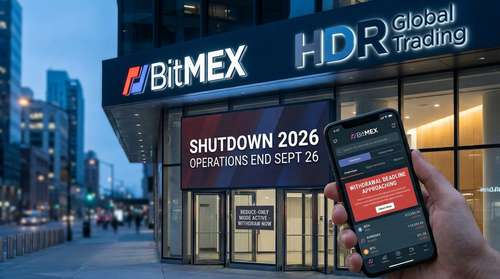
The most critical date for active traders is August 26, 2026. On this day, the platform will officially enter a reduce-only mode crypto trading state. During this phase, users will be completely restricted from opening any new market positions. The matching engine will only process orders that actively reduce or close existing market exposure.
Any contracts left open after the final bell on September 23 at 04:00 UTC will face mandatory forced closure at current market rates. The exchange explicitly stated it will bear no responsibility for trading losses incurred by users who fail to manage their own risk before the liquidation engine takes over. Furthermore, any fully verified accounts with unwithdrawn balances after the platform goes dark will incur a recurring maintenance fee of $50 or 1% per year (whichever is mathematically greater), slowly draining dormant funds.
The Legacy of Arthur Hayes BitMEX and the Crypto Perpetual Swap
It is virtually impossible to discuss the history of digital finance without acknowledging the profound impact of the Arthur Hayes BitMEX era. Founded in 2014 by Arthur Hayes, Ben Delo, and Samuel Reed, the platform started with a simple but radical mission: bringing institutional-grade risk management tools to retail cryptocurrency traders.
Before BitMEX, shorting Bitcoin or trading on margin was a clunky, heavily fragmented nightmare. In 2016, the exchange revolutionized the market by inventing the crypto perpetual swap. This instrument lacked a traditional expiry date, instead utilizing a novel funding rate mechanism to tether the contract to the underlying spot price. Combined with the unprecedented introduction of 100x leverage, this derivative catalyzed an explosion in trading volumes that crowned BitMEX the undisputed king of liquidity during the late 2010s.
The history of the exchange was certainly not without intense controversy. The meteoric rise of the platform eventually drew the ire of United States regulators. In 2020, the founders faced federal indictments for failing to implement adequate anti-money laundering protocols. Though the founders eventually pleaded guilty in 2022, they received a highly publicized presidential pardon from Donald Trump in 2025, a move that highlighted the increasingly political nature of cryptocurrency regulation. Despite these aggressive legal hurdles, the technical architecture they built remained robust, impressively never once suffering a loss of customer funds to external hackers over 11 years.
How the Cryptocurrency Derivatives Exchange Market is Reacting
The immediate market reaction to the sunsetting of this historic cryptocurrency derivatives exchange was swift and brutal for its native ecosystem. Following the announcement, the exchange's native BMEX token suffered a catastrophic crash, plummeting over 90% and wiping out nearly all of its remaining market capitalization down to roughly $497,000. In response, the exchange preemptively unstaked all BMEX tokens, returning them directly to user wallets.
Despite the dramatic token crash, broader market contagion appears incredibly unlikely. Data analysts noted that BitMEX's market share had drastically dwindled to less than 0.01% of global trading volume by mid-2026, processing a mere $400,000 in daily trades. The closure is largely symbolic, representing a changing of the guard rather than a systemic risk event. The very product BitMEX birthed, the crypto perpetual swap, eventually became its undoing, as larger centralized competitors and decentralized finance protocols captured the massive market share that the pioneers originally built.
If you have an active account, the directive for the BitMEX shutdown 2026 is clear: close your positions and process your digital asset withdrawals immediately. Traders should also be hyper-vigilant against phishing scams during this transition. Malicious actors are already deploying fraudulent emails promising to rescue trapped funds. Legitimate communications will only come through official channels, and moving funds to self-custody hardware wallets remains the safest strategy. As the digital asset space continues to mature into regulated traditional finance venues, the legacy of BitMEX will quietly live on through the global market architecture it leaves behind.