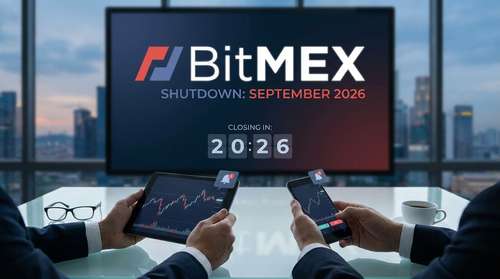
After more than a decade of defining the high-stakes world of digital asset speculation, the legendary platform that birthed the modern derivatives market is permanently closing its doors. In a move that symbolizes a massive shift in the digital asset landscape, the impending BitMEX shutdown will see all exchange operations cease on September 23, 2026. The platform’s parent company, HDR Global Trading Limited, cited a comprehensive strategic review of the broader industry as the driving force behind the difficult decision to sunset the exchange.
For veteran traders, the news represents the end of the "Wild West" era of offshore crypto derivatives. BitMEX once commanded the lion's share of global trading volume, yet shifting crypto leverage trading regulations and fierce competition slowly eroded its dominance. Now, users have a strict two-month window to wind down their activities.
The Timeline: BitMEX Closing September 2026
The wind-down process for the veteran exchange is happening in distinct, irreversible phases. Immediately following the July 23 announcement, the platform permanently halted all new account registrations. The company is actively guiding its existing user base through a structured exit strategy to prevent market shocks.
Starting August 26, 2026, BitMEX will transition into a "reduce-only" mode where strict risk limits are enforced. Traders will be completely blocked from opening new positions and can only shrink or close their active trades. The final curtain falls on September 23 at 04:00 UTC, when trading engines go offline permanently. Any derivative contracts left open at that exact moment will face immediate, forced liquidation by the system's risk engine, which could result in highly unfavorable settlement prices for negligent account holders.
How to Withdraw from BitMEX Before the Deadline
The primary concern for active users is securing their capital. Understanding how to withdraw from BitMEX correctly is critical, as failing to remove your assets carries harsh financial penalties. While the company maintains that all client funds remain fully backed by reserves, waiting until the last minute is a dangerous game in the digital asset space.
Users must navigate to their account dashboards, consolidate their balances, and initiate on-chain transfers to self-custodial wallets or alternative exchanges. All staked BMEX tokens have already been automatically unstaked and returned to user spot accounts to expedite the extraction process.
If you fail to remove your assets before the September 23 deadline, your account will incur steep maintenance charges. HDR Global Trading will automatically deduct either a $50 monthly administrative fee or a 1% annual levy on dormant balances, depending on which is higher. Taking immediate custody of your assets guarantees you avoid these punitive post-closure fees.
The Legacy of Perpetual Swaps BitMEX Created
You cannot discuss the history of modern cryptocurrency trading without acknowledging the innovations this platform introduced. The Arthur Hayes crypto exchange close marks the symbolic death of the venue that originally invented the 100x leverage perpetual contract. Founded in 2014 by Hayes, Ben Delo, and Samuel Reed, the exchange solved the fragmented liquidity problems that plagued early futures markets.
The funding-rate mechanism created by BitMEX anchored perpetual contracts to the spot price of Bitcoin, revolutionizing market dynamics forever. Today, these perpetual swaps BitMEX engineered are the unquestioned backbone of the global digital asset economy, generating massive volume across industry giants like Binance and Bybit, as well as decentralized platforms like Hyperliquid.
Remarkably, the platform departs the industry with an unblemished security record. Over its 11-year lifespan, the exchange never lost a single dollar of user funds to external hackers—a staggering achievement in a sector notorious for devastating security breaches and high-profile insolvencies.
HDR Global Trading Shutdown: What Went Wrong?
Despite its technical brilliance, the exchange failed to adapt to a rapidly maturing regulatory environment. The HDR Global Trading shutdown is the culmination of years of sliding market share and legal friction. U.S. regulators notoriously targeted the platform in 2020 for Bank Secrecy Act violations, leading to heavy scrutiny and legal battles.
Although the executives ultimately pleaded guilty, paid a staggering $200 million in combined regulatory and criminal fines across 2021 and 2025, and received pardons from President Donald Trump in March 2025, the reputational damage proved fatal. The compliance overhead for offshore platforms surged. Global market share migrated toward regulated competitors or fully decentralized finance (DeFi) alternatives. By mid-2026, data providers noted that the exchange's market share had plummeted below 0.01%, capturing a mere $400,000 in daily global volume.
Industry insiders report that the firm had been desperately seeking a buyer since early 2025, but the lingering legal baggage kept suitors at bay. With no acquisition deal materializing, an orderly closure became the only viable path forward. The demise of this pioneering giant serves as a stark reminder: in the ruthless economy of digital assets, even the original architects must evolve, or face inevitable extinction.