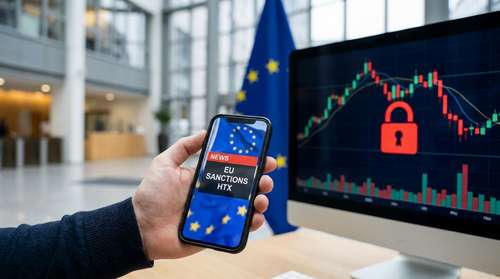
The European Union has drastically escalated its financial countermeasures against Moscow with the adoption of its 21st sanctions package on July 23, 2026. This sweeping legislative move represents a pivotal moment for EU crypto sanctions 2026, shifting the regulatory landscape by targeting digital asset platforms directly. Most notably, the 21st sanctions package crypto provisions have blacklisted 14 distinct global exchanges—including the high-profile platform HTX. Alongside direct blacklists, the EU introduced an unprecedented legal mechanism designed to shut out entire third-country jurisdictions that harbor sanctions-evading crypto platforms.
The 21st Sanctions Package: Unprecedented Regulatory Scope
For years, European authorities have aggressively sought to close loopholes in crypto regulation Russia uses to circumvent traditional banking restrictions. This latest package, arguably the most aggressive action against digital assets yet, zeroed in on platforms operating in jurisdictions spanning Panama, the United Arab Emirates, Georgia, and the Marshall Islands. The broader package also targets 94 Russian banks, expands restrictions on the shadow fleet, and freezes the Russian oil price cap at $44.10 per barrel to further choke Moscow's economic engine.
European Union Foreign Policy Chief Kaja Kallas emphasized the urgency of these measures, noting they aim to cut off the financial lifelines used to sustain the conflict. By imposing direct transaction bans on these 14 platforms, the EU effectively bars any European individual or entity from interacting with them, escalating the compliance burden for legitimate financial institutions worldwide. Any bank or payment processor caught routing funds to these blacklisted exchanges now risks severe regulatory blowback.
Justin Sun's HTX Enters the Crosshairs
The most shocking inclusion in the new sanctions list is HTX, formerly known as Huobi. With the HTX exchange sanctioned EU operators must immediately sever any transaction channels tied to the platform. Founded in China in 2013, the platform remains one of the world's most heavily traded crypto exchanges. Hong Kong-based billionaire Justin Sun HTX's controlling figure since his 2022 acquisition, has historically maintained that the exchange strictly adheres to international regulations, often referring to his official capacity simply as an "advisor".
However, European regulators claim HTX, alongside entities tied to the A7 crypto payment network and Garantex, has facilitated massive capital flows that enable Russian users to bypass existing trade walls. This move closely follows action taken by the United Kingdom in May 2026, which similarly targeted HTX over allegations of supporting shadow financial systems facilitating over $1.5 billion in suspect transfers. While the EU's action does not yet include a full asset freeze for HTX, the transaction ban isolates the exchange from the entirety of the European market.
The Sweeping 'Third-Country' Crypto Ban
Beyond naming specific entities, the legislation fundamentally alters how Europe deals with foreign non-compliance. The EU has armed itself with a novel third-country crypto ban mechanism. This legislative tool allows the European Council to institute comprehensive transaction prohibitions on crypto operators in entire foreign jurisdictions if those countries systematically fail to prevent sanctions evasion.
While no specific country has been slapped with a blanket ban yet, the inclusion of this legal basis serves as a massive deterrent. Jurisdictions that have traditionally taken a hands-off approach to crypto regulation—such as certain regions in the Caribbean and Central Asia—now face the very real threat of being entirely cut off from the European financial system if they allow Russian money to flow unchecked through local digital ledgers.
MiCA Meets Geopolitics: The Belarusian Ownership Ban
As the bloc tightens its grip on offshore evasion channels, it is also actively cleaning house domestically. The EU's robust Markets in Crypto-Assets (MiCA) framework fully transitioned into effect on July 1, 2026, requiring rigorous licensing for crypto service providers. Leveraging this new regulatory apparatus, the EU has integrated its geopolitical strategy directly into its market oversight.
Under a newly adopted amendment expanding the sanctions framework, the EU has effectively banned Belarusian nationals and residents from owning, controlling, or managing any crypto-asset service provider within its borders. Starting August 25, 2026, this rule mandates strict MiCA compliance Belarus-linked entities can no longer bypass. The restriction encompasses every category of crypto service authorized under MiCA, including operating trading platforms, providing custody, exchanging assets, and managing crypto portfolios.
This mandate closes a critical loophole where foreign actors could theoretically set up shop within the EU under the guise of local entities, ensuring that the oversight of European digital assets remains tightly aligned with the region's broader security goals.
What This Means for the Global Crypto Landscape
The convergence of the EU's 21st sanctions package and its freshly implemented MiCA framework signals a new era for international cryptocurrency operations. Digital asset exchanges can no longer rely on ambiguous offshore jurisdictions to shield them from Western regulatory oversight. The inclusion of a major exchange like HTX proves that regulators are willing to go after the industry's biggest players if compliance lapses are detected.
For investors and operators, the stakes have never been higher. Exchanges operating globally must now conduct rigorous audits of their user bases and ensure that they are not inadvertently facilitating restricted capital flows. As the EU continues to wield its economic power to isolate Russian interests, the crypto industry is rapidly maturing from a largely unregulated frontier into a highly scrutinized extension of traditional global finance.