The clock is ticking on the most comprehensive piece of US cryptocurrency legislation to date. A newly revised draft of the Digital Asset Market Clarity Act—widely known as the CLARITY Act 2026—began circulating in Washington this week, adding a controversial sunset ethics ban on the digital asset activities of senior federal officials. But just days before the Senate's crucial August recess, key Democrats are slamming the Republican-led compromise as completely inadequate.
A Temporary Crypto Conflict of Interest Bill?
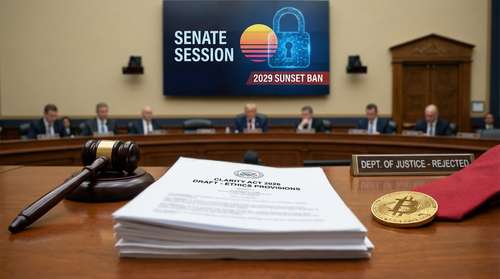
The core of the latest political stalemate revolves around an eleventh-hour ethics package negotiated by Senate Republicans, including crypto advocate Senator Cynthia Lummis. Designed to address mounting concerns over government officials regulating markets they are financially invested in, the updated text explicitly prohibits the president, vice president, members of Congress, and their spouses from issuing or sponsoring digital assets for compensation while in office.
However, the new crypto conflict of interest bill comes with a major caveat: the restriction automatically expires on January 20, 2029. Furthermore, the legislation hands enforcement powers directly to the Department of Justice (DOJ), granting them civil authority to penalize non-compliance and sue exchanges that list banned tokens. Regulators would have precisely one year after enactment to implement these rules.
Why Democrats Reject the 'Unserious' Proposal
Senate Democrats are firmly rejecting the proposal, halting the Senate crypto regulation bill in its tracks. Senator Angela Alsobrooks—one of the few Democrats who initially supported the bill in committee—was blunt in her assessment. "This DOJ enforcing an ethics provision? That's an unserious offer," Alsobrooks stated, threatening to pull her support entirely if the language remains intact.
A broader coalition, including Senators Cory Booker, Mark Warner, and Elizabeth Warren, issued a joint statement arguing that the current text fails to protect market integrity. Critics argue that delegating ethics oversight to the DOJ, rather than independent ethics bodies, fundamentally neuters the provision. The lawmakers indicated they would continue negotiating in good faith, but stressed that consumer protection and illicit finance gaps must be closed.
The Elephant in the Room: Donald Trump Crypto Holdings
The intense focus on governmental ethics isn't an abstract legal exercise; it is directly tied to Donald Trump crypto holdings. Recent financial disclosures reveal that President Trump earned an estimated $1.4 billion from cryptocurrency ventures in 2025 alone, largely linked to his family's enterprise, World Liberty Financial.
Senator Elizabeth Warren's office released a scathing analysis claiming the bill's divestment-or-blind-trust safe harbor is riddled with massive loopholes. Transparency International U.S. echoed this sentiment, noting the legislation allows substantial family business arrangements and revenue-sharing deals to escape scrutiny. Instead of closing the door on self-dealing, watchdog groups warn the bill could effectively immunize Trump's digital asset ventures from strict congressional oversight.
Resolving the SEC CFTC Crypto Jurisdiction
Lost in the partisan ethics brawl is the core structural achievement of the legislation. The 616-page framework remains the most serious attempt in history to resolve the long-standing turf war over SEC CFTC crypto jurisdiction. For years, the U.S. crypto sector operated in a gray area, enduring aggressive enforcement actions because regulators had overlapping and sometimes competing claims over digital assets. This ambiguity turned basic compliance into guesswork and expensive litigation into a standard business model.
Under the current draft, the Commodity Futures Trading Commission (CFTC) would gain exclusive regulatory authority over spot markets for "digital commodities," such as Bitcoin. Meanwhile, the Securities and Exchange Commission (SEC) would retain jurisdiction over assets structured as investment contracts. A key feature of the bill is the "mature blockchain test," which could allow certain tokens to transition from SEC to CFTC oversight once their underlying networks become sufficiently decentralized. Open-source developers and non-custodial wallet providers would also receive specific legal protections, exempting them from rules designed for centralized exchanges.
Banking Industry Pushback
While the crypto industry strongly supports the jurisdictional clarity, traditional finance is pushing back. A coalition of major banking trades, including the American Bankers Association, warned that the bill's prohibitions on interest-like payments for holding stablecoins could siphon away traditional bank deposits that fuel local lending. This adds yet another layer of complexity to the ongoing negotiations.
Can the Senate Crypto Regulation Bill Survive August?
The window for legislative action is closing fast. To become law, the CLARITY Act 2026 needs 60 votes to overcome a Senate filibuster. Republican leaders are negotiating frantically to secure bipartisan support before the August recess clears out the Capitol.
Senator Cynthia Lummis expressed commitment to reaching a deal in the coming days, framing the current moment as the last real chance to establish a comprehensive framework. Crypto executives are pushing for an immediate vote, viewing this as a generational opportunity to legitimize the multi-trillion-dollar ecosystem. However, the stakes are monumental. If the Senate cannot find common ground on ethics and oversight, the industry will face another year of regulatory ambiguity, leaving institutional capital stranded on the sidelines and forcing innovation overseas.