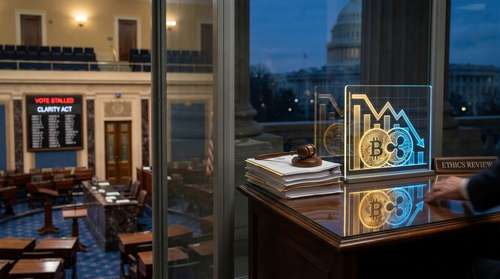

In a landmark move for US Senate crypto regulation, lawmakers released an updated draft of the highly anticipated digital asset market structure legislation on July 22, 2026. The sweeping legislation introduced a surprise twist: a stringent ethics provision that prohibits presidents, lawmakers, and federal officials from issuing or sponsoring cryptocurrencies. The market response has been overwhelmingly positive, helping ignite the ongoing Bitcoin price rally July 2026 as the premier digital asset surged past the $66,500 mark on renewed institutional optimism.
Inside the Updated Clarity Act Crypto Bill
The latest iteration of the Clarity Act crypto bill addresses one of the most contentious hurdles that has historically stalled legislative progress in Washington: conflicts of interest at the highest levels of government. Under the newly drafted language, federal public officials and their immediate family members are temporarily banned from issuing or sponsoring any digital assets until 2029. Furthermore, politicians are required to either place their existing digital asset holdings in a blind trust or divest from them entirely during their tenure in public office.
This ethics compromise is widely seen as a necessary olive branch designed to court Democratic support, as the bill requires 60 votes to overcome procedural hurdles in the Senate. By effectively neutralizing the potential for officials to cash in on digital asset projects they directly regulate, lawmakers hope to end the era of regulation by enforcement and formally divide oversight between agencies. If enacted, the legislation would give the Commodity Futures Trading Commission (CFTC) exclusive jurisdiction over decentralized digital commodities like Bitcoin, while the Securities and Exchange Commission (SEC) would retain authority over tokens deemed investment contracts.
Driving the Bitcoin Price Rally July 2026
The prospect of finally achieving regulatory clarity has dramatically shifted global market sentiment. The Bitcoin price rally July 2026 has seen the leading cryptocurrency break out of its recent summer consolidation phase, reclaiming key technical resistance levels and absorbing strong spot ETF inflows. Markets are reacting to the realization that firm federal guardrails could soon legitimize decentralized finance for major institutional players.
Derivatives markets and prediction platforms are closely monitoring the political maneuvering. The Polymarket Clarity Act odds have climbed to a solid 43%, reflecting a cautious but growing belief among traders that a bipartisan compromise is within reach before the upcoming congressional recess. While trading volumes are typically muted during the summer months, the potential for a breakthrough in US Senate crypto regulation has provided a powerful macroeconomic catalyst, convincing investors to deploy capital after weeks of sideways price action.
The American Bankers Association Crypto Pushback
Despite the optimism on Wall Street, not everyone is celebrating the revised digital asset legislation. On July 22, the Bank Policy Institute, the Consumer Bankers Association, and other trades joined forces to issue a public statement sharply criticizing the latest draft. The core of the American Bankers Association crypto opposition revolves around how the legislation handles payment tokens and yield-bearing digital rewards.
Traditional banking alliances argue that the current version of the bill fails to adequately protect the local lending ecosystems that drive the broader American economy. By allowing crypto exchanges and issuers to offer yield-like rewards to users simply for holding tokenized funds, banks fear a massive exodus of traditional deposits.
Understanding the Stablecoin Interest Rates Risk
The stablecoin interest rates risk remains a severe structural concern for community banks. If retail consumers can seamlessly move their fiat currency into digital stablecoins and earn higher yields through platform-offered rewards, traditional checking and savings accounts will struggle to compete. Without sufficient consumer deposits, banks warn they will lack the vital liquidity required to issue local mortgages, small business loans, and automotive financing.
Bank executives are actively lobbying lawmakers to close what they consider a dangerous regulatory loophole. They are demanding targeted amendments that would strictly prohibit any interest-like payments linked to stablecoin balances, forcing digital dollars to function purely as payment and settlement infrastructure rather than lucrative investment vehicles.
Looking Ahead to the Senate Markup
As lawmakers prepare for a pivotal markup session, the tension between fostering technological innovation and protecting the traditional banking sector has never been higher. The ultimate fate of the legislation will not only determine the future of digital asset supervision but could also dictate whether the recent Bitcoin price surge sustains its momentum through the end of the year. Investors, politicians, and traditional financial institutions are all watching the Senate clock as the window for 2026 crypto legislation rapidly closes.