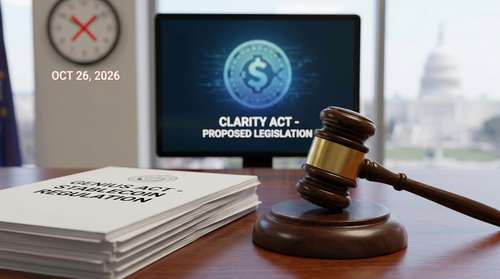

The digital asset industry is staring down a historic legislative breakthrough. Following an optimistic status update, Treasury Secretary Scott Bessent crypto remarks ignited a state of hyper-bullish anticipation across the market. Bessent boldly declared that the comprehensive US crypto regulation bill is resting squarely on the "1-yard line" as lawmakers race toward an early August recess. Anticipation of the impending CLARITY Act Senate vote has sent shockwaves across financial markets, triggering a massive wave of institutional buying.
Racing Against the August Clock
For years, U.S. blockchain builders and digital asset exchanges have operated in a legal gray area, subjected to what critics call "regulation by enforcement". Now, lawmakers are closer than ever to establishing a definitive framework. Speaking to reporters this week, Secretary Bessent emphasized that the legislation has finally cleared its most daunting political hurdles.
With Congress scheduled to adjourn for its August recess in a matter of weeks, the legislative window is narrowing. Senator Kevin Cramer echoed Bessent's sentiment, noting that the Senate is "almost there" as they iron out the final enforcement technicalities. Prediction markets have responded favorably, with odds of a pre-recess vote surging past 72%. However, the arithmetic remains tight. Republicans currently hold 53 seats in the Senate, meaning the bill requires at least seven Democratic crossover votes to bypass the 60-vote filibuster threshold.
Overcoming the Gridlock: The Trump Crypto Ethics Clause
For months, the legislation appeared deadlocked over a single, highly charged issue: conflicts of interest. That changed this week when the White House agreed to a sweeping set of new restrictions. To win over reluctant Democrats, the administration signed off on the heavily debated Trump crypto ethics clause. This provision explicitly prohibits federal officials—including the president, vice president, and members of Congress—from issuing or profiting from their own digital assets while in office.
The concession carries significant political weight. Recent financial disclosures from the U.S. Office of Government Ethics revealed that President Trump earned roughly $1.4 billion from digital asset ventures in 2025, heavily fueled by projects like World Liberty Financial and politically tied meme coins.
While the core ethics language has been resolved, last-minute friction remains regarding who enforces the rules. Republicans advocate for the Department of Justice to hold exclusive enforcement authority, while key Democratic negotiators, including Maryland Senator Angela Alsobrooks, insist state attorneys general must also possess the power to step in. Alsobrooks recently warned she would not support the bill if the DOJ remains the sole enforcer.
Market Explosions: Bitcoin, XRP, and the Coinbase Stock Surge
The prospect of an established federal rulebook unleashed a wave of institutional capital, catalyzing the aggressive Bitcoin price rebound July 2026 trading desks had been anticipating all summer. Bitcoin surged sharply, approaching the critical $67,000 threshold as institutional confidence fully returned.
The ripple effects extended deep into the altcoin ecosystem, sparking a massive XRP price rally that pushed the token's value to $1.15. XRP stands to benefit immensely from the legislation. The CLARITY Act permanently cements the commodity status of adequately decentralized tokens, transforming a temporary regulatory interpretation into binding federal law. For pension funds and asset managers, this removes the single largest legal overhang previously preventing them from gaining XRP exposure.
Equally impressive was the reaction on Wall Street. Investors aggressively priced in a favorable regulatory landscape for domestic exchanges, triggering a stunning Coinbase stock COIN jump of more than 13% in morning trading. A bifurcated regulatory environment significantly reduces the legal threats that have historically hindered U.S.-based firms.
Inside the US Crypto Regulation Bill
At its core, the Digital Asset Market Clarity Act officially divides regulatory jurisdiction between the Securities and Exchange Commission (SEC) and the Commodity Futures Trading Commission (CFTC).
- CFTC Jurisdiction: The agency gains exclusive oversight over "digital commodities," which include sufficiently decentralized networks like Bitcoin.
- SEC Jurisdiction: The SEC retains authority over "investment contract assets," ensuring that token offerings mirroring traditional securities are closely monitored.
Protecting Retail Investors
Beyond market structure, the bill introduces stringent guardrails for everyday traders. Following the disastrous collapses of platforms like Voyager and FTX in previous years, the legislation mandates that crypto firms keep customer assets strictly separated from corporate funds. Under these new rules, customer holdings cannot be utilized to repay creditors if an exchange becomes insolvent.
Building on the foundation of the 2025 GENIUS Act, which established a regulatory framework for payment stablecoins, the CLARITY Act represents the final pillar of America's digital asset architecture. If lawmakers can finalize the enforcement language and secure the necessary Democratic votes in the coming days, the U.S. market is poised for a generational transformation.