Exactly one year ago, the signing of the GENIUS Act stablecoin law was heralded as a watershed moment for American financial innovation. Today, that optimism has collided with a bureaucratic wall. On July 18, 2026, the statutory deadline for federal regulators to finalize a comprehensive framework for digital dollars officially expired without a finished rulebook.
Six federal agencies—including the Office of the Comptroller of the Currency (OCC), the Federal Deposit Insurance Corporation (FDIC), and the Federal Reserve—were legally mandated to deliver final US stablecoin rules by today. Their collective failure to meet the mandate has ignited fresh political friction in Washington, leaving a booming digital asset sector in a state of regulatory suspense.
The GENIUS Act Stablecoin Law Anniversary: What Exactly is Missing?
When the Guiding and Establishing National Innovation for U.S. Stablecoins (GENIUS) Act became Public Law 119-27 on July 18, 2025, it represented the first federal framework for payment stablecoins in American history. The legislation required issuers to back their digital tokens one-to-one with liquid assets, like U.S. Treasuries, and mandated transparent, monthly disclosures to protect consumers.
The market responded aggressively to the law's passage. According to industry data, the global stablecoin market swelled from $206 billion in early 2025 to over $315 billion today, with real-world payment volume practically doubling to nearly $390 billion. Institutional players moved off the sidelines, assuming the federal guidelines outlined in the GENIUS Act stablecoin law would be locked in stone by this exact date.
However, execution required coordinated agency action. As the GENIUS Act anniversary arrives, the necessary interagency consensus remains elusive. Key implementations, such as the FDIC's finalized reporting forms for state-chartered issuers and the OCC's specific capital requirements, are still trapped in the draft phase. Despite accelerated closed-door meetings over the past week, officials failed to unify their disparate supervisory guidelines into a single, cohesive mandate.
Senator Hagerty's Vision Hits a Roadblock
The legislative stall is particularly frustrating for the bill's original bipartisan authors. The initial push for the Bill Hagerty stablecoins legislation was driven by a clear directive: cement the U.S. dollar's status as the undisputed global reserve currency by integrating digital assets directly into existing domestic payment rails.
Senator Hagerty designed the act to prevent fragmented, state-by-state oversight and open the door for nonbank financial firms to compete safely. With the deadline blown, lawmakers on Capitol Hill are publicly questioning the operational efficiency of the banking regulators tasked with overseeing this critical financial modernization.
Kevin Warsh Holds the Line on Federal Reserve Risk
Much of the recent regulatory friction stems from the central bank's highly cautious approach to digital asset integration. Testifying before the House Financial Services Committee just days before the July 18 deadline, the newly appointed Kevin Warsh Federal Reserve Chair delivered a stark assessment of the central bank's defensive posture.
"We do not want to be in the bailout business, full stop," Warsh told lawmakers on July 14, rejecting suggestions from crypto skeptics that the Fed might be forced to backstop failing digital-asset firms in a systemic crisis. Citing his experience during the 2008 financial meltdown, he emphasized that the Fed would prioritize protecting traditional liquidity facilities over fast-tracking unvetted crypto frameworks.
Warsh, who took office in May 2026, is currently battling sticky inflation and managing a $6.7 trillion balance sheet. While he previously indicated that the Fed was racing the clock to finalize the required stablecoin regulations 2026 implementation by today's cutoff, severe interagency disagreements regarding systemic risk safeguards reportedly derailed the final publication.
Pivoting Focus to the CLARITY Act Crypto Bill
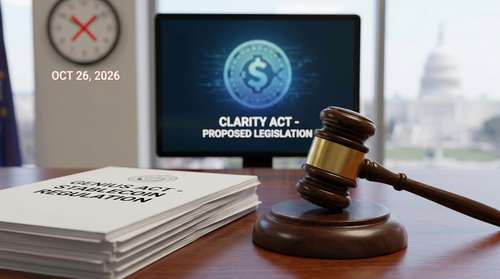
With the stablecoin-specific mandate stranded in limbo, industry leaders and frustrated legislators are immediately shifting their political capital toward a broader, structural solution. The pending CLARITY Act crypto bill (Digital Asset Market Clarity Act of 2025) is now taking center stage as Congress hurtles toward its fast-approaching August recess.
Unlike the GENIUS Act, which narrowly targeted dollar-pegged payment instruments, the CLARITY Act offers a comprehensive market overhaul. It aims to decisively divide oversight between the Securities and Exchange Commission (SEC) and the Commodity Futures Trading Commission (CFTC), ending the jurisdictional turf wars that have historically plagued financial innovation.
- Provisional Registration: Allows digital commodity exchanges to operate compliantly while permanent agency rules are developed.
- The Mature Blockchain Test: Creates a clear legislative pathway for tokens to transition from SEC to CFTC oversight once their underlying networks become sufficiently decentralized.
- DeFi Safe Harbors: Fully exempts non-custodial protocol developers and validators from overly burdensome traditional banking regulations.
Overcoming Senate Gridlock Before August
Political strategists view the passage of the CLARITY Act as the strongest mechanism to force regulatory alignment. If the banking agencies cannot execute the GENIUS Act stablecoin law on a strict one-year timeline, Congress may use this broader market structure bill to strip away discretionary delays and impose hard, actionable boundaries.
Yet, the path forward is heavily contested. With the Senate recess looming on August 7, the CLARITY Act faces its own hurdles. Ethics debates surrounding former President Trump's $1.4 billion in crypto earnings, partisan concerns over illicit finance, and the sheer complexity of reconciling committee drafts threaten to run out the clock.
As the sun sets on the statutory deadline for final US stablecoin rules, the digital asset industry finds itself navigating painfully familiar territory. The finalized rules of the road were promised today, but until Congress resolves its broader structural debates, American crypto markets will remain tethered to regulatory uncertainty.