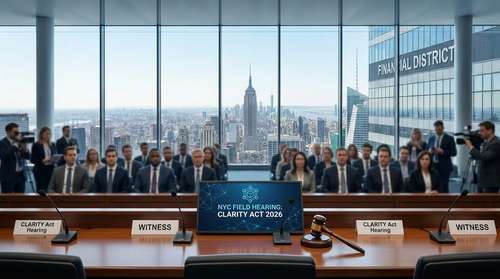
The U.S. cryptocurrency industry has spent years operating in a state of regulatory purgatory. But today, the battle for a permanent legal framework is coming to a head in the heart of traditional finance. On July 17, 2026, the U.S. House Financial Services Committee is convening a high-stakes CLARITY Act hearing 2026 in New York City. Titled 'Building the Future of Finance: How the CLARITY Act Unlocks Innovation,' this unprecedented event isn't just an informational panel—it is a calculated pressure campaign designed to force the Senate's hand before time runs out.
The legislation at the center of the debate, the Digital Asset Market Clarity Act (H.R. 3633), represents the most comprehensive crypto policy overhaul to ever move through Congress. While the House passed the measure with a decisive 294-134 bipartisan vote exactly one year ago today, the Senate has stalled. With the legislative clock ticking down, today's gathering in Manhattan aims to spark the momentum needed for a final floor vote.
What the Digital Asset Market Clarity Act Actually Does
For over a decade, American crypto businesses have been caught in a bitter turf war regarding SEC vs CFTC crypto jurisdiction. This landmark legislative effort seeks to end the era of regulation by enforcement by drawing explicit statutory boundaries between the two watchdog agencies.
If passed into law, the crypto market structure bill will grant the Commodity Futures Trading Commission (CFTC) exclusive jurisdiction over spot markets for 'digital commodities,' provided the underlying networks are sufficiently decentralized. Conversely, the Securities and Exchange Commission (SEC) would retain authority over digital assets that strictly function as investment contracts.
The Mature Blockchain Test
One of the most heavily debated features of the legislation is the 'mature blockchain test'. This mechanism allows a digital asset to officially transition from being classified as a security under SEC oversight to a commodity under the CFTC once its underlying protocol achieves functional decentralization. It offers token projects a clear compliance pathway—something industry leaders and software developers have demanded for years.
Inside the NYC Field Hearing CLARITY Act Strategy
Holding a congressional session outside of Washington, D.C., is a rare and deliberate maneuver. By staging the NYC field hearing CLARITY Act event at the Federal Hall National Memorial on Wall Street, lawmakers are physically bridging the gap between legacy banking and the digital asset ecosystem. The Subcommittee on Digital Assets, Financial Technology, and Artificial Intelligence, chaired by Rep. Bryan Steil, wants to demonstrate that blockchain regulation is now a mainstream financial priority.
Today's witness list features a heavyweight roster of legal and policy experts from across the industry. Ryan Louvar, Chief Legal Officer at WisdomTree, is expected to testify on the safe integration of tokenized assets into U.S. markets. Other key figures addressing the panel include Nova Labs Chief Legal Officer Sarah Aberg, Coin Center's Director of Policy Jason Somensatto, and Bullish executive Randi Abernethy. Together, they are tasked with explaining exactly why this ongoing regulatory limbo is threatening American financial dominance.
Global Competitiveness at Risk
The urgency surrounding the CLARITY Act hearing 2026 is heavily amplified by international developments. While Washington debates jurisdictional boundaries, regions like the European Union and the Asia-Pacific have aggressively implemented comprehensive digital asset frameworks. Witnesses today are prepared to argue that without a finalized regulatory baseline, the United States risks losing its historical edge in capital formation and technological innovation. The absence of federal certainty prevents major traditional institutions from fully deploying capital into on-chain infrastructure.
The Senate August Recess Crypto Deadline
Despite the overwhelming House victory last summer, the Senate Banking Committee only advanced the bill in May 2026 by a tight 15-9 margin. Now, the legislation is trapped behind three major partisan roadblocks that must be resolved ahead of the looming Senate August recess crypto deadline.
First, lawmakers are fiercely divided over an 'Ethics Rule' that would ban government officials from owning or trading cryptocurrencies while in public office. Senator Cynthia Lummis—a major proponent of the broader Lummis crypto bill 2026 push—has been actively negotiating with Republican leadership, including recent talks with Donald Trump, to resolve the ethics clause dispute and secure the necessary swing votes.
Second, a contentious 'Developer Protection Clause' remains heavily disputed. The tech sector argues that open-source software developers should not face legal liability for how malicious actors deploy their code, while federal law enforcement agencies are pushing for stricter accountability measures. Finally, legacy banking advocates have raised red flags over stablecoin yields, fearing that high-interest stablecoins could trigger massive deposit flight from traditional regional banks.
The Path Forward for the Crypto Market Structure Bill
The stakes for today's CLARITY Act hearing 2026 cannot be overstated. If the upper chamber fails to act before lawmakers depart for their late-summer break, the window for passing the legislation this year effectively closes. The digital asset sector would be forced to navigate another entire year of ambiguous guidelines, relying on shifting court rulings rather than clear, codified law.
As lawmakers, executives, and advocates gather in New York this morning, the message being sent to Capitol Hill is unequivocal. The blueprint for digital asset regulation is fully written, the corporate sector is ready to comply, and the global market is watching closely to see if the United States will lead the future of finance—or regulate itself into irrelevance.