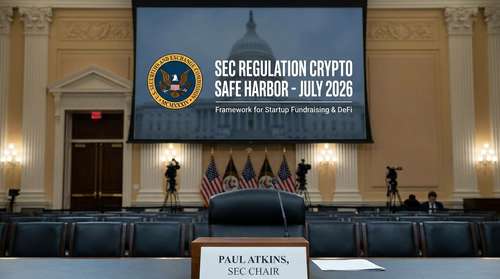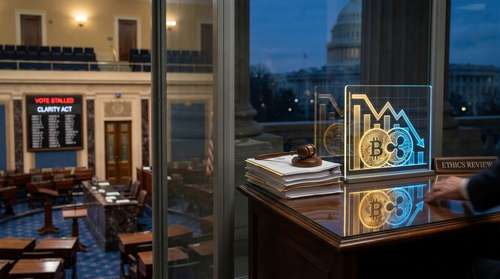
The highly anticipated Digital Asset Market Clarity Act—better known as the CLARITY Act—has hit a massive wall in the U.S. Senate. With an unforgiving 18-day window remaining before the August legislative recess takes effect, the landmark US crypto regulation bill is paralyzed by a fierce political standoff. The contention doesn't stem from the mechanics of blockchain technology itself, but rather from explosive conflict-of-interest concerns surrounding President Donald Trump's massive digital asset income. As a result of this gridlock, Polymarket bettors have slashed the odds of a successful CLARITY Act Senate vote passing in 2026 to a dismal 31%, leaving key digital assets trapped in a frustrating holding pattern.
The CLARITY Act Senate Roadblock: A Ticking Clock
For months, the crypto market structure bill enjoyed considerable momentum after clearing the Senate Banking Committee in May. Lawmakers finally seemed ready to establish a comprehensive framework for the digital economy. However, the path to a 60-vote filibuster-proof majority now requires significant bipartisan cooperation. Democrats are bluntly refusing to supply the necessary crossover votes unless strict ethics provisions are added to the legislative text.
The core dispute centers on a fundamental question of governance: should federal officials—and specifically the President—be permitted to write the rules for an asset class from which they personally profit? Without a resolution in the coming days, the legislation will miss the practical August deadline. If a floor vote isn't secured before lawmakers leave Washington, the bill almost certainly dies for the current calendar year.
The $1.4 Billion Question: Trump Crypto Earnings 2026
The legislative gridlock escalated sharply following late June disclosures from the Office of Government Ethics. The filings revealed that President Trump generated an estimated $1.4 billion from cryptocurrency ventures in 2025 alone. A staggering $635 million of that fortune came directly from the $TRUMP memecoin, alongside another $526 million connected to World Liberty Financial token sales.
In response, Democratic leadership is demanding updated financial transparency. The Elizabeth Warren Trump crypto disclosures push has become a central hurdle, with the Massachusetts Senator formally requesting comprehensive financial data covering the first half of 2026. Proponents of the ethics clause argue that without firm guardrails, the passage of a tailored CLARITY Act Senate bill could inappropriately skyrocket the value of the administration's personal portfolios.
Resolving the SEC CFTC Crypto Jurisdiction
To understand why the market is reacting so negatively to this delay, you have to look at what the legislation actually accomplishes. The CLARITY Act is widely considered the most consequential financial reform for digital assets in U.S. history. It was meticulously designed to end the exhausting era of "regulation by enforcement" that has plagued developers and institutional investors.
The bill draws a definitive regulatory line to settle the ongoing turf war:
- The Commodity Futures Trading Commission (CFTC) would gain exclusive oversight over "digital commodities" like Bitcoin and sufficiently decentralized networks.
- The Securities and Exchange Commission (SEC) would retain authority strictly over "investment contract assets".
- The legislation establishes a clear pathway for tokens to graduate from SEC to CFTC oversight once a network proves its decentralization.
By officially resolving the SEC CFTC crypto jurisdiction battle, the framework promises to give institutions the confidence needed to enter the space fully. Now, that desperately needed legal certainty hangs in the balance over political infighting.
XRP Clarity Act Impact and Sinking Passage Odds
The real-time market consequences of this gridlock are severe. The XRP Clarity Act impact is arguably the most visible example of how regulatory delays stifle market growth. After years of high-profile legal battles, the XRP ledger community has been waiting for explicit legislative guidelines to safely onboard traditional finance partners. A stalled CLARITY Act Senate vote means that banking institutions will remain sidelined, unwilling to risk compliance violations without a statutory shield. Consequently, XRP is struggling to break resistance levels, mirroring the broader market's fatigue.
When prediction markets show passage odds collapsing to roughly 31%, institutional capital pulls back. The sustained hesitation observed throughout early 2026 is directly tied to this legislative limbo. Traders simply refuse to allocate massive capital while the rules of the road remain undefined.
What Happens Next for the Crypto Market Structure Bill?
Lawmakers have roughly two and a half weeks to hash out a compromise. Passing the crypto market structure bill requires balancing the demands for stringent ethics safeguards with the Republican majority's push for swift market deregulation. If negotiators fail to find middle ground before the August recess, the U.S. cryptocurrency industry will be left navigating the exact same murky regulatory waters it has endured for years. The coming days will determine whether Washington can look past billion-dollar political disputes to finally deliver a functional rulebook for digital assets.