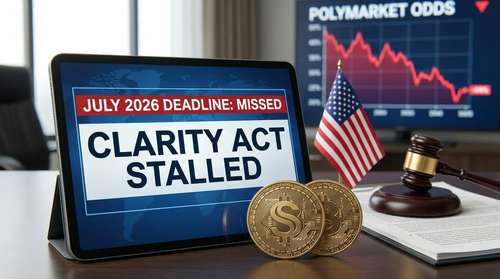

Polymarket crypto bill odds have taken a severe hit today as optimism fades for the much-anticipated CLARITY Act 2026. Following the release of an updated 616-page legislative draft, prediction market traders slashed the likelihood of the bill passing this year down to 38%, with some betting pools dipping as low as 35%. What was once heralded as the definitive legislative framework for the digital asset industry is now mired in fierce partisan warfare. The central issue threatening to derail the legislation involves newly introduced ethics provisions, which transparency advocates and key Senate Democrats claim contain massive loopholes surrounding President Donald Trump's multi-billion-dollar digital asset empire.
Trump Crypto Conflicts of Interest Take Center Stage
The fight over the Digital Asset Market Clarity Act is no longer solely about market structure—it has escalated into a high-stakes battle over government ethics. Recent financial disclosures filed with the Office of Government Ethics revealed that President Trump earned roughly $1.4 billion from digital asset ventures in 2025 alone. This massive windfall, largely tied to his family's World Liberty Financial project and various heavily promoted meme coins, has catapulted Trump crypto conflicts of interest to the absolute forefront of the current legislative debate.
Senate Republicans recently unveiled revised text negotiated with the White House that attempts to address these mounting concerns. The draft language proposes barring the President, Vice President, and senior lawmakers from issuing or sponsoring digital assets while in office. However, the proposed ethics ban includes a highly controversial sunset clause set for January 20, 2029—coinciding precisely with the end of the current presidential term. Furthermore, it leaves the enforcement of these restrictions entirely up to the Department of Justice.
Key Democrats have forcefully condemned the language. Senator Angela Alsobrooks called the reliance on the DOJ to police the executive branch an 'unserious' offer, warning that she would not support the bill in its current form. Meanwhile, Senator Elizabeth Warren has spearheaded demands for tighter restrictions, arguing that a temporary ban failing to target existing massive holdings effectively immunizes the President's current investments while pretending to clean up the broader industry.
DOJ Warnings Complicate SEC CFTC Crypto Jurisdiction
Beyond the explosive ethics disputes, the updated draft faces severe resistance from federal law enforcement agencies on the regulatory front. At its core, the legislation was meticulously designed to finally resolve disputes over SEC CFTC crypto jurisdiction, establishing clear rules for when a digital asset transitions from a security to a commodity through a specialized decentralized network test. Industry leaders have also championed the text as a necessary stablecoin regulation bill, with figures like Circle's Chief Strategy Officer Dante Disparte noting it requires dollar-pegged assets to be strictly backed one-to-one by safe assets like U.S. Treasuries.
However, the Department of Justice has raised fresh alarms that threaten to fracture bipartisan support even further. The DOJ recently warned lawmakers that Section 604 of the bill grants overly broad safe harbor protections to non-custodial developers, decentralized finance (DeFi) protocols, and automated mixers. According to federal prosecutors, these exemptions would impose an impossible burden of proof in money-laundering cases, fundamentally weakening existing Bank Secrecy Act frameworks and handcuffing authorities trying to track illicit financing. This potent combination of law enforcement warnings and partisan ethics standoffs is completely dominating the latest US crypto regulation news, leaving industry lobbyists scrambling to salvage the framework before the clock runs out.
Compliance and Market Ramifications
The stakes of this legislative deadlock extend far beyond Washington politics. Since the House of Representatives originally passed a preliminary version of the bill (H.R. 3633) in the summer of 2025, compliance teams at major exchanges and financial institutions have been bracing for operational overhauls. Should the bill pass, centralized entities would face rigorous new registration and risk-management mandates, explicitly demanding the use of advanced blockchain analytics to track suspicious activity. Conversely, consumer advocates worry that failing to pass the bill could push innovative DeFi development completely offshore, abandoning U.S. markets to a permanent state of regulatory ambiguity.
The Ticking Clock: Polymarket Crypto Bill Odds and the August Recess
Time is rapidly emerging as the ultimate enemy of the CLARITY Act right now. The Senate faces a notoriously rigid legislative deadline, with lawmakers scheduled to depart Washington for their traditional summer recess on August 7. Passing a comprehensive market structure bill of this magnitude requires 60 votes in the Senate to overcome a filibuster, meaning genuine bipartisan support is an absolute, non-negotiable necessity.
With neither side showing a willingness to compromise meaningfully on the ethics riders, and the banking industry simultaneously pushing back on deposit risk provisions, prediction markets have reacted with ruthless efficiency. The sudden, sharp plunge in Polymarket crypto bill odds reflects a stark market reality: what the blockchain industry originally envisioned as its defining regulatory victory of the decade may not even survive the summer.
As the crucial August 7 deadline approaches, the sudden injection of legislative uncertainty is already sending fresh ripples through a consolidating digital asset market. For retail investors and institutional compliance teams alike, the prolonged standoff serves as a harsh reminder that drawing clear, functional regulatory lines in Washington remains as politically volatile as the asset class itself.