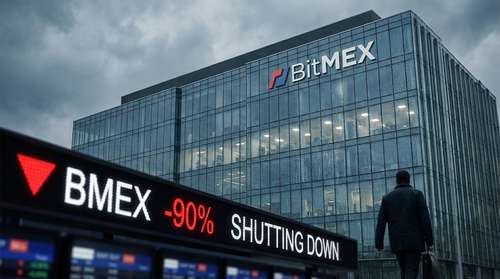
In a bombshell announcement that marks the end of an era for the digital asset industry, legendary cryptocurrency trading platform BitMEX has confirmed it is permanently closing its doors. Following an internal strategic review by parent company HDR Global Trading Limited, the pioneer of the crypto derivatives exchange market will cease all trading operations on September 23, 2026, at 04:00 UTC. The sudden news of BitMEX shutting down immediately halted new user registrations and triggered a catastrophic sell-off in the native market, culminating in a devastating BMEX token crash.
For more than a decade, BitMEX stood as a titan in speculative digital asset trading. Founded in 2014, the platform famously introduced the 100x leverage perpetual swap contract, an instrument that transformed how traders speculated on Bitcoin and entirely reshaped the industry. Now, as the exchange prepares to wind down, clients are scrambling to meet tight deadlines to liquidate positions and secure their assets.
The BitMEX Closure Timeline: Navigating the Final Months
Traders holding active positions must adhere to a strict and phased BitMEX closure timeline to avoid involuntary liquidations. While the platform is currently operating normally for existing users, HDR Global Trading has outlined critical cutoff dates.
Starting on August 26, 2026, at 04:00 UTC, the exchange will implement severe risk restrictions. Users will completely lose the ability to open new positions. From that point forward, the platform will only permit clients to reduce or entirely close their existing exposures. Any derivative trades that remain open as the September 23 deadline approaches will be forcefully liquidated by the platform's risk engine, and users will bear full responsibility for any resulting financial losses. Furthermore, illiquid contracts will be settled early.
It is imperative for users to manage their accounts proactively. For those who complete Identity Verification (KYC) but fail to withdraw their balances before the final closure, BitMEX will impose aggressive account management fees. Remaining balances will be subjected to a monthly charge of either $50 or a 1% annualized fee—whichever is higher.
BMEX Token Crash: 90% Value Wiped Out in Hours
The announcement delivered a fatal blow to the exchange's native digital asset. The BMEX token crash was swift and brutal, with the asset plunging over 90% almost immediately after the news broke on July 23, 2026. Trading data revealed that BMEX dropped from roughly $0.06 to as low as $0.002, stripping away millions in market capitalization within hours.
This historic price collapse occurred as the token essentially lost its core utility. BMEX was primarily used for trading fee discounts, staking rewards, and specialized VIP benefits on the platform. With the exchange's impending demise, the fundamental value proposition of holding BMEX evaporated. Additionally, the platform released all staked BMEX back into user accounts, creating immense immediate sell pressure that overwhelmed the remaining order books.
The Arthur Hayes BitMEX Legacy and Crypto Perpetual Swaps
Understanding the weight of this closure requires looking back at the platform's monumental influence. The Arthur Hayes BitMEX era fundamentally changed digital finance. Founded by Hayes alongside Benjamin Delo and Samuel Reed, the exchange achieved unprecedented growth during the 2017 and 2018 bull markets by offering something traditional finance could not: crypto perpetual swaps.
Unlike standard futures contracts that expire on a specific date, these perpetual swaps use a continuous funding rate mechanism to stay anchored to the underlying spot price. This allowed retail and institutional traders to hold highly leveraged positions indefinitely. At its peak, the platform was the undisputed king of the crypto derivatives exchange sector.
However, the journey was marred by intense regulatory scrutiny. In 2022, the founders pleaded guilty to violating the U.S. Bank Secrecy Act due to a lack of stringent Anti-Money Laundering (AML) and Know Your Customer (KYC) protocols during the platform's early years. While Hayes, Delo, and Reed were pardoned by the U.S. President in 2025, the reputational damage and the rise of massive competitors had already eroded BitMEX's dominant market share. By mid-2026, daily trading volumes had dwindled to roughly $400,000—a fraction of its former multi-billion-dollar glory.
Crucial Steps: BitMEX Withdraw Funds 2026 Guide
If you are an active user, prioritizing your capital security is the only logical next step. The directive to BitMEX withdraw funds 2026 is urgent, as network congestion and platform processing times could bottleneck during the final weeks of operation.
Actionable Steps for Traders
- Halt Strategy Deployments: Cease opening new positions immediately and evaluate your current market exposure.
- Close Trades Manually: Do not wait for the August 26 restriction phase. Manually close your contracts to avoid slippage or forced liquidation penalties.
- Export Tax and Trading Records: Once the exchange officially sunsets, accessing comprehensive historical data may become complicated. Download your complete CSV transaction history now.
- Revoke API Access: Disconnect any third-party trading bots, portfolio trackers, or charting software linked to your account via API keys to prevent unintended executions.
- Execute Withdrawals: Move all Bitcoin, Tether, and other digital assets to a self-custody cold wallet or a regulated alternative venue well ahead of the September 23 deadline.
HDR Global Trading Limited maintains that client assets are secure, noting that the exchange never lost customer funds to a security breach during its entire 11-year run. Nevertheless, relying on post-closure custodial services is an unnecessary risk, especially with the looming threat of the 1% annualized account management fee. By acting decisively today, traders can safely close the book on one of the cryptocurrency industry's most historic platforms.