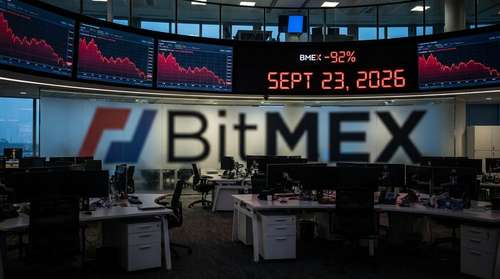
The cryptocurrency industry is witnessing the end of an era as pioneer exchange BitMEX will shut down its operations permanently. On July 23, 2026, the digital asset community was stunned by the announcement that the legendary trading platform will close its doors for good. The firm, which fundamentally reshaped global markets by introducing the high-leverage perpetual swap, has already halted all new user registrations. As the landscape shifts toward stricter regulatory frameworks and new market structures, the impending closure marks the twilight of the industry's formative frontier days.
A Shocking Exit: BitMEX Closing September 2026
The official timeline for BitMEX closing September 2026 leaves a tight window for existing users. According to HDR Global Trading Limited, the exchange's parent company, the decision came after a comprehensive strategic review of the business and the wider crypto industry. The platform will officially cease all operations on September 23, 2026, at precisely 04:00 UTC. While the company did not specify one single catalyst for the closure, leadership framed the event as an orderly wind-down rather than a catastrophic failure, emphasizing their pride in what the company built since 2014.
Key Deadlines for Active Traders
Market participants need to monitor their portfolios closely. Starting August 26, the platform will restrict all existing accounts to a strict 'reduce-only' mode. This means traders will only be able to close out existing positions and will be barred from opening new ones. The native BMEX token reacted violently to the closure news, plunging over 90% almost immediately after the announcement went live.
Securing Your Assets: How to Withdraw Crypto from BitMEX
If you still have assets on the platform, your immediate priority is capital preservation. To safely withdraw crypto BitMEX holds in your account, you must initiate transfers before the final September deadline. Unlike many abrupt exchange collapses we have witnessed in recent years, BitMEX currently maintains full 1-to-1 reserves and proudly boasts a spotless 11-year record of zero funds lost to hacks. However, complacency could be costly.
Failing to close out active trades before the transition phases will trigger automated systems. To ensure a smooth exit, follow these critical steps:
- Liquidate Open Positions: Close all active trades before the August 26 'reduce-only' phase to maintain control over your exit prices.
- Cancel Open Orders: Clear your order book of any limit orders that could execute unexpectedly during high volatility.
- Initiate Transfers Early: Navigate to your wallet dashboard and process your standard withdrawal protocols to secure your Bitcoin and stablecoins in a personal hardware wallet.
Any remaining open positions will face forced liquidations as the platform scales down its matching engine. Furthermore, accounts that fail to retrieve their digital assets before September 23 may be subject to hefty administrative maintenance fees as the company manages leftover custodial wallets.
The Unmatched Legacy of the Arthur Hayes Perpetual Swap
To understand the gravity of this closure, one must look back at how this single entity transformed crypto derivatives trading. Founded in 2014 by Arthur Hayes, Benjamin Delo, and Samuel Reed, BitMEX was an ambitious experiment that eventually birthed the modern leverage market. In May 2016, the team unleashed the Arthur Hayes perpetual swap through the XBTUSD contract, a financial instrument that married the mechanics of margin trading with a continuous, non-expiring contract structure.
Before the perpetual swap, traders wrestled with clunky, dated futures contracts that required constant rolling and suffered from severe liquidity fragmentation. BitMEX introduced a novel funding rate mechanism—a brilliant piece of financial engineering that tethered the contract's price to the underlying spot asset without requiring physical settlement. Offering up to 100x leverage, this product catered to an aggressive retail trading culture while simultaneously providing vital delta-neutral hedging tools for institutional miners and market makers. The innovation was so disruptive that even traditional finance giants eventually sought to replicate the model for legacy asset classes. Today, the perpetual swap is the undisputed king of cryptocurrency volume, adopted by every major decentralized and centralized venue globally.
Navigating Crypto Exchange Closures 2026
The decision by HDR Global Trading highlights a broader narrative surrounding crypto exchange closures 2026. The digital asset market of 2026 operates in a starkly different regulatory and competitive environment than the unregulated bull runs of earlier cycles. Global financial authorities have tightened the screws on offshore derivatives platforms. Simultaneously, traditional finance heavyweights have successfully launched their own regulated crypto derivatives, absorbing the institutional order flow. On the other side of the spectrum, decentralized perpetual exchanges have captured massive retail market share by allowing users to trade directly from their self-custody wallets without centralized intermediaries or localized regulatory risk.
BitMEX undeniably paved the way for these modern innovations. While the exchange's market dominance waned over the past few years amidst aggressive competition and shifting market structures, its architectural blueprint remains the foundation of global crypto derivatives trading. The pioneer platform may be logging off for the final time this September, but the mechanics it invented will continue to power trillions of dollars in trading volume for decades to come.