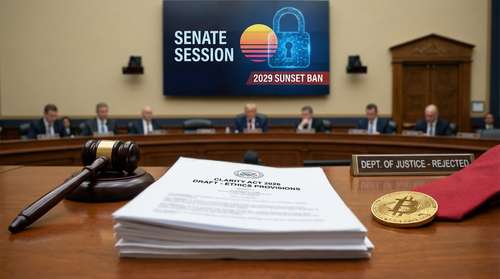

The landmark push for comprehensive US crypto regulation 2026 has hit a massive legislative roadblock just days before the Senate's August 7 summer recess. The CLARITY Act crypto legislation, officially known as the Digital Asset Market Clarity Act, was widely expected to cross the finish line this year. Instead, following a highly anticipated 600-page draft release on July 22, the bill has violently stalled out. Senate Democrats quickly rejected newly proposed ethics provisions, sending shockwaves through the digital asset industry and signaling a potential collapse of the bipartisan momentum that carried the bill through the House last year.
For market participants and institutional investors, the stakes are incredibly high. The failure to secure a floor vote now could shelve the framework until after the November midterms, leaving the industry stranded in a state of regulatory limbo during a crucial growth phase.
Polymarket CLARITY Act Odds Signal Market Panic
The immediate fallout from the Senate deadlock was visible in real-time on decentralized prediction markets. The Polymarket CLARITY Act odds, which track the probability of the bill being signed into law by the end of 2026, collapsed overnight. Traders had priced the legislation's chances above 80% earlier this month following optimistic committee meetings and perceived bipartisan compromises.
As news broke that the 72-hour negotiation window had failed, those odds crashed to a dismal 37%. The prediction contract, which has generated nearly $3 million in trading volume, reflects the collective wager of market participants who now see the August recess as a fatal chokepoint.
A falling prediction price points directly to weakening trader conviction. Congress.gov still lists the bill as having passed the House in a commanding 294-134 vote back in July 2025. However, since the Senate Banking Committee referred it for further review, the legislative machinery has ground to a halt, leaving traders highly skeptical of any sudden breakthroughs.
The Sticking Point: Elizabeth Warren Crypto Ethics and Loopholes
The collapse in negotiations centers entirely on conflict-of-interest guidelines. On July 22, Senate Republicans circulated updated text featuring temporary ethics provisions—a direct concession aimed at skeptics across the aisle. However, the speed at which Democrats rejected the language told the market everything it needed to know.
A coalition of seven Democrats, led by Senator Angela Alsobrooks, publicly stated the revised text "falls short". The resistance is heavily influenced by the baseline established by Elizabeth Warren crypto ethics standards, which demand strict firewalls preventing public officials from launching or promoting proprietary tokens while in office. These legislative demands intensified after recent financial disclosures showed former President Donald Trump earning upwards of $1.4 billion from cryptocurrency ventures, including controversial meme coins and decentralized finance projects tied directly to his family.
Closing the Profit Loophole
Democrats argue the Republican counteroffer contained glaring loopholes that would still allow senior government appointees to leverage public office for personal financial gain. Senator Ruben Gallego dismissed the updated text as a nonstarter, bluntly categorizing it as an unserious attempt at a finalized deal. Because a market structure bill requires 60 votes to survive cloture, this unified Democratic blockade is currently impenetrable.
Hanging in the Balance: SEC vs CFTC Crypto Jurisdiction
If the Digital Asset Market Clarity Act dies on the Senate floor, the digital asset industry loses its best chance at regulatory certainty in a decade. At its core, the legislation was meticulously designed to definitively settle the ongoing SEC vs CFTC crypto jurisdiction war.
The bill establishes a clear, statutory framework that hands the Commodity Futures Trading Commission (CFTC) primary oversight of digital commodity spot markets. More importantly, it writes into statute exactly where the Securities and Exchange Commission's (SEC) securities authority stops applying to digital assets. Without this boundary, crypto exchanges, stablecoin issuers, and decentralized finance protocols will continue to face unpredictable regulation by enforcement.
Legal experts and industry advocates argue that the current fragmented approach stifles growth. By splitting oversight cleanly based on asset classification, the CLARITY Act would finally allow institutions to participate without fear of retroactive litigation.
The Scaramucci CLARITY Act Warning
Industry leaders are not mincing words about the consequences of this legislative failure. In a stark Scaramucci CLARITY Act warning issued during a recent media appearance, SkyBridge Capital founder Anthony Scaramucci outlined the grim reality facing the sector if Senate Majority Leader John Thune fails to schedule a floor vote before the recess.
"If it doesn't get to the floor, it dies a brutal death," Scaramucci stated. He emphasized that the narrowing calendar leaves just a handful of days for procedural maneuvering. While Scaramucci noted that the formidable 48-for-48 record of crypto super PACs might force some younger lawmakers to vote in favor if the bill actually reaches the floor, failing to initiate that vote will prove catastrophic.
The sentiment is echoing across Wall Street and Silicon Valley. Prominent executives are already signaling that without clear market structure rules, the exodus of blockchain talent will accelerate. As Scaramucci warned, if Washington cannot deliver a functional regulatory framework this year, heavyweights like Coinbase will simply continue building the next generation of financial infrastructure offshore.