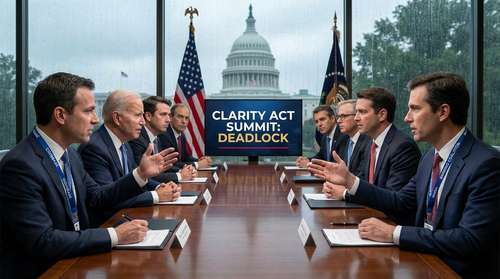
WASHINGTON, D.C. — A high-stakes White House summit aimed at resolving the deepening rift between the cryptocurrency industry and the traditional banking sector has ended without a breakthrough, leaving the landmark CLARITY Act in legislative limbo. As of Friday, February 6, 2026, negotiations remain deadlocked over the contentious issue of "stablecoin rewards," with major players like Coinbase and the American Bankers Association (ABA) digging into opposing trenches. The impasse threatens to derail the Senate's planned vote on the comprehensive crypto market structure bill, casting a shadow over the administration's goal to cement the U.S. as the "crypto capital of the planet."
Summit Deadlock: No Deal on Stablecoin Yields
The closed-door meeting, convened earlier this week by White House crypto adviser Patrick Witt, brought together top executives from Coinbase, Circle, and Ripple to sit across from powerful banking lobbyists. The goal was to hammer out a compromise on Section 404 of the Digital Asset Market Clarity (CLARITY) Act—a provision that would effectively ban crypto platforms from passing yield generated by stablecoin reserves on to retail customers.
Despite a directive from the White House to find common ground by the end of February, sources confirm the summit concluded with "significant distance" between the two sides. "The banks are treating stablecoin rewards as an existential threat to their deposit base," said one industry insider present at the meeting. "They want a total ban on third-party yield, while crypto exchanges view those rewards as a fundamental competitive feature." The failure to reach an agreement has forced Senate Banking Committee Chair Tim Scott to indefinitely pause the committee markup of the bill.
The Core Conflict: Banking Stability vs. Crypto Innovation
At the heart of the standoff is a battle over the lucrative interest rates generated by the U.S. Treasuries that back stablecoins like USDC. With traditional savings accounts still offering near-zero interest, crypto platforms have attracted millions of users by passing on these Treasury yields—often 4% or higher—as "rewards" for holding stablecoins.
Traditional banks argue this creates an uneven playing field. Lobbyists for the banking sector warned White House officials that allowing unregulated tech companies to offer high-yield, deposit-like products could trigger a massive "deposit flight" from community banks, destabilizing the broader financial system. Their proposed solution, enshrined in the current draft of the CLARITY Act, is a strict prohibition on any entity other than a bank offering interest on stablecoin balances.
Coinbase CEO Brian Armstrong has drawn a red line on the issue, threatening to withdraw industry support for the entire legislative package if the ban remains. Armstrong argues that the banking lobby is using "safety" as a pretext to crush competition and protect their low-interest business model. "This isn't about consumer protection; it's about protecting bank profit margins from innovation," Armstrong reportedly told officials.
SEC Chair Paul Atkins and the Regulatory Void
The legislative stall complicates the agenda for SEC Chairman Paul Atkins, who took the helm in 2025 with a mandate to dismantle the "regulation by enforcement" era. Atkins has launched "Project Crypto" to modernize securities rules but has repeatedly stated that Congress must provide the statutory framework for stablecoins and market structure.
Without the CLARITY Act, the regulatory landscape remains fragmented. The House-passed FIT21 Act provided a blueprint in 2025, but it lacks the Senate's buy-in on key banking provisions. If the CLARITY Act fails to pass before the mid-term election cycle heats up later this year, the industry risks reverting to a gray zone where neither the SEC nor the CFTC has clear jurisdiction over the $300 billion stablecoin market.
What’s Next for the 2026 Senate Vote?
The White House has issued a strict ultimatum: fix the yield provision by February 28, or risk the administration pivoting to executive orders to fill the gap. For now, the CLARITY Act remains stalled. Market analysts predict that if a compromise isn't reached—perhaps allowing capped yields or requiring higher reserve standards for yield-bearing products—the bill could die in committee.
For American crypto investors, the outcome will decide whether they can continue to earn passive income on their digital assets or if those returns will be walled off behind the traditional banking system. As the clock ticks down to the end-of-month deadline, all eyes are on whether the "crypto capital" ambition can survive the reality of Washington politics.