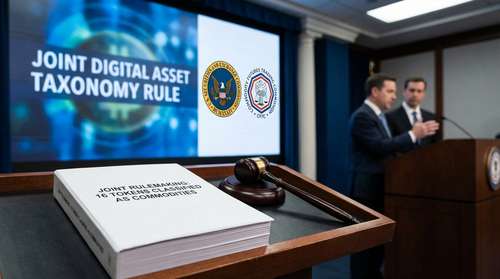
After more than a decade of jurisdictional tug-of-war and regulatory ambiguity, the United States government has finally drawn clear lines for the cryptocurrency industry. On March 17, 2026, federal regulators released a historic 68-page SEC CFTC joint crypto rule that fundamentally reshapes the future of decentralized finance. By establishing a formal digital asset taxonomy, the regulatory bodies have explicitly designated 16 major cryptocurrencies—including Ethereum, XRP, Solana, and Cardano—as digital commodities. This watershed moment effectively marks the end of "regulation by enforcement" and paves the way for a transparent, unified market structure that encourages domestic innovation.
The 68-Page Blueprint: A Five-Category Digital Asset Taxonomy
For years, builders and institutional investors have operated under the shadow of the SEC's 2019 framework and the dated 2017 DAO Report, which often left the industry guessing about compliance. The newly minted digital asset taxonomy replaces that guesswork with a coherent, five-tier classification system:
- Digital Commodities: Decentralized network tokens with functional value.
- Digital Collectibles: Assets encompassing most NFTs and certain cultural meme coins.
- Digital Tools: Access-credential instruments.
- Stablecoins: Payment tokens governed under the GENIUS Act, a landmark law signed in July 2025 that mandates 1-to-1 reserve backing and explicitly carves these assets out of standard securities oversight.
- Digital Securities: Traditional financial instruments tokenized on a blockchain.
Under this new framework, the guidance clarifies that the vast majority of circulating cryptocurrencies are exempt from federal securities laws. This establishes a clear jurisdictional split, placing oversight of spot markets firmly in the hands of the Commodity Futures Trading Commission, while the SEC retains authority exclusively over digital securities.
Ethereum Commodity Ruling and the 16 Exempted Assets
The most highly anticipated component of the release is the crypto commodity classification of specific digital assets. The agencies definitively named 16 tokens as digital commodities, including Bitcoin (BTC), Ethereum (ETH), Solana (SOL), Cardano (ADA), Polkadot (DOT), Avalanche (AVAX), Chainlink (LINK), Dogecoin (DOGE), and Shiba Inu (SHIB).
Perhaps most notably, this document officially resolves the long-standing legal battles surrounding Ripple's native token, cementing the XRP regulatory status 2026 as a recognized commodity. The regulators concluded that the value of these 16 assets derives from the programmatic operation of functional crypto networks and standard supply-demand dynamics. Because their value does not depend on the essential managerial efforts of an enterprise, they cleanly fail the Howey Test for investment contracts.
SEC Chairman Paul Atkins and the Pro-Crypto Policy Shift
The interpretive guidance is the first formal output of "Project Crypto," a joint regulatory initiative launched in response to a July 2025 mandate from the Presidential Working Group on Digital Asset Markets.
SEC Chairman Paul Atkins emphasized that the commission is shifting its approach entirely, declaring that the agency is no longer the "securities and everything commission". In a public address, Atkins noted that the interpretation acknowledges what previous administrations refused to recognize: that most crypto assets are not themselves securities. "After more than a decade of uncertainty, this interpretation will provide market participants with a clear understanding," Atkins stated, reinforcing the agency's commitment to drawing clear lines in clear terms.
CFTC Chairman Michael Selig, who was sworn in late last year after serving as chief counsel for the SEC's Crypto Task Force, echoed these sentiments, noting that for American builders, "the wait is over". This unprecedented alignment signals one of the most significant US crypto regulation updates in history, completely reversing the aggressive enforcement posture previously championed by former SEC leadership.
The "Attach and Detach" Doctrine and Staking
A pivotal innovation within the 68-page document is the "Attach and Detach" doctrine. The rule acknowledges that while a token might initially be sold to raise capital as part of an investment contract, that security status is not a permanent life sentence. Once a network becomes sufficiently decentralized and the issuer fulfills, abandons, or ceases its material managerial obligations, the token can "detach" and safely trade as a non-security commodity.
Furthermore, the joint rule provides a massive sigh of relief for the decentralized infrastructure sector. Protocol mining, liquid staking, and certain airdrops are now explicitly classified as non-securities activities. The SEC characterized the work of network validators as administrative and ministerial rather than discretionary business decisions, effectively nullifying the legal threats that previously loomed over major exchanges offering staking-as-a-service.
What This Means for US Crypto Regulation Updates Going Forward
To further stimulate the industry, Atkins outlined three proposed capital-formation safe harbors for a forthcoming "Regulation Crypto Assets" rulemaking: a startup exemption for projects raising up to $5 million, a fundraising exemption for raises up to $75 million, and a broader investment exemption. These pathways will allow developers to bootstrap early liquidity without running afoul of the law.
This comprehensive regulatory reset provides the clarity the digital asset space has desperately craved. With the CFTC officially taking the reins over digital commodity spot markets, institutional capital that has been sitting on the sidelines due to legal apprehension is expected to flow freely back into American decentralized networks.
Moving forward, builders can launch tokens without the paralyzing fear of retroactive lawsuits, provided they adhere to the clear guidelines surrounding initial capital formation. As the global financial sector digests the historic Ethereum commodity ruling and the broader implications of this collaborative framework, the United States is uniquely positioned to reclaim its title as the global epicenter for blockchain innovation.