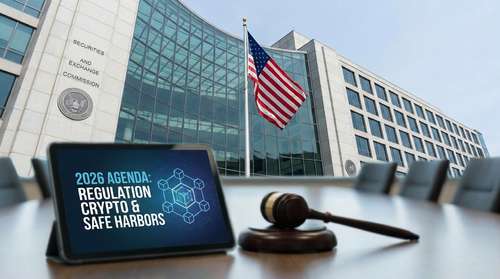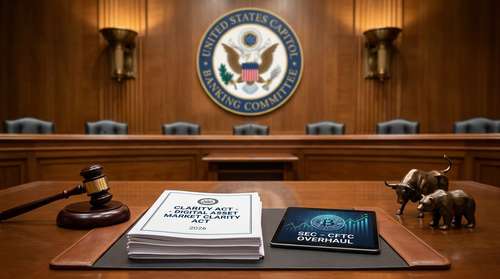
After years of navigating a fragmented and heavily contested legal landscape, the digital asset sector just scored a monumental victory on Capitol Hill. The US Senate Banking Committee recently voted 15-9 to advance the Digital Asset Market Clarity Act (CLARITY Act) to the full Senate floor. This landmark legislation, which seeks to definitively end the relentless jurisdictional turf wars that have plagued American blockchain innovation, represents the most substantial step toward comprehensive crypto regulation 2026 has seen thus far. By officially moving out of committee, lawmakers are setting the stage for a dramatic summer showdown that could fundamentally reshape the future of decentralized finance in the United States.
Bridging the Political Divide: The Bipartisan 15-9 Vote
The path out of the US Senate Banking Committee was anything but guaranteed. The measure successfully passed because of a critical bipartisan breakthrough: Democratic Senators Ruben Gallego of Arizona and Angela Alsobrooks of Maryland broke ranks to join all 13 Republican committee members in voting to advance the draft.
While the committee victory provides massive momentum for the Digital Asset Market Clarity Act, the legislative math ahead remains daunting. To survive a likely filibuster on the Senate floor, the bill will require 60 votes. Assuming the 53 Republican senators vote as a unified bloc, proponents must secure the support of at least seven Democrats to push the measure across the finish line. Both Gallego and Alsobrooks explicitly noted that their committee approval was conditional, emphasizing that intensive negotiations are still required.
A primary sticking point for skeptical lawmakers revolves around robust ethics agreements. Several senators are pushing for strict limitations on the digital asset holdings and trading activities of senior government officials, as well as enhanced anti-money laundering controls for decentralized platforms. Over the next few weeks, the bill must also be reconciled with concurrent drafts from the Senate Agriculture Committee before a unified version faces a final vote.
SEC vs CFTC: Establishing Boundaries with Regulation Crypto
For industry builders and institutional investors alike, the core appeal of the CLARITY Act lies in its decisive resolution of the ongoing SEC vs CFTC debate. Under current frameworks, digital asset firms have operated under what critics characterize as regulation by enforcement, often learning the rules only after receiving a lawsuit or subpoena.
This legislation replaces the existing patchwork of overlapping enforcement actions with clearly defined categories. Digital commodities, whose value is linked directly to the functional utility of a blockchain rather than an investment contract, will fall under the exclusive oversight of the Commodity Futures Trading Commission (CFTC). This firmly establishes the regulatory home for blue-chip assets like Bitcoin and Ether.
Conversely, assets that are offered and sold to fund the initial development of a network will remain under the jurisdiction of the Securities and Exchange Commission (SEC). However, the bill introduces a much-needed transitional pathway. Under a newly established framework dubbed Regulation Crypto, token issuers gain an exemption from traditional, burdensome public company registration requirements, provided they meet strict initial and semiannual disclosure standards. Once an ecosystem reaches the status of a mature, decentralized blockchain system, the SEC oversight phases out, and the secondary market trading transitions seamlessly to the CFTC.
A Breakthrough for Stablecoin Legislation
Beyond settling the broader securities debate, the committee markup also integrated essential stablecoin legislation. Earlier this year, progress stalled completely over a fierce dispute regarding whether crypto exchanges and intermediaries should be permitted to offer yield on stablecoin deposits.
The advanced draft reflects a delicate compromise, introducing a specialized regulatory framework for permitted payment stablecoins. The updated provisions balance the necessity for robust consumer deposit safeguards against the operational realities of decentralized networks. By creating a federal floor for stablecoin oversight, the bill ensures that dollar-pegged digital assets can function reliably as payment mechanisms without exposing retail users to unregulated systemic risks.
Market Reactions and the Path Forward
Predictably, the digital asset markets responded enthusiastically to the committee vote. Leading up to and immediately following the markup session, major assets posted significant gains, with Bitcoin pushing past the $81,000 threshold and altcoins like XRP experiencing sharp single-day surges. Investors are pricing in the possibility of an environment where secondary trading and decentralized network participation face far less legal friction.
Furthermore, the revised text carefully navigates the complex dynamic between federal preemption and state authority. The latest draft ensures that individual states retain the right to apply specific consumer protection laws and target fraudulent activities, particularly concerning virtual currency kiosks. This balanced approach appeased several skeptical lawmakers who wanted to guarantee that establishing a national regulatory floor would not gut local enforcement capabilities.
What the CLARITY Act Means for the Future
The advancement of the Digital Asset Market Clarity Act marks a generational pivot in how the United States approaches financial technology. Moving the bill to the Senate floor signals that Washington is finally ready to establish a permanent, pro-innovation environment. If passed, the regulatory certainty will likely unlock substantial institutional capital that has previously remained sidelined due to legal ambiguities. Startups will no longer have to fear arbitrary enforcement actions, and retail participants will benefit from mandated, standardized disclosures.
The upcoming weeks of Senate floor debate will undoubtedly feature fierce lobbying from both traditional finance titans and digital asset advocates. Yet, the bipartisan momentum achieved in the committee room demonstrates that the demand for regulatory clarity has officially eclipsed partisan divides. The CLARITY Act is no longer just a theoretical framework; it is the definitive battleground for the future of the American digital economy.