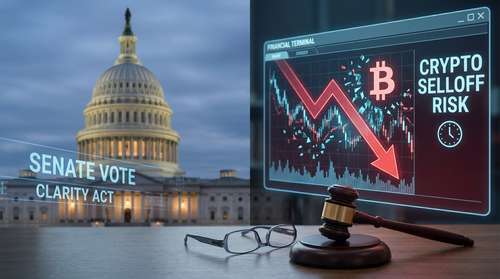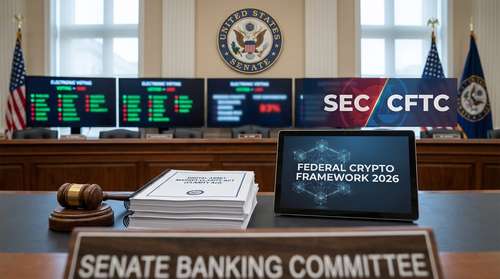
The US cryptocurrency industry has spent over a decade asking one critical question: who actually regulates digital assets? The answer is finally taking shape in Washington. In a landmark development for CLARITY Act crypto news, the Senate Banking Committee has officially advanced the Digital Asset Market Clarity Act. This legislative milestone represents the most significant progress to date for a comprehensive federal crypto framework, bringing much-needed certainty to a trillion-dollar industry.
Following months of intense partisan gridlock and closed-door negotiations, the bill cleared the committee on May 14, 2026, setting the stage for a critical full Senate floor vote. For blockchain developers, institutional investors, and everyday traders, this legislation could fundamentally reshape how digital assets operate within the traditional financial system.
The Senate Banking Committee Crypto Vote: A Bipartisan Breakthrough
The path to establishing viable US crypto regulation 2026 has been anything but smooth. However, the recent Senate Banking Committee crypto vote demonstrated a rare moment of bipartisan consensus. The committee approved the Digital Asset Market Clarity Act in a decisive 15-9 vote, with Chairman Tim Scott (R-S.C.) leading the charge.
Crucially, the bill secured support from across the aisle. Two Democratic senators—Angela Alsobrooks of Maryland and Ruben Gallego of Arizona—broke ranks to join all 13 committee Republicans in greenlighting the legislation. While both Democrats explicitly noted that their committee votes do not guarantee their support on the final Senate floor, their willingness to advance the bill signals a pragmatic shift in how Washington approaches digital innovation.
Following the vote, market optimism surged. Bitcoin quickly climbed above the $81,000 mark, injecting approximately $58 billion into the total cryptocurrency market capitalization within mere hours. Major altcoins, including XRP and Dogecoin, also posted notable gains, reflecting widespread investor enthusiasm for the regulatory clarity the bill promises.
Ending the SEC vs CFTC Jurisdiction Turf War
Perhaps the most celebrated feature of the Digital Asset Market Clarity Act is its direct intervention in the long-running SEC vs CFTC jurisdiction dispute. For years, the Securities and Exchange Commission (SEC) has primarily regulated via enforcement, claiming most tokens are unregistered securities. Meanwhile, the Commodity Futures Trading Commission (CFTC) has maintained oversight of assets like Bitcoin, viewing them as commodities.
This ambiguity left major exchanges and token issuers spending millions on legal fees rather than product development. The CLARITY Act resolves this by explicitly sorting digital assets into defined regulatory categories:
- Digital Commodities: Tokens whose value derives from a functional, decentralized blockchain network (such as Bitcoin and Ethereum) will fall under the exclusive purview of the CFTC.
- Investment Contract Assets: Tokens sold similarly to traditional startup equity, where investors rely on a centralized managerial team to build a network, will remain strictly under SEC authority.
By writing these definitions into federal law, the legislation provides the foundational pillars for a robust federal crypto framework that allows innovators to build without fear of retroactive enforcement actions.
The Stablecoin Yield Ban and Financial Safeguards
Beyond broad jurisdictional definitions, the markup session tackled specific operational mechanics of the digital economy. One of the most fiercely debated provisions involved how to handle stablecoins—tokens pegged to fiat currencies like the US dollar.
To bridge the gap between banking lobbyists and the crypto sector, Senators Alsobrooks and Thom Tillis (R-N.C.) authored a crucial compromise regarding a stablecoin yield ban. Under the advanced text, cryptocurrency exchanges and intermediaries are prohibited from issuing passive rewards on stablecoin balances that are "economically or functionally equivalent" to interest-bearing traditional bank deposits.
This language survived intact despite pushback from multiple angles. Traditional banking trade groups expressed concerns that workarounds could drain liquidity from conventional banks, while crypto-native advocates argued the restriction stifles decentralized finance (DeFi) innovation. Ultimately, the compromise held, serving as the necessary glue to secure bipartisan committee approval.
Debating Ethics and Anti-Money Laundering
The markup was not without its casualties. Several proposed amendments failed to make the final committee text. An anti-money laundering (AML) measure spearheaded by Senators Jack Reed (D-R.I.) and Tina Smith (D-Minn.) was denied inclusion. Furthermore, contentious debates over an ethics provision—which sought to restrict government officials' engagements with digital assets—ultimately failed to yield a consensus agreement, leaving a potential vulnerability as the bill moves forward.
What This Means for US Crypto Regulation 2026
Advancing out of committee is a massive victory, but the Digital Asset Market Clarity Act still faces a steep uphill climb. To become law, the bill now heads to the full Senate, where it will require a 60-vote supermajority to overcome any filibuster attempts. Assuming unanimous Republican support, the legislation still needs the backing of at least seven Democrats to pass.
Market watchers are closely monitoring the political math. According to recent predictive data, platforms like Polymarket currently assign a strong probability—hovering around 67%—that the CLARITY Act will officially pass in 2026. If successful, the Senate version must then be reconciled with earlier market structure legislation passed by the House of Representatives, specifically the FIT21 Act from previous sessions.
While the legislative hurdles remain significant, the 15-9 committee vote proves that establishing clear, effective rules for digital assets is no longer a fringe policy issue. Washington has finally recognized that the blockchain revolution is unfolding, and the United States is actively taking steps to ensure the infrastructure of the next financial generation remains on American soil.