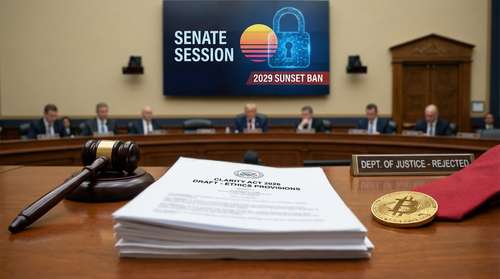

President Donald Trump has ignited the digital asset industry with a bold pledge to establish a permanent, future proof crypto market structure. This major announcement arrives precisely as the White House Office of Management and Budget (OMB) begins reviewing sweeping CFTC prediction market rules. Together, these coordinated moves represent the most significant executive-branch effort to formalize US crypto regulations 2026, signaling a historic shift toward federal protection for blockchain innovation and event contracts.
Trump's Vision for a Future-Proof Crypto Market Structure
Taking to Truth Social in late May 2026, President Trump delivered his strongest endorsement of the digital asset industry to date. He vowed to build a regulatory framework that future administrations and "crypto haters" cannot easily dismantle. According to the President, this digital asset market structure will firmly establish the United States as the undisputed global hub for blockchain technology and decentralized finance.
Trump did not mince words regarding previous regulatory regimes. He aggressively criticized former Securities and Exchange Commission (SEC) Chair Gary Gensler, accusing his enforcement-heavy approach of driving Bitcoin, perpetual futures, and entrepreneurial talent offshore. By promising a future proof crypto market structure, the administration aims to reverse this trend completely.
"Under my Leadership, we will codify a FUTURE-PROOF Digital Asset Market Structure that cannot be undone by the Crypto Haters," Trump posted, adding that the "new Frontier of Finance is being Built in America, and 'TRUMP' will NEVER let Crypto down!". Beyond standard token trading, Trump specifically highlighted "crypto perpetuals"—leveraged derivative instruments that never expire—as a vital financial product that the United States must dominate rather than export.
White House OMB Reviews CFTC Prediction Market Rules
While the President outlines his long-term legislative goals, immediate administrative action is unfolding behind closed doors. The White House OMB CFTC regulatory review process officially commenced this week. The Office of Information and Regulatory Affairs (OIRA) is currently evaluating the Commodity Futures Trading Commission's highly anticipated proposed rules on event contracts.
This rulemaking process marks a watershed moment for prediction markets regulation. Following a March advance notice that generated more than 3,000 public comments, the CFTC is moving to establish the first comprehensive federal framework for event-based trading. Industry stakeholders are watching closely to see how the agency balances innovation with market integrity.
Key components expected in the CFTC's proposal include:
- Strict guidelines to monitor and prevent insider trading within event contracts.
- Clear definitions of prohibited contract types to protect the public interest.
- Enhanced oversight mechanisms for platforms listing political, economic, or sports-based outcomes.
- Improved retail safeguards designed to prevent market manipulation.
Federal Jurisdiction vs. State Gambling Laws
The timing of this White House OMB CFTC review is critical. Event contracts allow users to trade on the outcome of future events, which often function similarly to binary options. Because of this, states like New York, New Jersey, and Illinois have launched enforcement actions against prediction market platforms, attempting to classify event contracts as illegal sports betting. Platforms such as Kalshi and Polymarket argue that their operations fall squarely under the Commodity Exchange Act and should be exclusively governed by federal derivatives law.
President Trump recently waded into this jurisdictional battle, firmly supporting the CFTC's exclusive authority over prediction markets. If the OMB clears the CFTC's rules, it will effectively set the standard for the nation, potentially preempting state-level interference entirely and opening the floodgates for institutional capital to enter the space.
Navigating US Crypto Regulations in 2026
The intersection of Trump crypto regulation promises and CFTC rulemaking highlights a broader push to solidify the American financial frontier. Lawmakers in Washington are feeling the pressure to translate pro-crypto messaging into binding legislation. The CLARITY Act, which recently advanced through the Senate Banking Committee, represents a parallel legislative effort to clearly demarcate the jurisdictional lines between the SEC and the CFTC regarding token classification.
Simultaneously, earlier legislative wins like the GENIUS Act have laid the groundwork for US exchanges to list sophisticated products legally. Market participants have long argued that a clear digital asset market structure is essential to keep domestic innovation alive. The current administration views US crypto regulations 2026 not just as a matter of financial oversight, but as a critical economic and geopolitical advantage.
What This Means for Digital Asset Investors
For investors and blockchain builders, this week's developments offer a rare glimpse of long-term certainty. If the future proof crypto market structure successfully passes into law, it will protect exchanges, stablecoin issuers, and derivative platforms from hostile regulatory shifts. Furthermore, finalized CFTC prediction market rules will legitimize event contracts as standard financial derivatives rather than unregulated wagers.
As the OMB completes its review, the public will soon get a detailed look at the CFTC's finalized proposal. Coupled with strong executive backing, the American digital asset ecosystem appears uniquely positioned for unprecedented growth, regulatory clarity, and institutional adoption throughout the remainder of the year.