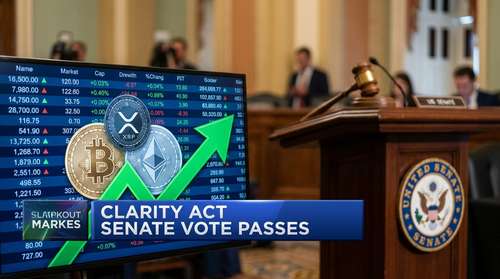
The United States has reached a major turning point in its financial history following a landmark decision in Washington. The long-awaited Digital Asset Market Clarity Act (CLARITY Act) cleared a critical hurdle in the Senate Banking Committee with a 15-9 bipartisan vote. This definitive action marks a massive step toward ending years of regulatory ambiguity. For investors seeking the most impactful crypto regulatory news today, this legislative progress formally shifts market dynamics. By classifying Bitcoin and Ethereum as digital commodities and providing a permanent framework for XRP, lawmakers have ignited an immediate market-wide surge.
Historic Bipartisan Consensus: Inside the CLARITY Act Senate Vote
After nearly a year of intense, often stalled negotiations, the CLARITY Act Senate vote officially moves the most comprehensive piece of US digital asset legislation to the Senate floor. Chaired by Senator Tim Scott (R-S.C.), the Banking Committee successfully advanced the 309-page bill on May 14, 2026, following a heated two-hour markup session. All 13 Republican committee members voted in favor, joined by Democratic Senators Angela Alsobrooks of Maryland and Ruben Gallego of Arizona.
This bipartisan compromise reflects a growing acknowledgment that the digital asset revolution is happening regardless of traditional political divides. Senator Alsobrooks stated for the record that while her vote signals a mandate to continue negotiating in good faith, there is still significant work required before securing her final floor vote. The measure now awaits full Senate consideration. A tentative timeline points toward floor debate by mid-June, with a final vote targeted for June 22. The bill requires a 60-vote supermajority to pass before heading to a bicameral reconciliation with the version adopted by the House in July 2025.
Defining Digital Assets: Ethereum CFTC Commodity Status and XRP Legal Clarity 2026
At the core of the legislation is a monumental shift in jurisdictional oversight. By establishing definitive boundaries between securities and commodities, the CLARITY Act solidifies Ethereum CFTC commodity status alongside Bitcoin. This removes the lingering threat of Securities and Exchange Commission (SEC) overreach that has plagued network token developers for years.
Equally significant is the provision securing XRP legal clarity 2026. After enduring a protracted, multi-year legal battle with the SEC, Ripple and the broader XRP ecosystem now have a permanent legislative framework that treats the token as an ancillary asset under a tailored regulatory regime. This statutory exemption shields secondary market transactions from traditional securities burdens, empowering developers and reassuring exchanges that they can operate without the constant fear of sudden, regulation-by-enforcement actions.
The Regulation Crypto Framework
To bridge the gap between innovation and consumer protection, the bill introduces a disclosure mechanism dubbed Regulation Crypto. Originators of network tokens can certify that entrepreneurial or managerial efforts have ceased, allowing the assets to function squarely as decentralized commodities rather than investment contracts. This pathway provides a direct runway for continued sector growth while safeguarding retail investors through mandated initial and semiannual disclosures.
Market Reaction: Bitcoin Price Forecast 2026 Hits New Highs
Financial markets reacted instantaneously to the committee markup session. Following the historic approval, Bitcoin surged past the $81,000 threshold, while legacy altcoins like XRP and Dogecoin posted immediate 5% overnight gains. Major infrastructure providers also saw massive equity leaps, with Circle shares surging nearly 19.9% and Coinbase jumping over 6.1%, illustrating how closely corporate valuations remain tied to regulatory certainty.
Analysts across Wall Street are rushing to update their models. The prevailing Bitcoin price forecast 2026 has turned remarkably bullish, with projection models heavily factoring in reduced friction for large-scale capital inflows. Prediction markets have subsequently upgraded the probability of the bill becoming law this year from 61% to over 70%. If the full Senate successfully clears the 60-vote filibuster hurdle next month, the momentum could trigger an unprecedented supply squeeze on major exchanges.
The Path Forward: Institutional Crypto Adoption 2026
While the committee victory is undoubtedly a watershed moment, the legislation still faces hurdles before reaching President Trump's desk. Lawmakers must navigate outstanding concerns over decentralized finance (DeFi) regulations and stricter ethical restrictions regarding digital asset holdings for senior government officials.
However, a major roadblock was already cleared regarding stablecoins. An earlier markup session in January had been canceled due to fierce disagreements over stablecoin yields. A successful compromise led by Senators Tillis and Alsobrooks now prohibits crypto exchanges from offering deposit interest-like returns for stablecoins, while still allowing usage-driven incentives. This critical balance protects traditional banks from deposit flight while keeping digital innovation intact.
The resolution of these jurisdictional turf wars clears the path for institutional crypto adoption 2026. Traditional financial heavyweights, previously sidelined by compliance uncertainties, can now engage with digital asset intermediaries operating under clear, statutory guidelines. As the legislative clock ticks down ahead of the November mid-term elections, the cryptocurrency sector stands on the precipice of full integration into the mainstream American financial system.