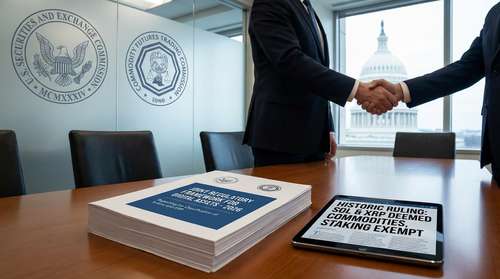
The decade-long era of "regulation by enforcement" in the United States cryptocurrency market has officially come to a close. On March 17, 2026, regulators delivered the long-awaited SEC CFTC crypto guidance 2026, fundamentally reshaping the financial landscape. Announced at the DC Blockchain Summit, this historic 68-page joint interpretive release establishes definitive rules of the road for developers, institutions, and investors.
Led by SEC Chairman Paul S. Atkins and CFTC Chairman Michael S. Selig, the framework hands exclusive spot market jurisdiction over major cryptocurrencies to the CFTC. By abandoning ambiguous enforcement tactics in favor of a clear, principles-based approach, the agencies have effectively halted the offshore capital flight that has plagued American financial innovation. As the SEC CFTC crypto guidance 2026 takes immediate effect, the industry finally has a workable compliance blueprint.
The Five-Category Digital Asset Taxonomy
At the heart of SEC Release 33-11412 (and its CFTC counterpart 34-105020) is a comprehensive five-category digital asset taxonomy designed to classify tokens based on their economic substance rather than technological form. The framework neatly divides the rapidly expanding digital asset universe into clearly defined regulatory buckets.
- Digital Commodities: Assets deriving value from a functional, decentralized blockchain network. This covers 16 major tokens, including Bitcoin, Ethereum, Cardano, and Avalanche.
- Digital Collectibles: Non-fungible tokens (NFTs), meme coins, and digital art.
- Digital Tools: Tokens utilized strictly for utility within a closed ecosystem.
- Stablecoins: Fiat-pegged assets, subject to specific legislative guardrails.
- Digital Securities: Traditional financial instruments, like stocks or U.S. Treasuries, tokenized on a blockchain. Only these remain under the strict jurisdiction of the SEC.
Decoding the Solana XRP Securities Ruling
For years, altcoin developers operated under the looming threat of sudden litigation. The new interpretation provides a definitive Solana XRP securities ruling, explicitly listing both tokens—alongside others like Chainlink and Aptos—as commodities.
The regulators formally adopted the "transaction, not the token" philosophy. According to the document, a token is essentially a "thing," not an investment contract in and of itself. The Howey Test remains binding precedent, meaning a non-security asset can temporarily become subject to securities laws if the issuer makes specific promises regarding "essential managerial efforts" from which buyers expect profits. However, once a network achieves sufficient decentralization, the token drops its security status—a massive victory for open-source development. The formal digital commodity classification ensures that secondary market trading of these assets will no longer trigger SEC enforcement.
Safe Harbors: Crypto Staking Regulation and Network Participation
Network validators and participants finally have the clarity needed to operate without fear of federal subpoenas. The interpretive release directly addresses crypto staking regulation, definitively stating that protocol staking on Proof-of-Stake networks—whether solo, liquid, or custodial—does not constitute a securities transaction.
The exemptions extend well beyond staking. Proof-of-Work protocol mining, one-to-one token wrapping, and standard airdrops distributed without financial consideration are entirely exempt from federal securities laws. This bright-line rule protects everyday network activities and allows decentralized finance (DeFi) infrastructure to scale cleanly within the United States.
The GENIUS Act Implementation and Stablecoin Clarity
Stablecoins represent the critical plumbing of modern crypto markets, and their status has been hotly debated. The joint framework heavily integrates the 2025 GENIUS Act implementation to resolve this regulatory bottleneck.
Under the Guiding and Establishing National Innovation for U.S. Stablecoins (GENIUS) Act, payment stablecoins issued by "permitted payment stablecoin issuers" are statutorily excluded from the definition of a security. This means that dollar-pegged assets managed by federally or state-qualified entities are safe from SEC interference. However, the agencies left a narrow caveat: yield-bearing or algorithmic stablecoins outside the GENIUS Act framework may still face scrutiny depending on their specific facts and circumstances.
A New Frontier for U.S. Capital Markets
This coordinated agency action represents more than just a regulatory update; it is a foundational shift in global finance. "This is what regulatory agencies are supposed to do: draw clear lines in clear terms," SEC Chair Atkins noted during the announcement.
By defining exactly what constitutes a digital commodity and providing explicit safe harbors for core blockchain activities, the SEC CFTC crypto guidance 2026 has legitimized the sector for Wall Street. Institutional investors, who previously hesitated due to compliance risks, now possess the structured pathway required to deploy capital safely. The long wait is over, and the blueprint for the next generation of American financial innovation is officially live.