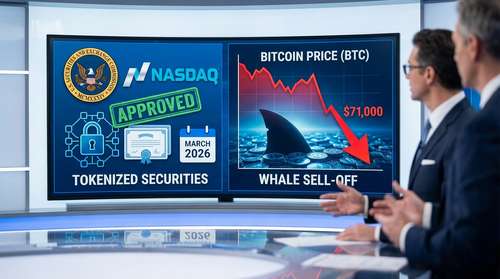
The U.S. Securities and Exchange Commission (SEC) has officially ushered in a new era for financial markets by granting approval for Nasdaq tokenized securities. This historic regulatory shift bridges the gap between traditional equities and blockchain technology, fundamentally altering how assets will be traded and settled. Yet, while Wall Street celebrates a monumental leap toward a fully integrated digital economy, the broader cryptocurrency sector is navigating severe immediate volatility. Bitcoin prices have tumbled to the $71,000 level, pressured by a massive Bitcoin whale sell-off and the central bank's firm policy stance during the Federal Reserve March 2026 meeting, which kept interest rates locked at 3.50%.
The Dawn of the Tokenized Stock Market
The SEC blockchain approval represents a watershed moment for digital assets and legacy finance. Under the newly sanctioned pilot program, Nasdaq can now issue, trade, and settle select equities in a tokenized format. The initiative initially targets highly liquid assets, specifically focusing on stocks within the Russell 1000 Index and popular exchange-traded funds (ETFs) tracking major benchmarks like the S&P 500 and the Nasdaq-100.
For traders and investors, these digital representations function identically to their traditional counterparts. They share the exact same ticker symbols, CUSIP numbers, dividend rights, and voting privileges. By executing these trades through the Depository Trust Company (DTC), Nasdaq is seamlessly embedding blockchain technology into legacy financial infrastructure. This strategic move removes the friction typically associated with digital asset migration, allowing market participants to interact with tokenized assets without needing to completely overhaul their existing regulatory and compliance frameworks.
The dual-system approach ensures that if tokenization requirements fail or network issues arise, trades will automatically default to traditional settlement routes. This built-in redundancy was a critical factor in securing the SEC's blessing, ensuring that market stability and investor protections are never compromised in the pursuit of technological innovation.
Accelerating Real World Assets RWA Trading
This regulatory milestone essentially legitimizes Real World Assets RWA trading on a global scale. For years, the integration of distributed ledger technology into a major traditional stock exchange was viewed as a theoretical endgame by industry optimists. Now, it has transitioned into an operational reality. By proving that blockchain can handle the rigorous demands of global equities, the SEC has opened the floodgates for the eventual tokenization of bonds, real estate, and commodities.
Institutional Crypto Adoption Reaches a Tipping Point
The launch of this pilot program serves as a massive catalyst for institutional crypto adoption. Market participants can now explicitly flag their orders for tokenized settlement at the point of entry. This offers a high-profile testbed for the efficiency, speed, and transparency of blockchain networks.
Major financial institutions have been quietly building out their digital asset desks for years, waiting for exactly this type of regulatory clarity. With a framework now established by the SEC and Nasdaq, asset managers, hedge funds, and pension funds have a compliant pathway to diversify into tokenized ecosystems. The move signifies that the institutionalization of crypto is no longer just about buying Bitcoin ETFs; it is about upgrading the fundamental technology of the financial sector itself. Ultimately, this paves the way for a comprehensive tokenized stock market where borderless, near-instantaneous settlement becomes the standard rather than the exception.
Bitcoin Slumps on $72 Million 'OG' Whale Sell-Off
Despite the overtly bullish structural news from regulators, spot cryptocurrency markets have faced intense downward pressure this week. Bitcoin plummeted toward the $71,000 support zone, driven heavily by an ancient wallet waking up to liquidate massive holdings.
According to recent on-chain analytics, a decade-old "OG" Bitcoin holder unloaded approximately 1,000 BTC—valued at nearly $72 million—onto major cryptocurrency exchanges. The entity, which originally accumulated 5,000 BTC back in 2013 at an average cost of just $332, has been systematically taking profits to the tune of hundreds of millions of dollars. This latest Bitcoin whale sell-off triggered a cascade of long liquidations across derivatives markets, temporarily overpowering the positive market sentiment generated by the SEC's landmark Nasdaq decision.
When early adopters move such vast quantities of capital, it naturally creates short-term supply shocks. While the $71,000 floor has managed to hold for now, order book heatmaps indicate that heavy resistance walls remain above $74,000, severely limiting immediate upside momentum.
Federal Reserve Holds Rates at 3.50% in March 2026
Compounding the localized crypto sell-offs are stringent macroeconomic conditions. During the highly anticipated Federal Reserve March 2026 meeting, the Federal Open Market Committee (FOMC) opted to hold benchmark interest rates steady at 3.50%.
While inflation has shown sustained signs of cooling from its historic highs, the central bank remains hesitant to pivot toward aggressive rate cuts. Fed Chair Jerome Powell's cautious tone signaled that restrictive monetary policy will persist until economic data provides overwhelming confidence that inflation is completely and permanently stabilized. For high-beta assets like Bitcoin, the lack of cheap, abundant liquidity creates a challenging environment for aggressive short-term price discovery.
At 3.50%, the risk-free rate continues to offer institutional investors a compelling yield, raising the opportunity cost of deploying capital into non-yielding assets like Bitcoin. However, the introduction of tokenized traditional equities creates a fascinating bridge. Investors can now theoretically earn traditional equity dividends while holding assets on blockchain rails, effectively merging the yield generation of traditional finance with the operational efficiency of decentralized technology.
The current financial landscape presents a fascinating dichotomy. On one side, macroeconomic tightening and strategic whale liquidations are actively suppressing spot crypto prices. On the other, the foundational plumbing of global finance is actively being rebuilt on the blockchain. As Nasdaq tokenized securities begin their live trading phases, the long-term trajectory for digital asset infrastructure has never looked more robust or institutionalized.