The United States has taken a monumental step toward regulatory certainty, as the Senate Banking Committee officially advanced the Digital Asset Market CLARITY Act. This landmark piece of US crypto legislation arrives at a critical moment for financial markets, countering a turbulent week defined by a massive macroeconomic shock. The sudden regulatory breakthrough provided exactly the catalyst investors were seeking, pushing the Bitcoin price $81k milestone back into focus and demonstrating the market's robust appetite for institutional safeguards.
The Historic 15-9 Vote on the Senate Crypto Bill
On May 14, 2026, the Senate Banking Committee passed the Digital Asset Market CLARITY Act (H.R. 3633) following hours of intensive debate and last-minute procedural maneuvers. Led by Chairman Tim Scott, the markup session concluded with a decisive 15-9 bipartisan vote. The legislation secured unanimous support from all thirteen Republican committee members, while Democrats Ruben Gallego of Arizona and Angela Alsobrooks of Maryland broke ranks to cast crucial affirmative votes.
This development represents the most significant advancement for crypto regulation 2026. For years, the digital asset industry has operated in a regulatory gray zone, subjected to enforcement actions rather than clear legislative guidelines. The CLARITY Act is specifically designed to resolve the long-standing jurisdictional friction between the Securities and Exchange Commission (SEC) and the Commodity Futures Trading Commission (CFTC). By establishing a three-category classification system—digital commodities, investment contract assets, and permitted payment stablecoins—lawmakers are attempting to lay out a comprehensive framework that protects retail consumers without stifling domestic financial innovation.
During the session, Senator Alsobrooks noted that the digital revolution is happening regardless of legislative action, emphasizing that her vote was a good-faith effort to keep the legislative process moving forward to address systemic financial concerns.
Defying the PPI Shock: Bitcoin Price $81k Resilience
The timing of this legislative victory could not have been more vital for digital asset investors. Just 24 hours prior to the committee vote, the Bureau of Labor Statistics released scorching April Producer Price Index (PPI) data that severely rattled traditional equities and digital markets alike. The index registered a startling 1.4% monthly increase and a 6.0% year-over-year surge, driven heavily by escalating energy costs and persistent supply chain issues.
If you closely follow crypto market news today, the immediate reaction to the hot inflation data was a steep and aggressive sell-off. Bitcoin briefly tumbled below the $79,000 support level as traders rapidly priced in the likelihood of a higher-for-longer interest rate environment from the Federal Reserve. Rising bond yields traditionally compress risk assets, and the heavy leveraged liquidations painted a grim picture for the week.
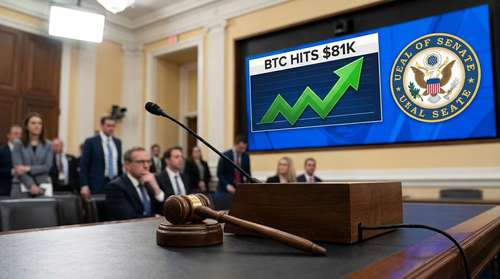
However, the successful markup of the Senate crypto bill served as a powerful counter-narrative, completely reversing the bearish momentum. Digital assets abruptly decoupled from traditional equity sell-offs. The flagship cryptocurrency surged to reclaim its footing, with the Bitcoin price $81k level proving remarkably resilient against heavy macroeconomic headwinds. Major altcoins followed suit, reinforcing the idea that legislative progress can offset traditional economic pressures within the blockchain ecosystem.
Fueling Institutional Digital Asset Adoption
Wall Street has long cited regulatory ambiguity as the primary barrier to entry for decentralized finance and wide-scale corporate tokenization. The advancement of the Digital Asset Market CLARITY Act directly addresses these deeply rooted institutional anxieties. The bill creates a functional safe harbor for network token originators and provides a clear mechanism to certify when entrepreneurial efforts have ended, allowing tokens to transition away from being heavily regulated securities.
This newly proposed legislative clarity is widely expected to serve as a massive accelerant for institutional digital asset adoption. Financial heavyweights now have a preliminary, legally binding blueprint for compliance. This framework allows banks and asset managers to confidently integrate digital commodities into their balance sheets and settlement operations without the looming threat of sudden regulatory penalties.
Furthermore, the bill's provisions for stablecoin regulation offer traditional financial institutions a structured, risk-mitigated pathway to utilize dollar-pegged assets. By clearly defining the operational boundaries for digital intermediaries, Congress is effectively signaling to Wall Street that the United States intends to remain the global capital for financial technology.
The Path Forward for US Crypto Legislation
While the committee vote marks an undeniable watershed moment, the journey toward final enactment remains politically complex. The legislation must now be reconciled and merged with similar structural text previously passed by the Senate Agriculture Committee. Once the provisions are unified into a single comprehensive package, the bill will face its most demanding test: a full Senate floor vote.
Passing the upper chamber will require a 60-vote supermajority to overcome standard procedural filibusters. This means the bill's sponsors must successfully court at least seven additional Democratic senators to ensure passage. Opposition remains fierce, with Senator Elizabeth Warren heavily criticizing the latest procedural maneuvers and maintaining her stance against what she views as lenient industry concessions.
Despite these upcoming hurdles, the initial bipartisan support indicates a rapidly shifting political tide in Washington regarding blockchain technology. For the time being, the cryptocurrency ecosystem is celebrating a hard-fought and historic legislative victory, confident that the United States is finally charting a definitive course toward a regulated, transparent, and globally competitive digital economy.