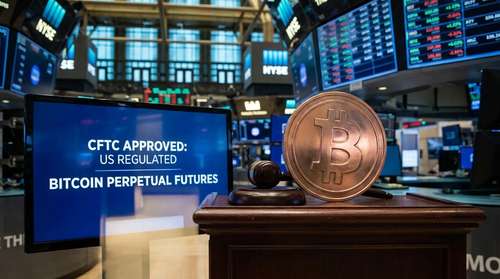
The U.S. derivatives landscape underwent a seismic shift on May 29, 2026, when regulators unlocked a domestic gateway to a $90 trillion global market. The historic approval of CFTC Bitcoin perpetual futures effectively onshores the most heavily traded asset class in the digital economy. After years of being sidelined or forced into regulatory gray areas, American investors now have formal access to these powerful trading instruments.
Following a highly anticipated review, the Commodity Futures Trading Commission greenlit the Kalshi BTCPERP contract, a perpetual futures product tied directly to the spot price of Bitcoin. Simultaneously, regulators granted Coinbase Financial Markets a crucial no-action letter. This dual-action approach ends the offshore monopoly previously held by unregulated platforms and instantly legitimized the domestic market, sending shares of domestic brokerages like Coinbase and Robinhood surging by 4% and 11%, respectively.
The Mechanics of the Kalshi BTCPERP Contract
Traditional futures contracts are bound by strict expiration dates, forcing traders to constantly roll over their positions. The newly approved Kalshi BTCPERP contract eliminates this friction. Acting as a cash-settled instrument that trades continuously 24/7, the product relies on the CF Benchmarks Bitcoin Real Time Index to track spot prices.
Instead of an expiration date, the contract maintains price parity with spot Bitcoin through a funding rate mechanism applied every eight hours. Kalshi CEO Tarek Mansour emphasized that this approval represents a major evolution for the company. 'Onshore, safe, and regulated perps will improve capital allocation and risk management for countless American businesses,' Mansour stated, highlighting the broader prediction market Kalshi expansion into a full-fledged next-generation derivatives exchange.
Coinbase, Deribit, and the Offshore Pipeline
While Kalshi took the direct listing route, Coinbase utilized a different regulatory framework to achieve a similar outcome. The CFTC's no-action letter permits Coinbase Financial Markets to route domestic traders to Deribit FZE, its Dubai-based affiliate. This establishes a compliant pipeline for Coinbase Deribit perpetuals US customers who previously had to jump through complex offshore hoops.
Coinbase acquired Deribit in 2025 in a massive $2.9 billion transaction, a strategic bet that is now paying significant dividends. By classifying these specific contracts as foreign futures, the CFTC effectively allows Coinbase to leverage Deribit's deep liquidity pool—which generated nearly $1.9 trillion in trading volume last year. The guidance also clarifies that futures commission merchants can accept customer-owned digital assets and payment stablecoins as margin, significantly reducing the friction of entering these leveraged trades.
Changing the Landscape of US Regulated Crypto Derivatives
This landmark policy shift fundamentally redefines US regulated crypto derivatives. Historically, centralized offshore exchanges and decentralized platforms captured the vast majority of perpetuals volume because domestic regulations outright banned them. The absence of a regulated domestic path led to fragmented infrastructure and split capital across multiple overseas venues.
By forcing the market to operate within a CFTC-regulated framework, institutions can deploy capital without the towering counterparty risks associated with unregulated overseas entities. The introduction of compliant onshore venues also poses a direct challenge to offshore giants and decentralized platforms like Hyperliquid, which built massive user bases largely due to the regulatory arbitrage that previously locked incumbents out of the market. Industry analysts note that retail brokerages like Robinhood are expected to fast-track similar services following this precedent-setting decision.
How to Trade Crypto Perps in US Markets
Retail and institutional traders are already asking how to trade crypto perps in US jurisdictions under the new rules. The landscape now offers two distinct avenues. On Kalshi, traders can interact directly with the BTCPERP product, buying and selling contracts in fractional units as small as 0.0001 BTC. The platform handles all compliance, reporting, and KYC requirements domestically.
Alternatively, eligible Coinbase users will soon find perpetual futures integrated directly into their existing trading interfaces. Rather than managing separate offshore accounts, institutional clients can immediately begin onboarding through Coinbase Financial Markets to access Deribit's global order books. Both options require strict adherence to CFTC leverage limits and margin controls, providing a domestic safety net that offshore platforms notoriously lack.
The Push for American Crypto Dominance
The driving force behind this rapid onshoring effort is CFTC Chairman Mike Selig. For months, the Mike Selig CFTC crypto strategy has focused on reversing the enforcement-heavy approach that previously dominated the agency. Selig has openly categorized perpetual contracts as a foundational risk management tool and framed the recent approvals as a fulfillment of President Donald Trump's mandate to establish America as the global crypto capital.
The agency is not stopping at Bitcoin. Kalshi has already indicated plans to pursue regulatory clearance for perpetuals tied to more than a dozen other cryptocurrencies. As liquidity inevitably migrates back to American shores, the massive global derivatives market is entering a mature, regulated phase that will dictate the next decade of digital finance.