
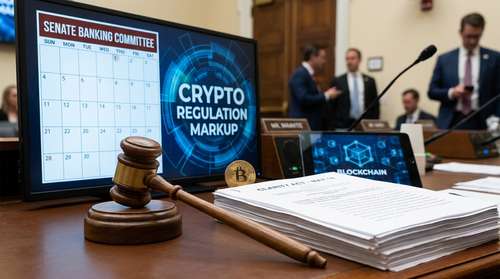
After months of grueling negotiations and partisan gridlock, the digital asset industry is on the verge of a monumental legislative breakthrough. The U.S. Senate Banking Committee has officially scheduled an executive session for May 14, 2026, to mark up the Digital Asset Market Clarity Act. Known as the CLARITY Act crypto bill, this comprehensive legislation represents the most significant attempt yet to establish a cohesive federal regulatory framework for the American digital asset sector. Following a breakthrough bipartisan compromise on stablecoin yield language, the upcoming Senate Banking Committee crypto vote could finally draw the elusive jurisdictional lines between federal financial regulators and serve as a massive Bitcoin price catalyst heading into the summer.
The Stablecoin Yield Compromise That Rescued the Bill
The primary roadblock stalling the Digital Asset Market Clarity Act since January was a fierce dispute over whether crypto platforms could offer interest on stablecoins. Last Friday, Senators Thom Tillis (R-N.C.) and Angela Alsobrooks (D-Md.) introduced legislative text that successfully threaded the needle. The new language strictly prohibits crypto firms from offering passive stablecoin yield that is "functionally or economically equivalent" to a traditional bank deposit.
However, the text preserves critical exemptions for reward programs tied to active network participation. Firms like Coinbase and Circle will still be able to offer incentives based on genuine platform activity, such as liquidity provision for market making, posting collateral, and staking.
The digital asset sector's reaction was swift and positive. Coinbase CEO Brian Armstrong, whose opposition helped stall earlier drafts, endorsed the new text with a concise demand: "Mark it up". Circle Chief Strategy Officer Dante Disparte praised the development as "meaningful progress," reflecting a broader industry consensus that advancing an imperfect U.S. crypto market structure bill is preferable to prolonged regulatory limbo.
Banking Industry Warns of Deposit Flight
While the crypto industry is celebrating, traditional financial institutions are mounting a rigorous pushback ahead of the markup. A powerful coalition of five major banking lobbies—including the American Bankers Association, the Bank Policy Institute, and the Consumer Bankers Association—warned lawmakers that the updated stablecoin regulation 2026 language still contains severe flaws.
The banking groups are specifically targeting Section 404 of the draft, which they argue creates a massive loophole. This section potentially allows crypto exchanges to pay yield through tiered user membership or loyalty programs, provided the payouts aren't explicitly structured like traditional bank interest. Financial associations argue that rewarding users based on duration, tenure, or account balances effectively incentivizes idle holding, defeating the core purpose of the prohibition.
The stakes for the traditional sector are exceptionally high. Industry research cited by the banking coalition indicates that a sudden deposit flight driven by yield-bearing stablecoins could slash consumer, agricultural, and small-business lending by up to one-fifth across the country. The lobbies have pledged to aggressively push for tighter language before the committee convenes in Room 538 of the Dirksen Senate Office Building on May 14.
Reshaping the Digital Asset Regulatory Framework
If passed, the CLARITY Act will fundamentally alter the operational reality for digital asset enterprises in the United States. Beyond stablecoin provisions, the legislation aims to decisively settle the long-standing turf war between the Securities and Exchange Commission (SEC) and the Commodity Futures Trading Commission (CFTC). By establishing clear statutory definitions, the bill would shift the U.S. away from the SEC's controversial "regulation-by-enforcement" approach toward a structured, workable compliance regime.
The digital asset regulatory framework will establish distinct registration and operational requirements for brokers, dealers, and exchanges serving American customers. It also introduces a tailored disclosure regime allowing responsible blockchain projects to raise capital while maintaining robust anti-fraud and consumer protection authorities. Furthermore, the legislation incorporates strict measures to combat illicit finance and sanctions evasion, addressing key national security concerns without driving legitimate crypto businesses offshore.
High Stakes and a Tightening Senate Clock
Despite the recent momentum, passing any major crypto legislation news into law this year remains a delicate balancing act. Senate Banking Subcommittee on Digital Assets Chair Cynthia Lummis recently issued a stark warning: if the Senate fails to advance the bill this year, the next realistic window for comprehensive federal legislation likely won't arrive until 2030.
The calendar is working against lawmakers. The committee must navigate the markup ahead of the Memorial Day recess, which begins on May 21. The political pressure has escalated dramatically, with Treasury Secretary Scott Bessent openly calling crypto executives who previously resisted compromises "nihilists" in a recent Wall Street Journal op-ed.
Financial analysts view the situation cautiously. In an April research note, Galaxy Digital estimated the odds of the CLARITY Act becoming law in 2026 at roughly 50-50, pointing to the sheer volume of unresolved technical questions facing a severely compressed legislative timeline. Polymarket bettors mirrored this sentiment, placing the probability of passage at around 48% late last week. Ultimately, the May 14 markup will be a definitive stress test for the industry's lobbying power and a potential turning point for the future of American finance.