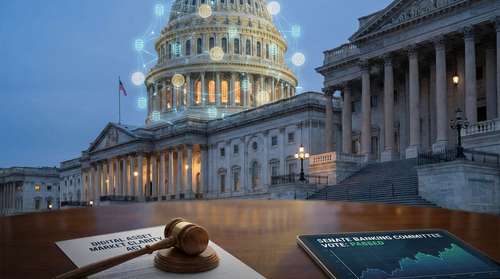
After years of navigating a hostile environment dominated by regulation by enforcement, the United States is officially on the precipice of a definitive crypto rulebook. In a landmark 15-9 bipartisan decision, the Senate Banking Committee officially voted to advance the Digital Asset Market Clarity Act (widely known as the CLARITY Act). Over the last 48 hours, the substitute text has officially begun its move toward a full Senate floor vote, marking the most substantive step toward comprehensive federal crypto legislation in American history.
The legislation, spearheaded by Banking Committee Chairman Tim Scott and unblocked by a recent bipartisan compromise on stablecoin yields, promises to overhaul the crypto regulatory framework US markets have struggled with for a decade. By drawing strict jurisdictional lines, introducing a pathway to commodity status, and protecting decentralized infrastructure, lawmakers are finally addressing the industry's loudest demands for clear operational guidelines.
Ending the SEC vs CFTC 2026 Turf War
For the better part of a decade, crypto enterprises have operated in a severe legal gray zone, caught in a relentless jurisdictional battle between two primary federal regulators. The Securities and Exchange Commission (SEC) and the Commodity Futures Trading Commission (CFTC) have frequently issued overlapping—and sometimes conflicting—claims over digital assets. This ambiguity drove major innovators offshore and left domestic companies at the mercy of sudden enforcement actions.
The Digital Asset Market Clarity Act directly neutralizes this conflict. It establishes a formal framework to categorize tokens, drawing a hard statutory boundary between what constitutes an investment contract and what qualifies as a digital commodity. By mandating a coordinated memorandum of understanding between the two agencies, the bill ensures that the SEC vs CFTC 2026 debate is settled through legislative clarity rather than competing lawsuits.
Companies launching new tokens will no longer have to guess which agency they must answer to. This foundational clarity is expected to significantly lower the barrier to entry for institutional capital, paving the way for Wall Street to interact safely with digital assets without fear of retroactive penalties.
The Critical Role of the Mature Blockchain Test
Perhaps the most transformative element to emerge from this Senate Banking Committee crypto vote is the formal introduction of the mature blockchain test. This specific threshold determines precisely when a digital asset transitions out of the SEC's stringent securities purview and into the CFTC's digital commodities jurisdiction.
Under the proposed legislation, if a blockchain network becomes sufficiently decentralized—meaning no single centralized entity, person, or coordinated group exerts control over its core functionality—the native token is no longer classified as a security. The bill utilizes the concept of ancillary assets, allowing an originator to certify with reasonable evidence that their network's entrepreneurial or managerial efforts have ceased.
This mechanism is a massive victory for older, established networks. Market participants have long argued that tokens can start as securities during initial fundraising but organically evolve into commodities as their networks distribute globally. The mature blockchain test codifies this evolution. Networks with long operating histories and distributed validator sets are widely expected to pass this test quickly, shielding them from endless litigation and solidifying their status as digital commodities.
Establishing a DeFi Legal Safe Harbor
Beyond asset classification, lawmakers tackled one of the most technically complex aspects of the modern blockchain ecosystem: decentralized finance. Prior legislative drafts terrified the tech community by threatening to treat independent software developers and node operators as traditional financial brokers. Such a mandate would have effectively criminalized permissionless blockchain development within U.S. borders.
The advanced bill rectifies this by introducing a non-decentralized protocol test that serves as a highly anticipated DeFi legal safe harbor. The legislation explicitly acknowledges that decentralized governance protocols are not corporate entities or coordinated groups.
More importantly, it exempts core infrastructure providers—such as network validators, routing nodes, and non-custodial software developers—from being classified as regulated financial intermediaries. By separating the underlying technical infrastructure from front-end financial services, the United States is signaling that it intends to remain a global hub for Web3 innovation.
Unblocking the Stablecoin Stalemate
It is worth noting that the CLARITY Act almost stalled permanently in committee. For months, the legislation faced friction over heated debates regarding stablecoin yields. Traditional banks lobbied aggressively against allowing crypto firms to pay interest on stablecoin balances, fearing a mass exodus of retail deposits. The logjam finally broke when Senators Thom Tillis and Angela Alsobrooks forged a crucial bipartisan compromise.
The resulting agreement prohibits yield structures that mimic traditional passive banking deposits but permits rewards tied directly to the active, on-chain use of stablecoins. This buy and use exception appeased both banking advocates and digital asset proponents, clearing the path for the committee's historic vote.
What's Next for Federal Crypto Legislation?
While the committee approval is a monumental milestone, the Digital Asset Market Clarity Act still faces a rigorous legislative gauntlet. The substitute text must now be reconciled with similar market structure frameworks originating from the Senate Agriculture Committee. Following that, it requires 60 votes to overcome a filibuster on the deeply divided Senate floor.
If it clears the Senate, the legislation will merge with the companion version that passed the House of Representatives with a commanding 294-134 bipartisan majority in July 2025.
The timeline remains fragile, but the momentum is undeniable. With the 2026 midterm elections looming, lawmakers are increasingly eager to demonstrate legislative competence and capture the growing demographic of pro-crypto voters. For now, the digital asset industry is watching closely. The foundation for a transparent, innovation-friendly regulatory landscape has finally been poured; Congress just needs to finish building the house.