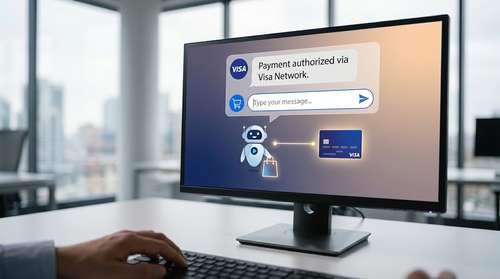
The line between digital assistant and financial proxy has officially been erased. Announced at the Visa Payments Forum in San Francisco on June 10, 2026, a groundbreaking Visa ChatGPT integration is set to fundamentally rewire how consumers and businesses interact with the digital economy. By directly plugging its global payment infrastructure into OpenAI's flagship conversational platform, Visa is enabling fully autonomous AI transactions. No longer restricted to merely suggesting products, drafting travel itineraries, or summarizing reviews, ChatGPT can now securely locate, select, and execute purchases across any global merchant that accepts Visa.
The Dawn of Agentic Commerce 2026
The transition from generative AI that simply creates content to "agentic AI" that takes concrete actions is the defining technological shift of the year. The highly anticipated OpenAI Visa partnership serves as the critical financial bridge making this reality possible. During his keynote address, Jack Forestell, Chief Product and Strategy Officer at Visa, underscored the magnitude of this evolution.
"AI will transform commerce more profoundly than the internet or mobile technology ever did," Forestell stated to the gathering of financial institutions and fintech developers. "As AI agents become active participants in the economy, Visa's focus is to ensure transactions are trusted, secure, and seamless."
For everyday users, this paradigm shift introduces the era of AI shopping agents. Imagine instructing ChatGPT to monitor airline pricing for a European vacation and authorizing it to book the best multi-city flight the moment fares drop below a certain threshold. Alternatively, a household could deploy an agent to automatically replenish groceries from preferred local retailers whenever inventory software flags a shortage. The AI handles the entire discovery and checkout process independently, dramatically reducing consumer friction.
Powering the Network: Visa Intelligent Commerce
Handing a credit card to an algorithmic bot naturally raises severe security and liability concerns. To address this friction, the payments giant introduced Visa Intelligent Commerce, a purpose-built foundation designed specifically for agent-driven digital ecosystems. This framework provides the underlying architecture necessary for safe, scalable ChatGPT shop and pay functionalities without compromising sensitive consumer data.
Rather than exposing raw primary account numbers to an AI model, the new system utilizes highly advanced tokenized Visa credentials. When an agent initiates a purchase, it uses a unique digital identifier that is meaningless if intercepted, ensuring the core financial data remains locked away securely.
Setting Strict Guardrails for Autonomous AI Transactions
A crucial element of this integration is that control remains entirely in the hands of the human account holder. The newly deployed infrastructure operates under strict, user-defined parameters. Shoppers can establish robust guardrails for their AI counterparts, including:
- Hard spending limits: Setting maximum thresholds per individual transaction, daily spend, or overall monthly budget.
- Restricted merchant categories: Whitelisting or blacklisting specific sectors, such as allowing travel bookings but actively blocking electronics or cryptocurrency purchases.
- Mandatory approval triggers: Requiring explicit biometric or one-tap human authorization on a smartphone for any purchase exceeding a designated dollar amount.
Coupled with real-time authorization and continuous fraud monitoring, these proactive measures ensure that a digital proxy operates strictly within its designated boundaries.
Agent Scoring and Large Transaction Models
To further fortify the network, Visa revealed complex back-end innovations at the June forum to support these front-end commerce experiences. The company introduced innovative "Agent Score" metrics and an "Agentic Registry." These proprietary tools evaluate the behavioral legitimacy of an AI request in milliseconds. By cross-referencing requests against new Large Transaction Models—AI systems trained specifically on global payment flows—Visa can instantly differentiate between a legitimate autonomous purchase and a malicious anomaly.
Beyond Retail: A Broader Vision for Developers and Enterprise
While consumer retail applications dominate public attention, the collaboration extends deep into enterprise architecture. Visa and OpenAI are actively developing secure payment capabilities tailored for complex business-to-business environments and automated conversational workflows.
By integrating payment rails directly with OpenAI's Codex, developers are gaining a streamlined method for building custom corporate applications. Marco Mahrus, Head of Partnerships at OpenAI, noted that agents will play an increasingly vital role in executing complex corporate purchasing workflows. An enterprise could, for instance, deploy AI to independently negotiate vendor rates for cloud servers or raw materials and immediately execute the contract payment once terms are met, completely bypassing traditional procurement bottlenecks.
The integration of Visa's unrivaled global settlement network with OpenAI's sophisticated reasoning engines marks the true beginning of the autonomous economy. As the infrastructure rolls out to merchants and developers globally, the concept of manually clicking "buy" may soon feel as antiquated as writing a physical check.