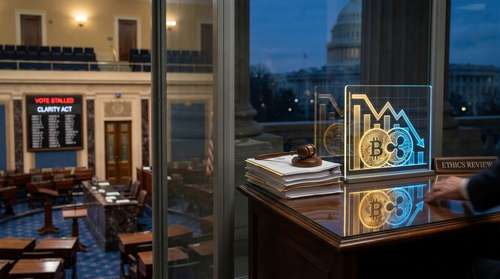

The cryptocurrency market has witnessed its fair share of staggering financial shifts, but few match the symmetrical precision of a recent discovery. According to a bombshell Reuters Trump crypto investigation published this week, the family of U.S. President Donald Trump has engineered an unprecedented financial maneuver. From November 2024 through April 2026, Trump crypto profits soared to an estimated $2.3 billion. Coincidentally, the over one million everyday buyers who backed these political-brand projects experienced retail investor crypto losses totaling precisely the same amount: $2.3 billion.
The staggering figures represent what ethics experts are calling a historic Trump family wealth transfer, executed with minimal upfront capital. Through strategic licensing deals, governance token launches, and sheer brand power, the administration's inner circle managed to extract massive wealth while leaving ordinary supporters bearing the risk of collapsing assets.
The Mechanics of a $2.3 Billion Financial Siphon
The blueprint for the Donald Trump cryptocurrency empire relies on a highly asymmetrical risk structure. Journalists and blockchain analysts discovered that the Trump family consistently contributed minimal personal funds. Instead, figures like Eric Trump and Donald Trump Jr. actively promoted the ventures, drawing upon a massive base of political supporters eager to buy in.
To grasp the sheer scale of this operation, one must compare it to the bedrock infrastructure of the digital asset industry. During the exact same post-election period, major exchange Coinbase reported $2.1 billion in income, while BlackRock's spot Bitcoin ETF business generated an estimated $109 million. However, unlike Coinbase, the Trump ventures did not spend years building deep liquidity, secure market infrastructure, or compliance frameworks. Once retail liquidity entered the ecosystem, the family extracted massive returns through pre-arranged revenue-sharing agreements and token allocations.
World Liberty Financial WLFI and the Illusion of Governance
The flagship enterprise of this operation is World Liberty Financial WLFI, a decentralized finance protocol launched in September 2024. The platform's structure guaranteed the Trump family a 75% cut of net token sales and stablecoin proceeds, alongside a 60% controlling equity stake.
While the family raked in over $1.4 billion from the venture, ordinary buyers faced a vastly different reality. The platform's governance token launched at around $0.31 but has since steadily declined to just $0.05. Because these tokens primarily offered voting rights rather than a direct claim to platform revenues, early buyers found themselves locked into an asset with rapidly depreciating value. Overall, WLFI holders absorbed roughly $674 million in pure market losses.
The controversy surrounding WLFI extends well beyond retail losses. Blockchain billionaire Justin Sun filed a lawsuit against the venture in April 2026, alleging his tokens were illegally frozen—an accusation World Liberty Financial dismissed as a smear campaign before countersuing for defamation. Furthermore, reports surfaced in 2025 that a firm associated with the Abu Dhabi government secretly purchased a 49% stake in the company for half a billion dollars. Such maneuvers have raised alarms among ethics watchdogs regarding foreign influence intermingling with the administration's financial platforms.
Severe TRUMP Memecoin Losses and Crashing Equities
The speculative frenzy wasn't limited to decentralized finance. The political brand also fueled severe TRUMP memecoin losses. Driven by social media hype surrounding the return to the White House, the $TRUMP token saw its price temporarily spike before losing 97% of its value.
Reuters highlighted the story of ordinary buyers like a California-based software engineer who invested $2,000 in the meme coin, only to watch her portfolio shrink to less than $120 by late May 2026. In total, the meme coin project funneled an estimated $616 million to the Trump family while saddling retail participants with over $700 million in negative equity.
Publicly traded equities associated with the family followed an identical trajectory. Shares of ALT5 Sigma—later rebranded as AI Financial Corp—plummeted from over $9 down to $0.75, erasing $675 million in retail value. American Bitcoin, another affiliated enterprise, saw its stock price crater from $11 to $1.15, wiping out an additional $200 million for shareholders.
Regulatory Scrutiny Looms Over the Crypto Capital
The ethical implications of an active administration profiting massively from an industry it directly regulates have ignited fierce debate in Washington. Lawmakers, including Senator Elizabeth Warren, are actively pressing the Securities and Exchange Commission (SEC) to launch a formal inquiry into the ventures. Adding fuel to the fire, the president's 2025 pardoning of former Binance CEO Changpeng Zhao has drawn intense scrutiny, particularly after the exchange reportedly helped facilitate transactions that enriched World Liberty Financial.
Defenders of the business model argue that digital asset speculation inherently carries severe risks. Wilbur Ross, who served as Commerce Secretary during the first Trump administration, noted that buyers of speculative assets must understand the inherent volatility. "If people are buying something speculative, they should understand the risk," Ross stated.
Despite these defenses, the sheer scale of the capital extraction remains a defining moment for modern digital finance. As the administration continues to position the United States as a global blockchain hub, the stark juxtaposition of billionaire family profits against devastated retail portfolios casts a long, unresolved shadow over the sector's regulatory future.