
The era of regulation by enforcement in the digital asset space appears to be drawing to a definitive close. On May 19, 2026, President Trump signed a landmark directive titled Integrating Financial Technology Innovation into Regulatory Frameworks. This sweeping Trump crypto executive order formally directs federal financial regulators to dismantle outdated barriers that have historically blocked digital assets from seamlessly integrating into the traditional U.S. banking system. After years of friction between the cryptocurrency industry and Washington, the White House is pivoting sharply toward domestic innovation, signaling a massive overhaul of federal bitcoin policy and digital asset oversight.
Decoding the Trump Crypto Executive Order
For years, digital asset providers and fintech innovators have struggled against fragmented supervisory practices that effectively walled them off from traditional finance. The May 19 mandate specifically targets these bottlenecks. The executive order instructs key federal regulators, including the Federal Reserve, to reassess long-standing policies that prevent non-bank innovators from accessing critical payment infrastructures and Federal Reserve master accounts.
By officially characterizing incumbent financial protections as overly burdensome, the administration is forcing a structural reboot. Regulators are now under strict marching orders to foster direct collaboration between traditional federally regulated institutions and emerging fintech firms. This strategic shift not only normalizes crypto services but establishes a cohesive federal bitcoin policy designed to position the United States as the undeniable center of global digital finance, echoing the administration's earlier pledges to build a strategic domestic stockpile.
Project Crypto Deregulation and the SEC Regulatory Pivot
The executive order is the capstone of a broader administration strategy that began gaining momentum earlier this year. Central to this transformation is the SEC regulatory pivot, driven by agency leadership eager to shed the commission's former reputation as a persistent roadblock to technological innovation.
Spearheaded under the banner of Project Crypto deregulation, the Securities and Exchange Commission is actively moving away from its historically aggressive litigation strategy. Instead of relying on costly court battles and surprise subpoenas to define market rules, the agency is now focusing on modernizing securities laws to accommodate unique blockchain architectures. This pivot has already catalyzed significant victories for the industry, such as the systematic dismantling of restrictive accounting mandates like SAB 121, which previously made it prohibitively expensive for commercial banks to custody digital assets. By replacing the threat of prosecution with clear regulatory guidelines, the federal government is laying out the welcome mat for institutional capital.
Rebuilding Trust with Capital Markets
Institutional investors have long cited regulatory ambiguity as their primary barrier to entry. With the administration mandating a functional, transparent framework, sidelined institutional capital is already beginning to flow into digital asset ventures. Pension funds, asset managers, and corporate treasuries are moving forward with confidence, recognizing that the government is prioritizing market growth and integration over blanket penalization.
CLARITY Act Senate Update: Redefining Digital Asset Market Structure
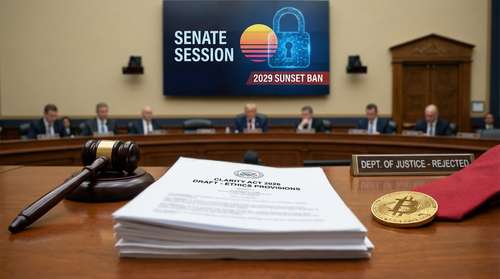
While the White House uses executive authority to reshape agency behavior, lawmakers on Capitol Hill are busy cementing these structural changes into law. The most critical legislative development occurred on May 14, 2026, when the Senate Banking Committee voted 15 to 9 to advance the Digital Asset Market Clarity Act (H.R. 3633).
This pivotal CLARITY Act Senate update represents a bipartisan breakthrough, with two Democrats crossing the aisle to join Republicans in pushing the bill toward a full floor vote. The legislation is designed to fundamentally overhaul the digital asset market structure by drawing hard jurisdictional lines between the SEC and the Commodity Futures Trading Commission (CFTC). One of the most anticipated features of the bill is the mature blockchain test, a mechanism allowing tokens to transition from securities classification under SEC oversight to digital commodities regulated exclusively by the CFTC once their underlying network achieves sufficient decentralization.
What This Means for US Crypto Regulation 2026
The combined force of executive action and legislative momentum has effectively ended the regulatory purgatory that previously forced a staggering 88 percent of centralized exchange volume offshore. US crypto regulation 2026 is no longer defined by agency turf wars. Instead, the focus has shifted toward codifying sensible anti-money laundering requirements, bringing crypto kiosks into compliance, and offering domestic developers a predictable, secure legal environment.
If the CLARITY Act successfully navigates the full Senate and reaches the President's desk, the statutory rulebook will finally match the administration's pro-innovation rhetoric. Market participants face a rapidly accelerating transition period. Centralized exchanges will need to adapt to new federal registration regimes under the CFTC, while truly decentralized protocols operate under clearer exemptions. Ultimately, this relentless push to legitimize blockchain technology has transformed Washington from the industry's biggest adversary into its most powerful growth catalyst.