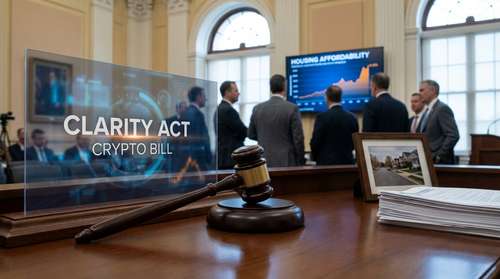
The U.S. Senate Banking Committee has officially postponed its consideration of the landmark crypto market structure bill, pushing the timeline for regulatory clarity into late February or March 2026. This latest Senate crypto bill delay comes as lawmakers pivot their immediate focus toward President Donald Trump’s new housing affordability agenda, specifically targeting restrictions on institutional real estate purchases. The move has frustrated industry leaders who were expecting a decisive markup of the Digital Asset Market Clarity Act (CLARITY Act) this week, leaving the future of US digital asset regulation in a state of heightened uncertainty.
Housing Shift Derails Crypto Market Structure Legislation 2026
In a sudden legislative pivot, the Senate Banking Committee has shelved the much-anticipated markup of the CLARITY Act to prioritize a sweeping housing reform package. Sources close to the Committee indicate that the delay was precipitated by an urgent request from the White House to fast-track legislation curbing "predatory investing" in the housing market. The proposed housing measures aim to ban large institutional investors—such as private equity firms and hedge funds—from purchasing single-family homes, a key pillar of the administration's strategy to lower costs for American families.
This shift has effectively bumped the crypto market structure legislation 2026 from the calendar, despite months of bipartisan negotiation. "The housing affordability crisis is sucking all the oxygen out of the room," noted one legislative aide. "Crypto is still a priority, but the administration sees the housing ban as a critical win needed immediately." For the digital asset industry, however, this means the window for passing comprehensive regulation before the mid-term campaign season heats up is narrowing dangerously.
The Hidden Friction: Banks vs. Stablecoins
While the housing pivot provides a convenient political reason for the delay, insiders suggest that deep-seated policy disagreements were already stalling the bill. Earlier in January, major industry players, including Coinbase, withdrew their support for the draft legislation, citing provisions that would have effectively banned stablecoin issuers from offering yield or rewards to users. This controversial clause was reportedly inserted at the behest of the banking lobby, which argued that interest-bearing stablecoins would drain deposits from community banks.
Coinbase CEO Brian Armstrong publicly criticized the draft, stating that "no bill is better than a bad bill," a sentiment that resonated across the sector. The withdrawal of industry support left the CLARITY Act status in limbo even before the housing agenda took center stage. The delay now buys lawmakers time to potentially renegotiate these contentious stablecoin provisions, though the banking lobby shows few signs of backing down. The conflict highlights the immense difficulty of crafting cryptovot regulation that satisfies both traditional financial institutions and crypto natives.
Defining the Rules: SEC vs CFTC Jurisdiction
At the heart of the delayed bill is the critical issue of SEC vs CFTC jurisdiction. The CLARITY Act aims to finally solve the regulatory turf war by establishing a clear two-part framework: digital assets that are sufficiently decentralized would be treated as commodities under the Commodity Futures Trading Commission (CFTC), while those that function as investment contracts would remain under the Securities and Exchange Commission (SEC).
The bill proposes a certification process where tokens can graduate from SEC oversight to the CFTC regime once they prove their blockchain networks are decentralized. This framework is viewed as essential for ending the "regulation by enforcement" era that has characterized US digital asset regulation for years. Without this legislative fix, crypto projects remain vulnerable to aggressive SEC lawsuits, and the U.S. risks continuing to lose market share to more regulatory-friendly jurisdictions like the EU and UK.
Senate Banking Committee Crypto News: What Comes Next?
Despite the setback in the Banking Committee, the legislative process hasn't ground to a complete halt. The Senate Agriculture Committee, led by Chair John Boozman, is still scheduled to hold a hearing on its portion of the market structure bill on January 27. However, because any final law must merge the Banking Committee's securities language with the Agriculture Committee's commodities language, the Banking Committee's delay effectively stalls the entire package.
The New Timeline
Stakeholders are now eyeing a new window in late February or early March for the Banking Committee to return to the table. This timeline would allow the Senate to address the urgent housing legislation first. However, if the Senate crypto bill delay stretches into April, the chances of passing the bill in 2026 diminish significantly as the congressional focus shifts entirely to the upcoming elections. For now, the industry must wait and see if the extra time can be used to fix the stablecoin yield issue or if the housing pivot marks the beginning of the end for this Congress's crypto ambitions.