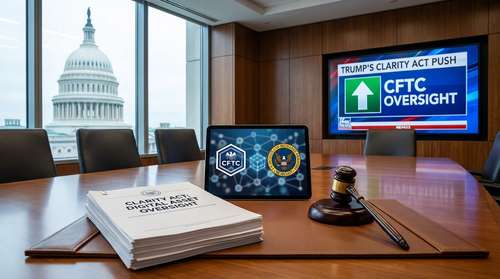
President Donald Trump is doubling down on his campaign promise to make the United States the "crypto capital of the planet," initiating a decisive final push this week to pass the Digital Asset Market Clarity Act (CLARITY Act). In a high-stakes move that signals a historic pivot in U.S. financial policy, the administration is reportedly accelerating efforts to transfer primary regulatory authority over digital assets from the Securities and Exchange Commission (SEC) to the Commodity Futures Trading Commission (CFTC). This strategic overhaul, which aims to classify major cryptocurrencies like Bitcoin and Ethereum as commodities, represents the most significant Trump crypto regulation shift to date, potentially ending years of jurisdictional ambiguity.
The Clarity Act: Ending the 'Regulation by Enforcement' Era
At the heart of this legislative blitz is the Clarity Act, a comprehensive bill designed to dismantle the aggressive "regulation by enforcement" approach that characterized the previous SEC regime. Sources close to the White House indicate that the President has directed Treasury Secretary Scott Bessent to prioritize the bill's passage through a gridlocked Senate before the summer recess.
The proposed legislation establishes a definitive "digital commodity" classification, effectively placing the vast majority of cryptocurrencies under the purview of the CFTC. This change is not merely semantic; it fundamentally alters the compliance landscape for institutional investors. By clearly defining digital assets as commodities rather than securities, the Act would grant the CFTC exclusive jurisdiction over spot markets, a move long demanded by industry leaders to foster innovation without fear of retroactive lawsuits.
SEC vs CFTC: A New Era of Harmonization
The transition is already underway at the agency level, marked by an unprecedented alignment between historically rival regulators. In a stark departure from the adversarial relationship of the past, newly appointed SEC Chair Paul Atkins and CFTC Chair Michael Selig have launched joint initiatives to streamline oversight. Their "Project Crypto" and "Crypto Sprint" collaborations, announced earlier this year, are now being fast-tracked to support the Clarity Act’s implementation.
"We are moving from a posture of prohibition to one of permission," Chair Selig stated in a press briefing on Monday. "The CFTC is ready to provide the robust, pro-innovation oversight that this trillion-dollar market deserves." This SEC vs CFTC news confirms that the administration is successfully dismantling the bureaucratic silos that previously stifled U.S. crypto adoption.
Institutional Digital Assets Poised for Growth
Wall Street has reacted swiftly to these developments. Major financial institutions, including JPMorgan and BlackRock, have issued revised forecasts for the second half of 2026, predicting a surge in institutional digital assets adoption should the bill pass. JPMorgan analysts noted on Tuesday that the clarity provided by the new legal framework could "unlock tens of billions in sidelined capital," as pension funds and insurance giants finally gain the regulatory certainty required to enter the market.
Breaking the Senate Deadlock: The Stablecoin Yield Debate
Despite the momentum, significant hurdles remain. The Clarity Act digital assets framework faces stiff resistance in the Senate Banking Committee, where a fierce debate over stablecoin yields threatens to stall progress. Traditional banking lobbyists are arguing that allowing non-bank stablecoin issuers to offer yield-bearing accounts could siphon deposits from community banks, destabilizing the traditional financial system.
To break this impasse, the Trump administration hosted a series of emergency roundtables at the White House over the weekend. Insiders report that a compromise is taking shape: a tiered regulatory system that would allow stablecoin issuers to offer yields only if they meet strict, bank-like capital requirements. This concession could be the key to securing the bipartisan support needed to bring the US crypto policy shift to fruition by mid-2026.
The Path Forward: What to Expect in 2026
As negotiations enter their final phase, the stakes for the global crypto economy could not be higher. A successful passage of the Clarity Act would not only legitimize the industry in the eyes of U.S. lawmakers but also set a global standard for cryptocurrency legal framework development.
Market participants should prepare for a volatile few weeks as the final details are hammered out. However, the overarching trend is undeniable: the U.S. is moving decisively toward a regulated, commodities-based model for digital assets. For investors and innovators alike, the message from Washington is clear—the era of uncertainty is ending, and the era of institutional adoption is just beginning.