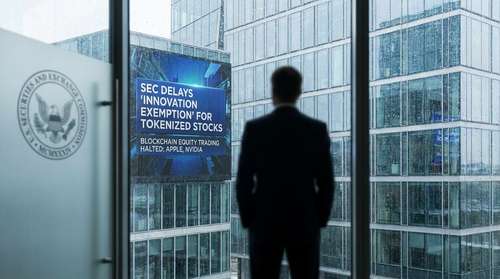
The U.S. Securities and Exchange Commission has officially slammed the brakes on a landmark regulatory shift that would have fundamentally reshaped digital asset markets. Originally expected to launch this week, the SEC's highly anticipated innovation exemption for tokenized equities has been indefinitely delayed. The decision effectively shelves immediate plans to allow digital versions of major tech equities, including tokenized Apple stock and Nvidia shares, to trade seamlessly on decentralized platforms.
The pause marks a significant bottleneck for SEC Chair Paul Atkins and his broader "Project Crypto" initiative, which aimed to loosen existing constraints on the digital asset sector. As traditional finance giants and crypto-native platforms clash over market structure, the delay highlights the complex realities of migrating Wall Street onto blockchain rails.
The Ambition Behind Blockchain Equity Trading
The core concept of the innovation exemption was to create a specialized regulatory sandbox. This framework would have allowed qualified third parties to mint and trade SEC tokenized stocks on blockchain networks without the heavy compliance burden traditionally required for standard securities offerings. For retail investors, the appeal was obvious: 24/7 fractional trading, instant settlement, and the ability to hold traditional equities in self-custodied digital wallets.
Under the initial draft championed by Paul Atkins, crypto platforms could potentially list third-party wrappers of publicly traded giants without needing direct consent from the underlying issuers. However, bringing trillion-dollar assets into decentralized stock markets proved too controversial for an accelerated rollout.
Why the Innovation Exemption Delay Happened
The primary catalyst for the Innovation Exemption delay was fierce pushback from established traditional financial institutions. Stock exchange officials, alongside groups like the World Federation of Exchanges (WFE)—which represents the New York Stock Exchange and Nasdaq—raised immediate red flags over market mechanics.
Their central argument focused on the dangers of liquidity fragmentation. If the same equity is simultaneously traded across multiple blockchains and decentralized exchanges, the unified order flow that guarantees tight bid-ask spreads on Wall Street would disperse. This fragmentation could lead to significant price discrepancies across different venues, increased slippage for institutional investors, and overall market inefficiency.
The Revenue Threat to Traditional Venues
Beyond liquidity concerns, traditional exchanges face an existential threat regarding revenue capture. Shifting trading volume from centralized domestic exchanges to decentralized, borderless platforms directly undercuts the lucrative transaction fees that legacy institutions rely upon. Consequently, the SEC found itself caught between fostering domestic crypto innovation and protecting the established market structure.
Hester Peirce's Stance: A Strict Ban on Synthetics
As the framework headed back to the drawing board, SEC Commissioner Hester Peirce took to social media late this week to clarify the agency's boundaries. Peirce, a well-known crypto ally, tempered industry expectations by stating that any eventual exemption would remain firmly limited in scope.
Peirce emphasized that the SEC will only tolerate digital representations of actual underlying equities. Synthetic tokens—derivatives that merely track the price performance of a stock without being backed by real shares—are completely excluded from the proposal. For a tokenized security to qualify, it must preserve fundamental shareholder rights, including voting capabilities and dividend distributions.
This strict requirement presents a massive technical hurdle. Distributing traditional dividends to pseudonymous wallet addresses on a blockchain network introduces severe Know Your Customer (KYC) and Anti-Money Laundering (AML) challenges that the crypto industry has yet to fully solve.
What This Means for Crypto Regulation in 2026
The current pause does not mean the end of blockchain equity trading. Instead, it signals a shift toward a more cautious, deeply regulated integration of decentralized finance. Crypto-native tokenization firms like Securitize, Ondo, and Superstate have actually voiced support for the SEC's stringent stance on synthetics, recognizing that working within compliance frameworks is the only sustainable path forward.
Looking ahead, crypto regulation 2026 will likely focus on closing the gap between decentralized innovation and investor protection. The SEC is now expected to demand integrated transfer agent functions that can maintain official shareholder records directly on-chain before giving the green light.
While the dream of trading tokenized Apple stock on a decentralized exchange this month has faded, the structural groundwork is still being laid. Traditional finance is aggressively guarding its territory, but the eventual collision between Wall Street and blockchain technology remains inevitable.