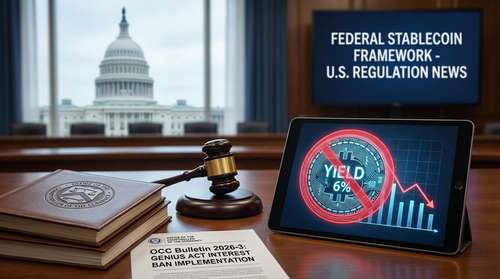
The ceasefire is over, and the Great Stablecoin Yield Battle has officially begun. On Wednesday, the Office of the Comptroller of the Currency (OCC) dropped a regulatory hammer that sent shockwaves through the crypto industry: OCC Bulletin 2026-3. This massive 376-page Notice of Proposed Rulemaking (NPRM) aims to close the so-called "affiliate loophole" in the GENIUS Act stablecoin regulation, a move that could permanently alter the economics of digital assets in the United States. If finalized, the rule would strictly enforce the stablecoin yield ban 2026 mandates, targeting not just issuers but the complex webs of third-party rewards that have kept crypto yields alive.
The "Rebuttable Presumption": Closing the Loophole
At the heart of the new proposal is a mechanism designed to catch evasion attempts: the "rebuttable presumption." Since the Guiding and Establishing National Innovation for U.S. Stablecoins (GENIUS) Act was signed into law by President Trump on July 18, 2025, payment stablecoin issuer requirements have explicitly forbidden issuers from paying interest directly to token holders. The goal was to prevent stablecoins from functioning as unregulated, uninsured savings accounts.
However, the crypto industry quickly adapted. Issuers stopped paying yield directly but struck revenue-sharing deals with exchanges and affiliates, who then passed "rewards" on to users. The OCC's new rule attacks this practice head-on. Under the proposal, the regulator will presume a violation exists if two conditions are met:
- The issuer pays yield or revenue to an affiliate or third party.
- That third party pays yield to token holders solely for holding the coin.
This "transitive property" of prohibition means the crypto interest prohibition lobby—which argued these arrangements were legal distinct services—now faces a steep uphill battle. Unless they can prove these payments are completely unrelated, the arrangement is dead.
GENIUS Act Implementation: A New Era for U.S. Crypto Regulation News
The release of this NPRM marks a critical phase in the federal stablecoin framework. For months, the industry has operated in a gray zone, waiting to see how aggressive regulators would be in implementing the GENIUS Act. We now have our answer. Comptroller Jonathan Gould stated that while the OCC wants the industry to flourish, it will not tolerate "regulatory arbitrage" that mimics banking activities without banking safeguards.
Beyond the yield ban, the proposal outlines stringent capital standards. New entrants will face a $5 million minimum capital floor, and all issuers must adhere to a strict "capital and operational backstop." These rules are designed to ensure that if a stablecoin issuer fails, it does so without triggering a systemic contagion event similar to the collapses seen in the early 2020s.
Banks vs. Crypto: The Lobbying War Intensifies
The reaction to the proposal has been starkly divided, reigniting the friction between Wall Street and Web3. The American Bankers Association (ABA) has publicly applauded the move. For traditional banks, the GENIUS Act stablecoin regulation was supposed to level the playing field. They argued that stablecoin issuers were effectively taking deposits and paying interest without paying into the FDIC insurance fund or adhering to the Community Reinvestment Act.
Conversely, crypto advocacy groups are mobilizing for a fight during the 60-day comment period. Major stablecoin issuers argue that the OCC is overstepping its authority by regulating third-party commercial relationships. They contend that this broad interpretation of the interest ban stifles innovation and will drive American crypto innovation offshore—a common refrain in U.S. crypto regulation news.
What This Means for Your Portfolio
For the average investor, the days of passive, risk-free stablecoin yield may be numbered. If this rule passes in its current form later in 2026, the "4% APY on USDC" offers currently available on many partner platforms could vanish overnight. The OCC has made it clear: if it looks like interest, and acts like interest, it will be regulated (and likely banned) like interest.
However, the proposal does leave a narrow path forward. Genuine "proof-of-stake" rewards or yields derived from decentralized finance (DeFi) protocols where the issuer has no direct commercial arrangement might still fall outside the scope. But for centralized payment stablecoin issuer requirements, the walls are closing in.
Looking Ahead: The 60-Day Countdown
The clock is now ticking. Industry stakeholders have until late April to submit comments. Legal experts anticipate a flood of challenges questioning the OCC's statutory authority to regulate downstream affiliates. Yet, with the GENIUS Act providing a robust statutory basis for federal oversight, the regulators appear confident.
As we move deeper into 2026, the OCC Bulletin 2026-3 will likely be remembered as the moment the U.S. government finally drew a hard line in the digital sand. Whether that line protects consumers or strangles an industry remains the billion-dollar question.