
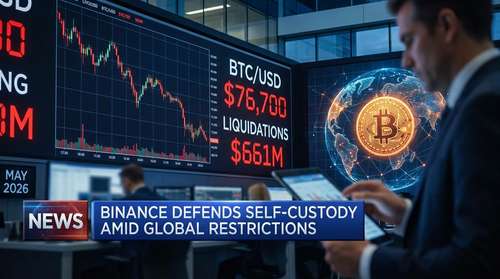
The cryptocurrency ecosystem is facing intense downward pressure today as the severe Bitcoin price crash May 2026 sends shockwaves across global trading desks. Plunging to a two-week low of $76,700 early Thursday morning, the sudden market downturn violently wiped out highly leveraged positions, resulting in more than $661 million in crypto market liquidations today. Yet beyond the flashing red charts, a fierce regulatory battle is unfolding. While regional exchanges quietly freeze customer assets citing legal ambiguity, Binance is taking a highly controversial stand by maintaining open withdrawal channels to private wallets.
The Anatomy of the $661M Flash Crash
Market volatility returned with a vengeance this week. Bitcoin's inability to hold support above the crucial $80,000 psychological level triggered a massive cascade of automated sell-offs. According to on-chain analytics, the bulk of the $661 million wiped from the market overnight came from over-leveraged long positions held by retail traders anticipating a rapid price recovery. Once the $78,000 defense line broke, liquidation engines on major derivative platforms forced market sell orders, accelerating the downward spiral.
Institutional exhaustion has heavily compounded the retail panic. Recent market filings reveal a sharp pivot in sentiment, driven primarily by consecutive days of heavy Bitcoin ETF outflows 2026. Wall Street's appetite for spot digital asset funds has temporarily cooled amidst shifting macroeconomic policies, depriving the market of the constant buy-side pressure that characterized the early months of the year. Without institutional capital absorbing the retail sell-off, price discovery plummeted.
Binance Withdrawal Policy 2026: A Defiant Stance
While the sudden price drop dominates mainstream financial headlines, an equally critical development is playing out behind the scenes regarding user access to funds. Several localized cryptocurrency platforms have paused external transfers, effectively trapping users' capital during a period of extreme volatility. In stark contrast, the newly solidified Binance withdrawal policy 2026 mandates continuous, uninterrupted off-ramps to decentralized wallets.
This decision puts the world's largest digital asset exchange on a direct collision course with regional financial authorities who prefer the strict ring-fencing of assets during market turmoil. By refusing to halt blockchain transfers, Binance is asserting that users must be allowed to move their capital off-exchange regardless of broader market conditions or liquidity crunches.
Clashing with the India Crypto Withdrawal Ban
The operational tension is most palpable in Southeast Asia and the Indian subcontinent. Recent localized crackdowns and banking pressures have led to what many industry insiders are calling an unofficial India crypto withdrawal ban. Domestic exchanges in the region have cited ambiguous regulatory guidelines from local finance ministries as justification for halting outbound crypto transfers. This maneuver forces regional users to either hold their depreciating assets on-platform or liquidate them into fiat currency at steep discounts.
Binance's refusal to implement similar geographic restrictions on its global platform has outraged local regulators but drawn immense praise from the trading community. By allowing users in restricted jurisdictions to move their Bitcoin to cold storage, the exchange is actively undermining the effectiveness of regional capital controls.
Defending Digital Asset Self-Custody Rights
At the heart of this standoff is a fundamental philosophical debate over who truly controls decentralized money. For years, the rallying cry regarding private keys has echoed through the crypto sector. The current crisis has elevated digital asset self-custody rights from a niche cypherpunk talking point to an urgent, mainstream financial necessity.
When centralized platforms restrict withdrawals during a market crash, they strip investors of their ability to secure their own wealth. Industry watchdogs have repeatedly warned that keeping funds on exchanges during high-volatility events exposes users to counterparty risk. Binance's current infrastructure strategy capitalizes on this sentiment, marketing their open-door transfer policy as a staunch defense of user autonomy against government overreach.
What This Means for the Crypto Ecosystem
As consistently highlighted in recent cryptovot tech market news, the intersection of price volatility and regulatory enforcement is rapidly reshaping the landscape of digital finance. This week's historic liquidations prove that the industry remains highly sensitive to institutional capital flows, but more importantly, it highlights a growing fracture between global mega-exchanges and local compliance frameworks. The fallout reveals several key trends:
- Institutional Capital Flight: Sustained outflows from spot ETFs are draining vital liquidity exactly when the market needs a backstop.
- Regulatory Fragmentation: The gap between global exchange capabilities and local compliance demands is widening rapidly, creating friction for users.
- Flight to Cold Storage: Hardware wallet activations typically surge following mass exchange freezes, a trend firmly repeating itself today.
Market analysts are watching closely to see if the $76,700 level will hold as macroeconomic support or if further pain is imminent. Meanwhile, users are voting with their actual wallets. On-chain data indicates a massive spike in outbound transactions from centralized exchanges to self-hosted addresses, proving that regardless of localized regulatory pushback, the demand for true digital ownership remains stronger than ever.