
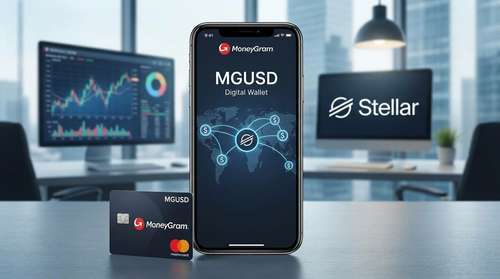
In one of the most significant digital asset deployments by a traditional financial institution to date, a legacy payments network has taken a massive leap forward. Announced on June 2, 2026, at the Money20/20 Europe conference in Amsterdam, the newly launched MoneyGram MGUSD stablecoin is set to fundamentally reshape how cross-border payments function. By building this digital asset natively on the Stellar network, MoneyGram aims to overhaul the global remittance landscape for its 60 million active customers, turning a legacy cash network into a modernized, programmable financial engine.
Unlike the vast majority of digital tokens that function primarily as speculative trading pairs on cryptocurrency exchanges, this initiative is engineered explicitly for real-world money utility. The token is integrated directly into the company’s existing ecosystem, giving consumers a reliable way to hold and transfer value across borders without relying on cumbersome traditional banking hours or suffering through steep currency conversion friction.
The Institutional Tech Stack Behind MGUSD
Bringing a compliant, enterprise-grade digital currency to market requires an immense coordination of specialized infrastructure. To ensure strict regulatory compliance and seamless operational flow, the remittance firm has partnered with several heavy hitters across the digital asset industry.
At the foundation of this initiative is the Stripe Bridge stablecoin issuer. Acquired by Stripe in 2025, Bridge operates as the regulated, GENIUS Act-ready issuer for the token, ensuring the digital dollars are fully backed and compliant with the latest federal guidelines. Meanwhile, the token creation and destruction logic is managed by M0 smart contract infrastructure. This protocol natively handles the minting and burning processes, automating the asset's supply dynamics efficiently.
To safely custody institutional pools of liquidity before routing them to end-users, the network leverages Fireblocks. This multi-party architecture essentially transforms the legacy remittance layer into an automated, programmatic stablecoin rail, designed to operate securely at a massive global scale.
Empowering Users with a Self-Custodial Digital Dollar
For the average consumer navigating inflation, currency instability, or limited local banking options, access to stable U.S. dollars can be life-changing. This is where the MGUSD digital dollar wallet comes into play. Rather than pushing customers to navigate complex decentralized finance applications, the token is embedded straight into the interface they already use.
Through the MoneyGram app self custodial wallet integration, users instantly gain a borderless financial account. They can hold a stable, dollar-denominated balance, send funds globally around the clock, and ultimately convert their digital assets back into local fiat currency at any of the company’s nearly 500,000 retail agent locations worldwide.
Real-World Utility for the Unbanked
MoneyGram Chairman and CEO Anthony Soohoo emphasized this utilitarian focus during the asset's unveiling. He noted that while the broader digital asset industry has largely obsessed over the underlying tokens themselves, his organization is taking a fundamentally different approach. The company views this launch as a foundational layer to build future applications tailored specifically for families sending money home and for the billions of individuals worldwide who remain locked out of traditional finance.
Driving Down Remittance Costs
The push toward on-chain settlement is heavily driven by the stubborn inefficiencies of the legacy financial system. According to recent data from the World Bank, sending $200 across borders historically costs an average of 6.36 percent in total fees and margins. Similarly, a 2026 report by the Bank for International Settlements highlighted that retail cross-border payments remain disproportionately slow, expensive, and opaque compared to domestic transfers.
By leveraging programmable money, the remittance giant bypasses a labyrinth of correspondent banks and intermediary settlement layers. This direct, peer-to-peer digital architecture reduces frictional costs dramatically. Consequently, the savings generated by this streamlined backend will make an immediate impact, retaining more wealth within the local communities that rely on these vital financial lifelines.
Expanding the Stellar Blockchain Remittance Ecosystem
The decision to deploy this asset natively on a purpose-built ledger is a natural evolution of a five-year developmental partnership between the two organizations. Stellar has long positioned itself as the premier network for rapid, low-cost institutional money movement, making a Stellar blockchain remittance integration the logical choice for a high-volume payment processor.
Stellar Development Foundation CEO Denelle Dixon recently described the rollout as a critical milestone demonstrating exactly what a targeted blockchain can deliver when paired with a globally trusted payments network. Furthermore, this massive deployment is generating significant Stellar XLM token news across the broader financial technology sector. Because every transaction on the network requires Stellar’s native token to cover operational fees and account reserves, routing millions of daily remittance transfers through this new infrastructure is poised to drive unprecedented fundamental utility for the underlying ecosystem.
By migrating from simple backend settlement tests toward consumer-facing digital balances, this launch proves that stablecoin infrastructure has moved well beyond the pilot phase. As the industry shifts away from costly, slow, and opaque legacy systems, the introduction of this highly accessible digital dollar sets a rigorous new benchmark for what modern cross-border payments should look like.