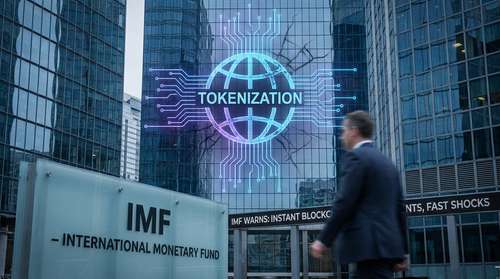
The global financial system stands at a critical crossroads as the rapid integration of distributed ledger technology strips away the natural time buffers that have historically protected markets from cascading failures. In a stark new IMF tokenization warning, the International Monetary Fund cautions that migrating traditional securities and currencies onto programmable digital ledgers represents a fundamental overhaul of market architecture. Rather than treating on-chain finance as a mere technological upgrade, international regulators are now sounding the alarm over how the very efficiencies touted by proponents could inadvertently become channels for unprecedented economic contagion.
The Double-Edged Sword of Atomic Settlement
Released on July 2, 2026, the comprehensive note authored by Financial Counsellor and Director of the Monetary and Capital Markets Department, Tobias Adrian, points to a paradigm shift in how risk is managed. The intersection of Tobias Adrian IMF blockchain research indicates that when execution, clearing, and settlement are compressed into a single, simultaneous process driven by software, the traditional windows used to detect errors and coordinate regulatory responses vanish. This lack of reaction time leaves global markets highly vulnerable to accelerated shock propagation.
The traditional financial world relies heavily on sequential, time-delayed processes. Today's end-of-day batch reconciliations and T+1 or T+2 settlement cycles are often criticized for their inefficiency, yet they serve a crucial, hidden purpose: providing a temporal safety net. When a crisis hits, these built-in frictions give clearinghouses and central banks the vital hours needed to intervene, enforce margin calls, and inject liquidity.
Transitioning to decentralized ledgers eliminates these delays, creating the looming threat of a crypto instant settlement shock. In a fully tokenized ecosystem, liquidity demands materialize instantaneously. A bug within a smart contract, an oracle manipulation, or an automated sell-off could trigger a domino effect across interconnected networks before human operators even receive an alert. While atomic settlement reduces counterparty risk and lowers operational costs, the IMF emphasizes that this loss of natural market friction allows financial crises to spread at the speed of code execution.
Evaluating RWA Systemic Risk in 2026
The scale of this transition is no longer theoretical. The landscape of real-world asset tokenization 2026 has expanded dramatically, with recent industry reports mapping roughly $60 billion in tokenized assets as of late May, spanning everything from tokenized US Treasuries and money market funds to private credit. Financial giants have actively championed these initiatives, with institutional liquidity funds serving as flagship products for an evolving capital market structure.
However, as these assets migrate onto shared networks, the nature of financial vulnerability fundamentally changes. The IMF notes that traditional risks once held on the balance sheets of heavily regulated intermediaries are now migrating toward the underlying infrastructure. This transition introduces severe RWA systemic risk. Market integrity becomes overly reliant on the resilience of third-party platform providers, consensus mechanisms, and the quality of off-chain data feeds. If a widely utilized decentralized platform experiences an operational failure, the resulting liquidity fracture could effortlessly spill over into traditional banking systems.
Market Fragmentation and Cross-Border Challenges
Compounding these operational vulnerabilities is the threat of infrastructure splintering. Financial institutions are currently building isolated, permissioned ledgers that lack seamless interoperability. If different asset classes and jurisdictions migrate to incompatible technological standards, cross-border resolution during a crisis will become exponentially more difficult. This fragmentation threatens overall blockchain financial stability, potentially locking up capital in siloed networks exactly when liquidity is most needed to stabilize international markets.
The Urgent Need for Coordinated Web3 Regulation
The future of institutional tokenization now hinges on structural policy decisions rather than technological capabilities. Policymakers face a delicate balancing act: harnessing the indisputable efficiencies of blockchain without compromising the safeguards that prevent economic collapse. Central to this debate is identifying the ultimate settlement asset for a fully tokenized economy. While private stablecoins offer programmability, they remain susceptible to runs and de-pegging events during severe market stress.
To safely anchor public trust, there is a growing consensus that tokenized finance must be grounded in safe settlement assets, such as tokenized central bank reserves or highly regulated deposit networks. Consequently, the push for comprehensive Web3 regulation IMF guidelines is accelerating. Global financial authorities are prioritizing frameworks that clarify property rights, establish strict cybersecurity mandates, and mandate real-time liquidity backstops tailored for continuous, 24/7 markets.
The modernization of the global economy through distributed ledgers promises unprecedented efficiency, but it requires an equally sophisticated regulatory evolution. As the financial sector hurtles toward an automated future, global institutions must ensure that the speed of innovation does not outpace the essential mechanisms of market resilience.