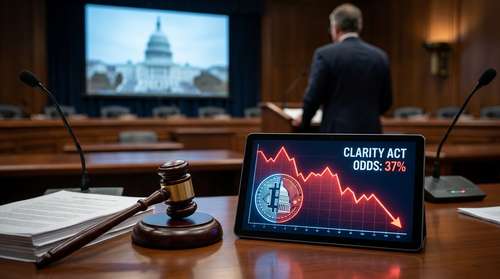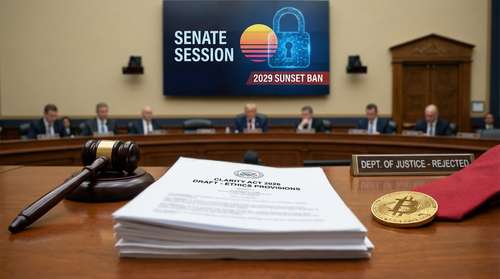
The push for comprehensive US crypto regulation has hit a massive legislative roadblock. The U.S. Senate officially postponed a floor vote on the Digital Asset Market Clarity Act, shelving the highly anticipated 600-page regulatory framework until at least September. Driven by fierce pushback from state regulators over conflict-of-interest ethics provisions, this CLARITY Act delay has sent shockwaves across digital asset exchanges. Investors reacted rapidly to the ongoing uncertainty, triggering a broad market correction that erased billions in capital as hopes for a unified federal structure faded.
The CLARITY Act Delay: Why the Senate Hit Pause
Senate Majority Leader John Thune made the decisive move this week to sideline the market structure bill ahead of the chamber's fast-approaching August recess. With the legislative clock running out, Thune prioritized clearing a backlog of federal nominations and advancing a prominent Russia sanctions package—newly dedicated to the late Senator Lindsey Graham—over the digital asset framework.
However, calendar congestion only masks deeper ideological divides. While Republican proponents like Senators Cynthia Lummis and Jon Husted argue the bill is essential for keeping American digital asset innovation competitive, Senate Democrats labeled the current ethics provisions a nonstarter. The inability to reach a bipartisan consensus on anti-money-laundering mandates, combined with the escalating crypto ethics dispute, ultimately derailed the bill's momentum. As a result, research firms like Galaxy have slashed the bill's odds of passing in 2026 to a bleak 30%.
Letitia James and the State-Level Resistance
A major catalyst for the legislative pause came from powerful state-level opposition. New York Attorney General Letitia James launched a coordinated campaign against the federal override proposed in the Senate crypto bill, arguing it would severely weaken local fraud enforcement.
In written testimony submitted to a Senate subcommittee, James warned that the legislation would "neuter state and local law enforcement" by preempting existing investor protection laws. The statistics she provided to lawmakers were stark: local and state authorities handle roughly 98.8% of all law enforcement arrests nationwide, leaving just 1.2% to federal agencies. Noting that crypto scams have cost New Yorkers nearly $500 million over the past five years, the Letitia James crypto intervention demanded stricter mandates for cybersecurity, compliance, and holding platforms financially accountable. Her pushback solidified Democratic hesitation, making a pre-August compromise virtually impossible and ensuring that local prosecutors retain their jurisdiction for now.
Inside the Digital Asset Market Clarity Act
Had it secured a floor vote, the Digital Asset Market Clarity Act would have established the most comprehensive regulatory blueprint for the American cryptocurrency sector to date. The legislation aims to neatly divide federal jurisdiction between the Securities and Exchange Commission (SEC) and the Commodity Futures Trading Commission (CFTC). Under the draft text, the CFTC would gain exclusive authority over spot markets for digital commodities, while the SEC would retain oversight of assets that still classify as traditional securities.
Furthermore, the bill includes a "Regulation Crypto" exemption designed to help blockchain startups raise capital up to $50 million per year without facing the full suite of burdensome public company disclosures. It also features a fragile, hard-fought compromise on stablecoins, preventing issuers from offering direct interest-like yields to avoid draining traditional bank deposits. With the legislation shelved, this critical truce between the traditional banking lobby and the digital asset industry remains entirely in limbo.
Market Reaction: Bitcoin and Altcoins Face Immediate Corrections
Financial markets historically despise uncertainty, and the digital asset sector is no exception. The latest cryptocurrency regulation news triggered immediate sell pressure across retail and institutional portfolios alike. The total cryptocurrency market capitalization tumbled 2.8%, sliding back to $2.25 trillion as optimism for near-term federal compliance guidelines vanished.
Leading assets took noticeable hits. Bitcoin (BTC) dropped 3.1% to trade at $63,300, while Ethereum (ETH) saw a similar decline, slipping 3.5% down to $1,880. Altcoins tied to institutional utility felt the brunt of the pessimistic sentiment. Ripple (XRP) tanked roughly 5% to $1.05, hitting multi-week lows as investors digested the prolonged jurisdictional fragmentation. The pain was widespread, with even the non-fungible token (NFT) sector suffering a steep 12% drop in daily trading volume amid the broader retreat.
What Happens Next for U.S. Crypto Regulation?
With the Senate entering its scheduled summer recess on August 8, the legislative window for market structure reform will not reopen until mid-September at the earliest. This delay guarantees that digital asset exchanges and decentralized finance protocols will operate in a fractured, state-by-state regulatory environment for the foreseeable future. While industry lobbyists scramble to negotiate updated disclosure requirements that might satisfy skeptical lawmakers and state attorneys general, retail investors are forced to brace for continued market volatility. Until Congress can bridge the gap between financial innovation and consumer protection, unified crypto rules will remain an elusive target.