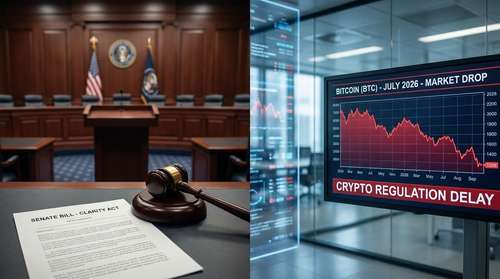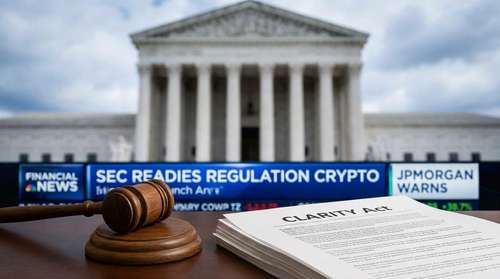
The legislative clock is quickly running out for digital asset markets. With the impending Senate crypto recess expected to halt legislative progress through August, the highly anticipated CLARITY Act crypto framework is faltering. Now, Wall Street and federal regulators are bracing for the fallout. SEC Chairman Paul Atkins announced the agency is preparing its own independent framework, while a new JPMorgan crypto warning highlights severe structural risks to decentralized platforms if Congress fails to pass the landmark legislation.
Passage Odds Plummet for Crypto Market Structure Bill
Earlier this year, the CLARITY Act crypto legislation seemed destined to provide the definitive legal bedrock for digital assets in the United States. Designed to permanently resolve jurisdictional ambiguities between the Securities and Exchange Commission (SEC) and the Commodity Futures Trading Commission (CFTC), the crypto market structure bill cleared the House with bipartisan support and successfully advanced through the Senate Banking Committee.
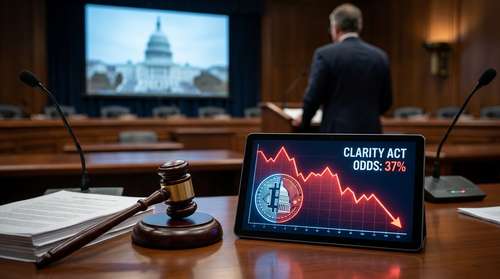
However, momentum has crashed into a wall of Senate gridlock. Recent data from prediction markets and institutional analysts indicate the likelihood of the bill passing before the end of the year has collapsed to just 37%. The underlying friction stems from competing regulatory demands. Senators are struggling to reconcile strict anti-money laundering (AML) controls with the permissionless nature of decentralized finance (DeFi) protocols. Additionally, debates over how to monitor yield-bearing stablecoins have drawn out negotiations beyond the current political timeline, leaving the digital asset industry in a state of suspended animation.
With the Senate crypto recess starting soon, the window for a unified statutory agreement is rapidly closing.
The JPMorgan Crypto Warning: A Threat to Public Networks
The legislative stagnation is not just a political headache; it carries massive economic implications. A stark JPMorgan crypto warning issued late this week outlines how the delay directly threatens the core ethos of decentralized networks.
Analysts at the banking giant argue that while tokenization continues to advance rapidly, a lack of clear federal guidelines will ultimately force institutional capital to default to private, permissioned ledgers. If the CLARITY Act crypto rules are not enacted, traditional finance institutions will likely absorb the immense economic value of blockchain applications. Rather than flowing into open public networks like Ethereum or Solana, tokenization initiatives will be strictly captured by established legacy infrastructures.
This structural risk changes the calculus for long-term investors. Institutional players are hungry for tokenized assets, but without clear boundary lines for intermediaries and brokers, they are unwilling to risk capital on legally ambiguous public blockchains.
SEC Chair Prepares "Regulation Crypto" Fallback
Recognizing the impending legislative failure, the SEC is actively shifting its posture. During recent public appearances, SEC Paul Atkins crypto policy took center stage as the Chairman declared his agency is "ready, willing, and able" to fill the regulatory void.
The fallback plan, informally dubbed Regulation Crypto SEC, stems from the agency's broader "Project Crypto" initiative. Rather than continuing the previous administration's strategy of regulation by enforcement, Atkins is developing a formal token taxonomy. This framework aims to officially categorize digital commodities, network tokens, and payment stablecoins to clarify precisely when an asset transitions out of security status.
Under the proposed Regulation Crypto SEC package, the agency plans to establish tailored disclosures, startup fundraising exemptions, and a safe harbor provision for decentralizing projects. These startup exemptions are designed to allow early-stage blockchain firms to raise foundational capital over several years without immediately facing the crushing compliance costs of full SEC registration. By creating a compliance pathway with defined timeframes, the SEC hopes to keep domestic innovation within the U.S. regulatory perimeter.
The Trajectory of US Crypto Regulation 2026
While the SEC's proactive stance offers a lifeline, industry advocates stress that administrative rules are a poor substitute for concrete statutory law. A SEC Paul Atkins crypto rulebook could easily be overturned by a future administration, leaving the sector vulnerable to ongoing political whiplash.
Statutes are necessary for true future-proofing. As the crypto market structure bill remains in jeopardy, the entire trajectory of US crypto regulation 2026 hangs in the balance. The market requires the permanence that only Congressional action can provide.
For now, all eyes are on Washington. If the Senate cannot find common ground following the summer break, the United States may see its public blockchain ecosystem starved of institutional liquidity—just as JPMorgan predicted. The coming months will determine whether America embraces decentralized innovation or allows traditional banking to completely co-opt the tokenization revolution.