The highly anticipated CLARITY Act Senate delay has sent shockwaves across the digital asset landscape this week, stalling what was poised to be the most consequential US crypto regulation bill in history. The Digital Asset Market Clarity Act 2026 suddenly lost its legislative momentum ahead of the August recess, caught in a complex web of scheduling conflicts, aggressive traditional banking sector lobbying, and a fierce partisan battle over executive ethics. Consequently, the sudden pause in regulatory progress has triggered a broad market sell-off, erasing billions in value as institutional investors and retail traders digest the mounting uncertainty.
A Perfect Storm: Why the Crypto Market Structure Bill Stalled
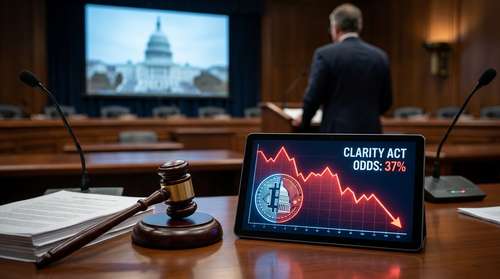
Market analysts initially priced in an 80% chance of the bill passing this year, but those optimistic odds have recently plummeted to roughly 35% on prediction platforms like Polymarket. The sudden legislative stall is multifaceted. Senate Majority Leader John Thune prioritized a pressing Russia sanctions package, moving the crypto market structure bill to the back of the legislative line just days before the August 7 summer recess. Furthermore, the Senate schedule was entirely monopolized this week by the funeral proceedings for a late prominent senator, leaving lawmakers with a nearly impossible time crunch.
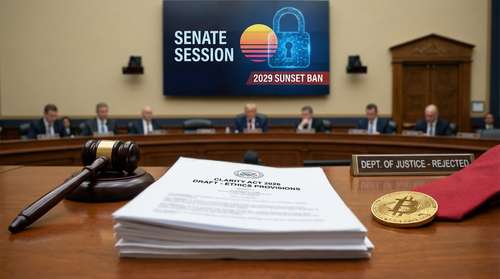
Beneath the scheduling hurdles lies a much deeper ideological divide. Lawmakers remain deadlocked over an ethics provision designed to prevent conflicts of interest for executive branch officials who hold significant digital wealth. With Republicans holding a slim 52-seat majority, the bill requires substantial bipartisan support to clear the 60-vote filibuster threshold. Adding to the friction, aggressive traditional banking sector lobbying has heavily complicated the bill's passage. Legacy financial institutions fear that unregulated yield-bearing stablecoins could trigger massive deposit flight. While the bill incorporates a delicate compromise stopping stablecoin providers from offering direct deposit-like interest, this hard-fought truce now remains in legislative limbo.
Letitia James Crypto Testimony Shakes the Senate
Adding immediate fuel to the legislative fire was the highly publicized Letitia James crypto testimony delivered to the Senate this week. The New York Attorney General issued a stark, written warning that the proposed federal framework would severely undermine state-level efforts to prosecute fraudulent crypto operations and protect retail investors.
James forcefully argued that the Digital Asset Market Clarity Act 2026 threatens to preempt critical state investor-protection laws, effectively gutting local enforcement powers. Her testimony struck a resonant chord with skeptical lawmakers, severely complicating the final negotiations. While proponents of the bill, such as Senator Cynthia Lummis, argue the legislation is absolutely necessary to prevent custody catastrophes reminiscent of the Celsius and Voyager collapses, state regulators remain entirely unconvinced that a blanket federal mandate is the safest path forward.
Resolving the SEC CFTC Crypto Jurisdiction Battle
At the core of the stalled legislation is an ambitious attempt to finally resolve the ongoing SEC CFTC crypto jurisdiction turf war. For years, the digital asset industry has suffered under arbitrary "regulation by enforcement," trapped between two powerful federal agencies competing for oversight.
The delayed bill aims to draw a definitive line in the sand. It designates exclusive jurisdiction over "digital commodities"—sufficiently decentralized assets like Bitcoin—to the Commodity Futures Trading Commission (CFTC). Meanwhile, the Securities and Exchange Commission (SEC) would retain authority strictly over "investment contract assets". Beyond jurisdiction, the legislation establishes much-needed registration requirements for intermediaries and solidifies self-custody protections for retail users. The prolonged delay ensures crypto exchanges, token issuers, and investors will remain stranded in a legal gray zone for the foreseeable future, sustaining the institutional hesitation that has weighed on the market throughout 2026.
The July 2026 Bitcoin Price Drop: Markets React
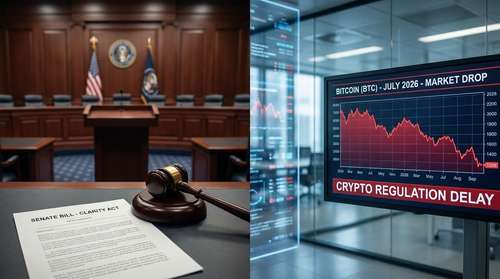
This legislative gridlock could not have materialized at a worse time for digital assets. The CLARITY Act Senate delay, combined with looming macroeconomic headwinds, directly catalyzed the massive Bitcoin price drop July 2026 witnessed earlier this week. Bitcoin tumbled nearly 3%, losing the critical $65,000 threshold to trade around $62,850, while Ethereum slumped nearly 4%, falling below $1,900.
The crypto market sell-off was heavily exacerbated by mounting anxiety surrounding the Federal Reserve's late-July FOMC meeting. Persistent inflation data has revived speculation of a hawkish interest rate path, further dampening investor appetite for risk-on assets. With a massive $2.5 billion Bitcoin options expiry looming on July 31, the market was already primed for extreme turbulence. The sudden removal of the crypto bill as a bullish catalyst instantly shattered hopes for an accelerated regulatory dividend, triggering a cascade of safe-haven sell-offs by institutional funds and retail traders.
As lawmakers pack up for the August recess, the path forward for comprehensive digital asset regulation looks murkier than ever. The industry must now brace for an extended period of volatility as it waits to see if Congress can eventually bridge the partisan divide and deliver the clarity the market so desperately craves.