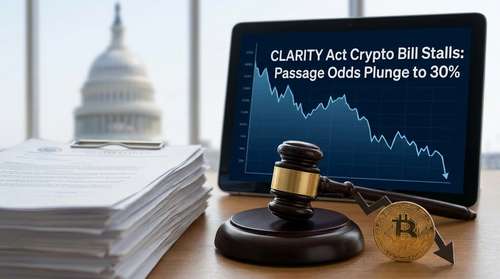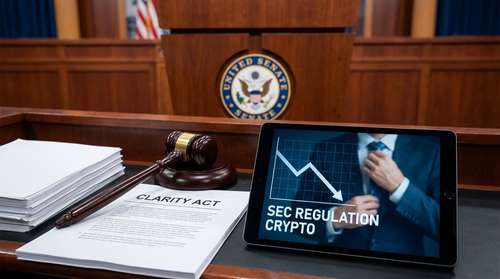
The highly anticipated CLARITY Act crypto legislation has hit a massive roadblock on Capitol Hill just days before lawmakers break for their August recess. What began as a bipartisan effort to establish a comprehensive framework for digital assets in the United States is now mired in fierce political battles. At the center of the controversy is a dispute over ethics provisions targeting President Donald Trump's digital asset ventures. With the legislative path narrowing, SEC Chairman Paul Atkins has stepped forward, announcing that the regulatory agency is fully prepared to implement its own rulemaking package to bring desperately needed structure to the digital asset market.
Senate Delays Hit the US Crypto Regulation Bill
The Digital Asset Market Clarity Act of 2025 initially gained significant momentum, passing the House of Representatives with solid backing. The legislation promised to finally clarify the jurisdictional boundaries between the Securities and Exchange Commission and the Commodity Futures Trading Commission. However, the US crypto regulation bill has ground to a halt in the upper chamber.
Lawmakers are currently deadlocked over an ethics clause specifically designed to restrict public officials from issuing or sponsoring digital assets. The sticking point involves President Trump, who reported $1.4 billion in cryptocurrency earnings last year. While Republicans introduced revised text to address these concerns, Democratic senators argue the new language falls completely short of providing real oversight.
The Trump Crypto Earnings Ethics Loophole
Critics of the revised legislative text point to what they describe as a glaring Trump crypto earnings ethics loophole. The current draft bars senior officials and their spouses from issuing tokens but fails to extend those restrictions to immediate family members. Furthermore, the bill assigns enforcement power exclusively to the Department of Justice while explicitly barring state attorneys general from bringing independent enforcement actions.
Prominent Democrats, including Senator Elizabeth Warren, have slammed the revisions, arguing they provide a massive loophole allowing the executive branch to keep profiting from private digital ventures. These deep partisan divides mean the Senate CLARITY Act delays will almost certainly push any potential floor vote well past the August congressional recess, leaving the digital asset industry in a continued state of legislative limbo.
Bitcoin Market Volatility Amid Political Gridlock
The sudden pause in legislative momentum has triggered noticeable Bitcoin market volatility. After rallying earlier in the month on hopes of definitive market structure, Bitcoin dropped by roughly $3,000 following news of the Senate suspension, briefly losing the $63,000 threshold. It has since seen a modest rebound to around $63,895 following reassuring regulatory comments. Market participants are simultaneously digesting the Senate deadlock and bracing for the Federal Reserve's impending FOMC interest rate decision. With derivative market data showing a 70.6% probability of rates remaining steady, the combination of high-stakes political maneuvering and persistent macroeconomic pressures has left digital asset traders navigating intense crosscurrents.
SEC Chairman Paul Atkins Offers a Regulatory Alternative
Recognizing the rapidly diminishing chances of congressional action this summer, the SEC is actively positioning itself to fill the legislative void. SEC Chairman Paul Atkins took to social media to reassure anxious markets, stating he remains committed to providing technical assistance to Congress but will not let the industry languish without guidance indefinitely.
Atkins confirmed the agency is ready, willing, and able to deploy its own comprehensive rules if the legislative route ultimately fails. Since taking the helm as the 34th SEC Chairman in April 2025, Atkins has actively shifted the agency away from the hostile regulation-by-enforcement strategy that frustrated the industry under previous administrations. His current mandate focuses strictly on establishing transparent, actionable guidelines for developers and institutional investors.
What SEC Regulation Crypto Means for the Industry
If the CLARITY Act crypto bill collapses, the SEC's fallback plan centers around an internal framework heavily rumored as SEC Regulation Crypto. This initiative, built alongside the agency's broader Project Crypto efforts, aims to construct a clear, practical token taxonomy without requiring an act of Congress.
Under this proposed framework, the SEC would clearly define digital commodities, payment stablecoins, and digital collectibles, safely exempting them from traditional securities classifications. Only tokenized financial instruments would remain under strict securities laws. This track mirrors the core jurisdictional objectives of the stalled congressional legislation, offering a viable alternative path toward regulatory clarity.
While statutory laws passed by Congress remain the most legally sound solution for long-term market structure, the proactive stance from the SEC provides a critical safety net. For now, the financial sector is keeping a close watch on the Senate to see if a last-minute ethics compromise can be reached, or if the SEC will officially take the reins on defining the future of American digital finance.