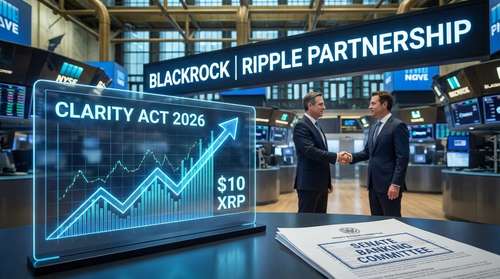
Within the last 48 hours, the trajectory of digital finance shifted permanently. The much-debated Clarity Act crypto bill 2026 has seen its passage probability rocket to 70% following an unexpected bipartisan breakthrough. But Capitol Hill is only half the story. A monumental Ripple BlackRock partnership centered on large-scale asset tokenization was just confirmed, setting global trading desks ablaze and fueling a highly credible XRP price prediction $10 target. As regulatory clouds finally part, Wall Street heavyweights are moving quickly to lock down blockchain infrastructure, fundamentally altering the market's baseline.
Senate Banking Committee Crypto Update: The Clarity Act Surges
Lawmakers have spent months deadlocked over how to oversee digital assets, but the latest Senate Banking Committee crypto update signals a massive thaw. Following intense closed-door negotiations over stablecoin yields and decentralized finance (DeFi) liabilities, the Clarity Act is now positioned for a decisive markup. This legislation represents the most aggressive push yet for comprehensive crypto market structure regulation in the United States.
Breaking the Partisan Deadlock
What sparked the sudden 70% confidence metric? A tentative agreement effectively draws a bright line between the jurisdiction of the Securities and Exchange Commission (SEC) and the Commodity Futures Trading Commission (CFTC). By establishing a clear digital commodity classification, the bill replaces the controversial regulation-by-enforcement model with a workable statutory framework. Assets that operate on decentralized networks will largely be treated as commodities, protecting software developers and shielding network validators from arbitrary crackdowns. For institutional investors sitting on the sidelines, this legal certainty is the exact green light they required to deploy capital safely.
The Ripple BlackRock Partnership Redefines Asset Tokenization
As lawmakers hammer out the legal framework, the private sector is already deploying the infrastructure. On April 12, Ripple CEO Brad Garlinghouse publicly detailed a landmark collaboration with BlackRock. This isn't a pilot program; it is a full-scale integration aimed at bringing real-world asset (RWA) tokenization to institutional markets.
Building the RWA Infrastructure
The mechanics of this Ripple BlackRock partnership rely heavily on multi-chain interoperability. BlackRock's USD Institutional Digital Liquidity Fund (BUIDL) is now leveraging the XRP Ledger (XRPL) via integrations with Wormhole and the Ripple-backed tokenization platform Securitize. By using the newly deployed RLUSD stablecoin as an institutional settlement layer, asset managers can instantly exchange shares and seamlessly manage tokenized funds across networks 24/7.
This architectural alignment bridges traditional finance with decentralized rails. Large financial institutions do not build plumbing for single-chain dependence; they require secure, rapid cross-chain messaging. Ripple's established ledger is providing the exact liquidity and settlement backbone required to handle billions in tokenized treasuries and securities.
Analyzing the XRP Price Prediction $10 Target
Market reaction to the BlackRock news was immediate. XRP trading volume shattered previous records as institutional floors stabilized the broader digital asset market. Analysts are rapidly updating their models, and the once-optimistic XRP price prediction $10 is now dominating institutional forecasts.
Why $10? The valuation calculates the sheer volume of liquidity required to facilitate BlackRock's multi-trillion-dollar ETF and tokenized fund operations. As tokenized real-world assets demand round-the-clock trading and instant settlement, XRP functions as the essential bridge asset. If even a fraction of BlackRock's liquidity shifts onto the XRPL, the demand for XRP to process these cross-border, cross-chain transfers will create an unprecedented supply shock. Buyers have already established an aggressive support floor, signaling that financial heavyweights are front-running the anticipated tokenization boom.
A New Era of Institutional Crypto Adoption
The events of the past two days highlight a synchronized maturity in both governance and enterprise application. We are witnessing the end of the speculative era and the beginning of structural integration. The Clarity Act's progress provides the necessary shield of digital commodity classification, while the BlackRock alliance delivers the sword of massive, real-world utility.
True institutional crypto adoption requires both halves of this equation. Financial titans need absolute assurance that the networks they build on won't be outlawed tomorrow, and they need the technical capacity to settle trillions of dollars securely. With the Senate Banking Committee clearing the regulatory roadblocks and Ripple proving its enterprise scalability, the broader market is entering a highly stabilized, high-value phase. The race to tokenize global finance has officially begun, and the infrastructure powering it is finally coming into focus.