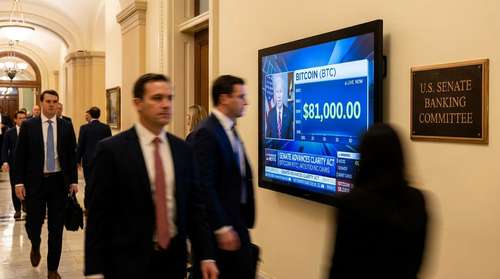
The regulatory fog lifting over the digital economy has finally crystallized into concrete policy. In a landmark 15-9 vote this Thursday, lawmakers advanced the Digital Asset Market CLARITY Act, establishing a long-awaited baseline for how blockchain networks and digital commodities will be governed in the United States. Following the contentious but successful Senate Banking Committee markup, financial markets are reacting with cautious optimism. According to the latest Bitcoin price news May 16 2026, the world's leading cryptocurrency is currently defending a crucial threshold, holding firmly at the Bitcoin $81k support level as traders digest the legislative breakthrough.
Inside the Historic Senate Banking Committee Markup
Thursday's executive markup session stretched past the two-hour mark, defined by fierce debate over dozens of proposed amendments. Ultimately, all 13 Republicans on the committee, led by Chairman Tim Scott, were joined by two Democrats—Senators Michelle Alsobrooks and Ruben Gallego—to push the legislation forward. This pivotal bipartisan vote signals a dramatic evolution in how Washington approaches decentralized technology.
The newly advanced bill introduces Regulation Crypto, a targeted exemption allowing digital asset originators to raise up to $50 million annually without immediately facing the massive compliance burden placed on traditional public equities. Perhaps most significantly, the legislation establishes a decentralization-based test that officially distinguishes network tokens from investment contracts. By legally classifying adequately decentralized digital assets as commodities rather than securities, the bill answers the industry's loudest demand for legal certainty.
Negotiating the Stablecoin Compromise
One of the most intensely negotiated aspects of this proposed U.S. crypto legislation revolves around stablecoin architecture. To address traditional banking industry fears regarding massive deposit flight, lawmakers engineered a delicate compromise. The current text restricts passive stablecoin yields—preventing them from acting identically to bank savings accounts—while explicitly permitting limited, activity-based rewards for users interacting directly with protocols.
During the session, lawmakers also adopted a handful of late-stage amendments introduced by Senator Cynthia Lummis. These changes secured broad backing, pulling 18 to 19 votes each, with notable support from Democrats like Senators Mark Warner and Raphael Warnock. The successful inclusion of these technical adjustments smoothed the bill's passage out of committee, though major roadblocks loom on the horizon.
The Road to the Senate Floor Demands Bipartisan Finesse
While the crypto sector is celebrating the committee victory, the legislation's future is far from guaranteed. The two Democrats who broke ranks to advance the bill explicitly stated that their committee votes do not represent a blank check for floor support. Senator Alsobrooks pointed directly to the need for robust ethics clauses that apply to all federal officials, an issue amplified by recent debates surrounding presidential candidates holding digital asset portfolios.
Lawmakers still have significant negotiations ahead to satisfy law enforcement agencies demanding stringent safeguards against financial crimes in decentralized finance (DeFi) environments. Securing the 60 votes required to bypass a Senate filibuster—a target leadership hopes to hit by July—will demand further concessions and a unified lobbying effort from the industry.
Institutional Crypto Investment 2026 Finds Its Catalyst
For Wall Street, a functional crypto regulatory framework serves as the ultimate green light. The historical absence of clear jurisdictional boundaries between the SEC and the CFTC has sidelined trillions in potential institutional capital. Now, with those boundaries finally being mapped out in federal law, traditional financial institutions are aggressively evaluating their blockchain strategies.
Major asset managers require predictable oversight to justify portfolio allocations. By establishing federal registration and anti-money laundering obligations for digital commodity intermediaries, the CLARITY Act removes the persistent threat of arbitrary, regulation-by-enforcement actions. Market analysts project that institutional crypto investment 2026 will shatter previous capital inflow records, driven entirely by banks and pension funds that can finally custody and trade digital assets under federal guidelines.
Bitcoin Defends the $81K Support Level
The broader macroeconomic response to the committee's vote is playing out live on the trading charts. After a period of heightened volatility leading up to Thursday's session, Bitcoin has found incredibly solid footing. Bears have repeatedly tested the Bitcoin $81k support level over the last 48 hours, but immense buying pressure from both retail and corporate treasuries has successfully absorbed the sell-offs.
- Commodity Confirmation: Reaffirming Bitcoin's status securely outside the SEC's purview dramatically emboldens long-term corporate treasury acquisitions.
- Regulatory Premium: The establishment of clear rules consistently reduces the risk discount traditionally applied to volatile emerging asset classes.
- Spot ETF Expansion: Market liquidity remains robust as exchange-traded fund issuers anticipate launching innovative products under the new regulatory regime.
Technical analysts watching the charts this Saturday morning note that holding this specific price floor is structurally vital. Should this support line hold through the weekend close, it establishes a formidable launchpad for the next major price discovery phase. Traders, builders, and politicians alike recognize that the dynamics of the market are permanently shifting. The U.S. is finally laying the legislative groundwork required to host the global digital economy.