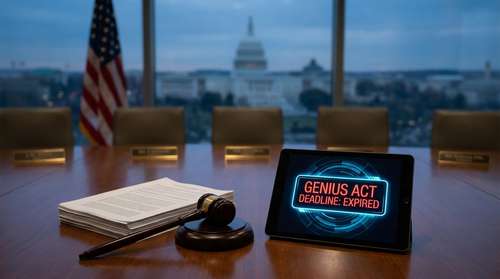
After months of legislative gridlock and intense lobbying from both Wall Street and the digital asset sector, a major bipartisan crypto bill update has emerged from Washington. In late March 2026, key U.S. lawmakers and White House officials secured a tentative agreement to advance the Digital Asset Market Clarity Act (CLARITY Act). The breakthrough resolves a bitter dispute over stablecoin yield regulation that had stalled the landmark US crypto market structure legislation in the Senate Banking Committee since January. With an "agreement in principle" now on the table, the industry is closer than ever to seeing a comprehensive federal crypto law 2026 enacted, setting the stage for a new era of financial innovation in the United States.
Resolving the Stablecoin Yield Standoff
Senators Thom Tillis (R-NC) and Angela Alsobrooks (D-MD) spearheaded the recent negotiations to bridge the gap between traditional banking interests and the digital asset sector. The primary roadblock centered on whether crypto platforms could offer yield-bearing rewards to customers holding stablecoins. While the GENIUS Act of July 2025 prohibited primary stablecoin issuers from paying interest directly, secondary platforms and exchanges sought to offer their own incentives to users.
Traditional financial institutions warned that allowing crypto exchanges to pay interest on these dollar-pegged assets could trigger a massive "deposit flight". Banking groups, alongside analysts from firms like Standard Chartered, estimated that unrestricted stablecoin yields could drain roughly $500 billion from conventional bank deposits by 2028, fundamentally threatening their ability to fund consumer lending. Conversely, industry leaders argued that restricting such rewards would be anti-competitive and stifle domestic innovation.
Under the tentative deal, lawmakers agreed on a framework that aims to prevent widespread capital flight while protecting the utility of blockchain networks. Early indications suggest the compromise will strictly prohibit yield payments on passive stablecoin balances. However, the legislation may leave the door open for specific, activity-based rewards tied to network staking, transaction validation, or direct platform utility. Senator Alsobrooks noted that the updated text strikes a vital balance, ensuring the U.S. remains globally competitive without introducing systemic liquidity risks to the banking sector.
The Landmark SEC CFTC Jurisdiction Agreement
Beyond the contentious yield dispute, the core feature of the CLARITY Act is its establishment of definitive regulatory boundaries. For years, the industry has operated under a cloud of uncertainty, subjected to overlapping and often conflicting enforcement actions. The new bill formalizes a highly anticipated SEC CFTC jurisdiction agreement, bringing much-needed structure to secondary markets.
Under the legislation, the Commodity Futures Trading Commission (CFTC) gains exclusive jurisdiction over "digital commodities" and their associated spot markets. This means that decentralized assets and mature blockchain networks will fall strictly under the CFTC's purview, requiring crypto exchanges, brokers, and dealers to register directly with the commodities regulator. Meanwhile, the Securities and Exchange Commission (SEC) retains explicit authority over "investment contract assets" and tokenized traditional securities.
Paving the Way with Joint Agency Guidance
Interestingly, federal regulators are not waiting for the final ink to dry on the CLARITY Act 2026 before taking action. Anticipating the bill's passage, the SEC and CFTC jointly issued a landmark interpretive release on March 17, 2026. The guidance preemptively categorizes 18 major cryptocurrencies as digital commodities and outlines a clear taxonomy for the market. This coordinated effort signals a definitive end to the agencies' historic turf war, proving that the government is fully preparing to execute the mandate of the upcoming legislation.
Building a Resilient Digital Asset Regulatory Framework
The passage of the CLARITY Act will represent the most significant shift in American financial policy in decades. By creating a unified digital asset regulatory framework, the legislation mandates strict consumer protection and compliance regimes. The bill replaces a fragmented, state-by-state approach with a comprehensive federal floor for oversight.
Key consumer protections introduced in the draft legislation include:
- Mandatory Fund Segregation: Centralized exchanges must strictly separate corporate operational funds from customer deposits, preventing the commingling that led to historic industry collapses.
- Enhanced Disclosures: Token issuers will be required to provide standardized, easily digestible information regarding tokenomics, governance structures, and potential risks.
- Qualified Custody Standards: The bill modernizes custody rules, allowing regulated entities like state-supervised non-depositary trust companies to act as qualified digital asset custodians.
- DeFi Safe Harbors: Software developers and peer-to-peer network validators are protected from being classified as financial intermediaries simply for publishing open-source code.
What's Next for the Federal Crypto Law 2026?
While the White House and key senators have agreed on the structural language, the legislative process still faces crucial hurdles. Lawmakers must now vet the compromise text with industry stakeholders to ensure all parties, from legacy banks to crypto startups, are aligned. Senator Tillis has emphasized that technical input from the crypto sector remains critical before the final details are locked in.
Senate Banking Committee Chairman Tim Scott (R-SC) is reportedly targeting mid-April for a formal markup session. If the committee successfully advances the bill, it will head to the Senate floor for deliberation and a full chamber vote. Should it pass, the CLARITY Act would finally integrate cryptocurrencies into the traditional financial architecture, delivering the exact regulatory certainty that market participants have demanded for over a decade.