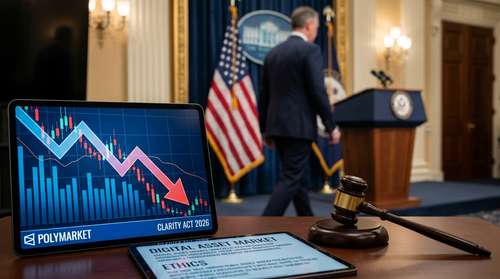
The future of the United States digital asset economy hangs in a precarious balance today after the Senate Banking Committee indefinitely postponed its markup of the landmark Digital Asset Market Clarity Act (CLARITY Act). The legislative stalemate, triggered by a sudden withdrawal of support from industry titan Coinbase, has sent shockwaves through Washington and Wall Street alike. With CLARITY Act 2026 negotiations crumbling just days before a critical vote, the delay highlights a deepening rift between Capitol Hill's legislative ambitions and the crypto industry's non-negotiable red lines.
Coinbase CEO Brian Armstrong Draws a Line in the Sand
The collapse of the scheduled markup is directly linked to a high-stakes standoff involving Coinbase CEO Brian Armstrong. Speaking from the sidelines of the World Economic Forum in Davos, Armstrong dropped a bombshell that effectively froze the legislative process. He publicly withdrew Coinbase's endorsement of the Senate's revised bill, citing the inclusion of what he termed "poison pills" that would cripple domestic innovation.
At the heart of the dispute are controversial provisions that would effectively ban crypto exchanges from offering yield or interest on stablecoins to customers—a core revenue stream for many platforms and a key feature for retail investors. Armstrong argued that the current text "over-empowers" the SEC at the expense of the CFTC and would cement a banking monopoly over digital dollar issuance. "We would rather have no bill than a bad bill," Armstrong stated, emphasizing that the current draft was materially worse than the status quo. His refusal to back the legislation forced Senate Banking Committee Chairman Tim Scott to pull the bill from the calendar, as industry consensus evaporated overnight.
The "Poison Pill": Stablecoin Regulatory Framework Disputes
The most contentious element stalling the US crypto regulation news cycle is the treatment of stablecoins. The revised CLARITY Act attempts to align with the recently debated GENIUS Act, which seeks to prohibit non-bank entities from paying interest on stablecoin deposits. Banks argue this is necessary to prevent massive deposit flight from the traditional banking system to higher-yielding digital assets.
However, crypto advocates view this as a protectionist move designed to kill competition. By restricting stablecoin rewards, lawmakers are inadvertently disincentivizing the use of US dollar-backed tokens, which Armstrong and other leaders argue will only drive users toward unregulated offshore alternatives. This fundamental disagreement over the stablecoin regulatory framework has turned a bipartisan effort into a bitter legislative deadlock.
Markets React: Crypto ETF Outflows Signal Investor Jitters
Wall Street has responded swiftly to the regulatory uncertainty. As political drama unfolded in Washington and Davos, the crypto market faced its most significant correction of the new year. Data from late January reveals that US spot Bitcoin ETFs experienced a staggering $1.33 billion in net outflows in a single week, marking the largest withdrawal event since the products launched.
The correlation between the legislative stall and market sentiment is undeniable. Institutional investors, who had priced in a smoother path to regulatory clarity in 2026, are now de-risking. Bitcoin's price slipped back toward the $87,000 level, struggling to regain momentum amidst the confusion. The crypto ETF outflows underscores a critical reality: institutional capital craves certainty, and the current political theater is providing exactly the opposite.
Davos Debates and the White House Factor
While the Senate scrambled to salvage the bill, the debate spilled over onto the global stage at Davos. Coinbase Brian Armstrong Davos appearances were characterized by tense exchanges with central bankers, including the Governor of the Bank of France, over the definition of monetary sovereignty. These high-level clashes reinforced the narrative that the US is at risk of falling behind other jurisdictions like the EU and UAE, which have already implemented comprehensive crypto frameworks.
Complicating matters further is the reported frustration from the White House. Administration officials, eager to deliver on promises to make the US the "crypto capital of the world," are reportedly annoyed by Coinbase's "all-or-nothing" stance. Tensions are running high as the administration tries to mediate between the banking lobby's safety concerns and the crypto industry's demand for operational freedom.
What's Next for the Senate Banking Committee Crypto Agenda?
Despite the setback, the legislation is not dead yet. Sources indicate that the Senate Banking Committee crypto markup has been tentatively rescheduled for January 29, giving negotiators a narrow window to hammer out a compromise. Lawmakers are under immense pressure to pass digital asset legislation before the mid-term election cycle fully consumes the political calendar.
For the bill to proceed, significant concessions will need to be made. Either the banking lobby accepts a more flexible approach to stablecoin yields, or the crypto industry swallows a bitter pill on SEC oversight—a scenario Armstrong has already rejected. As the clock ticks down to the rescheduled markup, the entire digital asset industry is holding its breath, waiting to see if CLARITY can be restored or if US crypto regulation will remain in limbo for another year.