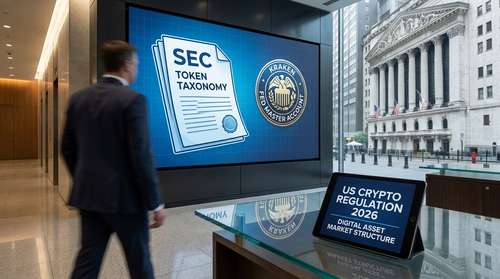
In a watershed week for US Crypto Regulation 2026, the digital asset industry has achieved two holy grails long thought impossible. On Wednesday, the Federal Reserve Bank of Kansas City granted Kraken Financial a limited-purpose Federal Reserve Master Account, making it the first crypto-native firm to directly access the central bank's payment rails. Almost simultaneously, the Securities and Exchange Commission (SEC), under Chair Paul Atkins, submitted its definitive "Token Taxonomy" guidance to the White House, finally providing the legal clarity needed to categorize digital assets.
Kraken Breaks the Banking Siege
The approval of Kraken Financial’s application by the Kansas City Fed marks a pivotal shift in institutional crypto adoption. For years, crypto firms have been forced to rely on intermediary banks—many of which have been volatile partners—to settle dollar transactions. Now, Kraken Financial, operating as a Wyoming Special Purpose Depository Institution (SPDI), can settle payments directly on Fedwire.
"This milestone marks the convergence of crypto infrastructure and sovereign financial rails," said Arjun Sethi, co-CEO of Kraken. "With a Federal Reserve master account, we can operate not as a peripheral participant in the U.S. banking system, but as a directly connected financial institution."
The account is designated as "limited purpose" and is subject to a one-year probationary period with strict oversight. Unlike traditional commercial banks, Kraken Financial operates on a full-reserve model, meaning it holds 100% of customer deposits in liquid assets and does not lend them out. This "narrow bank" structure was key to winning over the Kansas City Fed, despite heavy opposition from traditional banking lobbyists.
SEC's 'Token Taxonomy': The End of Regulation by Enforcement?
While Kraken rewired the plumbing of the digital asset market structure, the SEC moved to fix the blueprint. On March 3, the agency submitted its interpretive framework to the White House Office of Information and Regulatory Affairs (OIRA). This "Token Taxonomy" moves beyond the ambiguity of the 1946 Howey Test, offering four distinct categories for digital assets:
- Digital Commodities & Network Tokens: Assets used to pay for network operations (gas fees) or incentivize decentralized consensus, largely falling under CFTC jurisdiction.
- Digital Collectibles: NFT-type assets where value is derived from unique traits or access rights rather than managerial effort.
- Digital Utilities: Tokens granting specific access to software or services, distinct from investment contracts.
- Tokenized Securities: Digital representations of traditional financial instruments (stocks, bonds) which remain under strict SEC oversight.
This framework aligns with the ongoing legislative push for the CLARITY Act but allows the SEC to provide immediate guidance without waiting for Congress. "Economic reality trumps labels," Chair Atkins noted, signaling that the era of regulating every crypto asset as a security by default is officially over.
The Banking Sector Pushes Back
The dual announcements have not been without controversy. The Bank Policy Institute (BPI), a trade group representing the nation's largest banks, issued a sharp rebuke of the Fed's decision. Paige Pidano Paridon, BPI’s co-head of regulatory affairs, criticized the issuance of a "skinny" master account before the Federal Reserve Board had finalized its broader policy framework for novel institutions.
Critics argue that granting non-bank entities access to the Federal Reserve payment rails introduces systemic risk. However, proponents argue that the full-reserve model of Wyoming SPDIs actually de-risks the system by removing the fractional reserve leverage that caused the banking crises of 2023.
Market Reaction: The Institutional Floodgates Open
The crypto market news sent shockwaves through institutional trading desks. With the regulatory hazard of "unregistered securities" fading and the operational risk of banking partners vanishing, the barriers to entry for massive capital allocators have collapsed. Analysts predict that this structural legitimacy will accelerate the timeline for major U.S. pension funds and insurance giants to enter the DeFi space, using compliant "Digital Utility" tokens to access yield without fear of enforcement actions.
As 2026 unfolds, the U.S. has decisively pivoted from a jurisdiction of hostility to one of integrated oversight. The bridge between Wall Street and the blockchain is no longer a concept; it is now paved, permitted, and open for business.