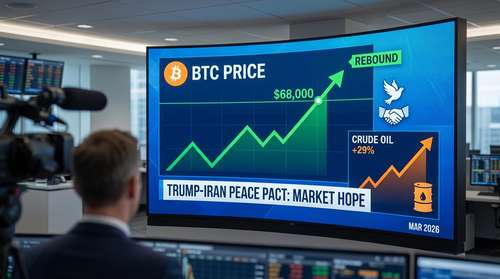
The geopolitical shockwaves of the past two weeks have tested the resilience of digital assets, yet the latest Bitcoin price March 2026 action reveals a stunning recovery. Bitcoin has staged a sharp rebound to the $68,000 level, aggressively defying a broader global market sell-off. This renewed momentum comes on the heels of a massive 29% surge in global oil prices triggered by intense Middle East tensions. Market optimism is rapidly accelerating following reports that U.S. President Donald Trump is actively discussing a potential resolution to the Iran conflict with Israeli Prime Minister Benjamin Netanyahu. The prospect of de-escalation has ignited intense market activity, leading to a massive 53% spike in BTC trading volume over the past 24 hours.
Iran War Crypto Impact: Defying the Global Equity Sell-Off
When geopolitical hostilities escalated late last month, traditional financial markets and digital assets initially reacted with panic. The scale of the disruption has few modern precedents, with millions of barrels of oil removed from daily global supply. Yet, the initial Iran war crypto impact saw only a swift flash crash, dragging Bitcoin down toward the $63,000 to $65,000 support zone. The dominant cryptocurrency quickly absorbed the shock, demonstrating remarkable decoupling from traditional equities which remain heavily battered by petroleum supply disruptions. Asian and European stock futures plunged as the week opened, but Bitcoin held its ground.
As investors digest the latest crypto market news 2026, a clear narrative is emerging. While major stock indexes continue to slide under the weight of an energy crisis, decentralized assets are attracting defensive capital. Traders are increasingly viewing Bitcoin as a hedge against fiat instability and geopolitical uncertainty, especially when standard macroeconomic playbooks are thrown into disarray by sudden conflict.
The Trump Iran Peace Deal: A Catalyst for Market Optimism
Geopolitical headwinds shifted dramatically over the weekend. Diplomatic channels appear to be opening, with a potential Trump Iran peace deal taking center stage. Reports indicate that President Trump and Israeli Prime Minister Netanyahu are outlining a framework to wind down immediate hostilities and address the nuclear threat without prolonged warfare.
For financial markets, peace is the ultimate bullish catalyst. The prospect of an immediate de-escalation acts as a powerful counterbalance to the macroeconomic fears gripping Wall Street. The mere hint of a diplomatic resolution has eased the extreme fear metrics that dominated early March trading. Trump recently took to his Truth Social platform to state that temporary economic pain would be a small price to pay, promising that market pressures would ease rapidly once the core geopolitical threats are neutralized. This diplomatic pivot provided exactly the reassurance institutional crypto investors needed, triggering aggressive spot buying that pushed Bitcoin firmly back to $68,000 and squeezing over-leveraged short positions in the process.
Analyzing the Bitcoin Oil Price Correlation
To understand current market dynamics, one must examine the shifting Bitcoin oil price correlation. Historically, digital assets and crude oil share an inverse relationship during times of conflict. The recent blockade in the Strait of Hormuz and coordinated production cuts from Middle Eastern producers sent crude prices soaring above $115 per barrel—a staggering 29% surge.
Skyrocketing energy costs typically force central banks to maintain elevated interest rates to combat inflation, a scenario that usually suppresses risk-on assets like crypto. However, the current environment has broken this traditional mold. The sudden realization that the oil spike might be a temporary geopolitical anomaly rather than a structural inflationary trend has allowed Bitcoin to thrive even as energy markets remain volatile. Investors are looking past the immediate pain at the gas pump, betting that a diplomatic resolution will quickly normalize global supply chains.
Institutional Inflows and the BTC Trading Volume Surge
The recovery narrative is heavily supported by on-chain data and exchange metrics. The prospect of easing tensions has resulted in a massive BTC trading volume surge, jumping 53% as sidelined capital rushes back into the ecosystem. This liquidity injection is largely driven by institutional players and spot exchange-traded fund inflows that capitalized on the recent dip.
High trading volume during a price recovery is a strong indicator of sustainable momentum. When volume drops during a rally, it often signals a weak recovery, but the current surge suggests robust conviction among buyers. External funds are rotating out of traditional safe havens like physical gold and silver, seeking the asymmetric upside that Bitcoin offers as the geopolitical landscape stabilizes.
Bitcoin Technical Analysis: Breaking Down the Next Targets
From a charting perspective, the recovery paints an intriguing picture. Our latest Bitcoin technical analysis indicates that reclaiming the $68,000 threshold was a critical step in invalidating bearish breakdown scenarios. The asset successfully defended the pivotal lower boundary near $63,000, utilizing it as a springboard for the current rally.
Indicators such as the Relative Strength Index are resetting from oversold territory, signaling that the asset has plenty of room to run before hitting overbought conditions. Furthermore, the 50-day moving average is beginning to curve upward, providing dynamic support for intraday pullbacks.
Moving forward, the immediate resistance sits squarely at the psychological $70,000 barrier. If buying pressure sustains and diplomatic news remains positive, a breakout above this level could easily clear the path toward $73,000 and eventually the $75,000 resistance zone. Conversely, should peace talks stall, traders must watch the $66,000 level for vital support. For now, the technical structure leans heavily bullish, supported by overwhelming volume and shifting macroeconomic sentiment.