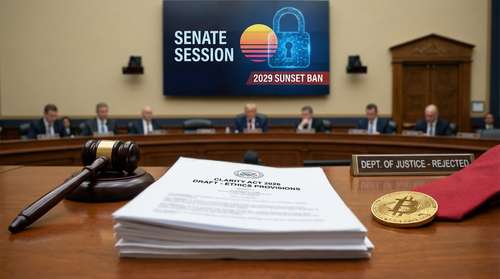
The American digital asset policy environment has reached a boiling point. As of mid-April, the highly anticipated CLARITY Act crypto bill is entering a critical 14-day window within the Senate Banking Committee. Lawmakers are warning that if the legislation fails to reach a floor vote before the upcoming May recess, the entire framework risks being shelved for months pending the midterm Congressional elections. What began as a sweeping, bipartisan effort to overhaul the digital asset market structure has now devolved into a heated standoff.
At the center of the legislative storm is a fundamental clash over stablecoin yield legislation. While the bill seamlessly integrates the historic regulatory shifts from earlier this year, traditional banking lobbyists have fiercely opposed provisions that would allow non-banks to offer yield-bearing stablecoins. With President Trump urging institutions to "remove all hurdles" before the midterms, the pressure on Capitol Hill is unprecedented.
The 14-Day Countdown for the Senate Banking Committee Crypto Vote
The urgency surrounding the CLARITY Act cannot be overstated. Senator Bill Hagerty recently indicated that there is sufficient consensus for the measure to move forward during the Senate's work period beginning April 13. However, the timeline is dangerously tight. To hit the critical July deadline and clear the August congressional recess, the Senate Banking Committee must conclude its markup by the end of this month.
A successful Senate Banking Committee crypto vote would mark the most significant regulatory milestone in the United States since the post-FTX cleanup of 2024. The legislation easily passed the House last summer by a definitive vote of 294 to 134, but the Senate has proven to be a far more complex battleground. The stakes for the broader cryptocurrency market are incredibly high, as trillions in institutional capital—from pension funds to insurance providers—remains sidelined by legal ambiguity.
Codifying the Historic SEC CFTC Joint Interpretation
Much of the momentum behind the CLARITY Act stems from the urgent need to codify recent regulatory breakthroughs. On March 17, 2026, regulators shocked the industry by issuing a landmark SEC CFTC joint interpretation. This pivotal guidance finally established a formal token taxonomy for federal law, officially defining five distinct asset categories: digital commodities, digital collectibles, digital tools, payment stablecoins, and digital securities.
Locking in Solana XRP Commodity Status
The most celebrated outcome of the March ruling was the definitive clarification of major altcoins. The interpretation formally paved the way to secure the Ethereum, as well as the Solana XRP commodity status, effectively removing the lingering threat of enforcement actions. Furthermore, the guidance explicitly stated that foundational blockchain activities, including protocol staking, mining, and airdrops, are not classified as securities transactions.
The CLARITY Act aims to cement this SEC CFTC joint interpretation into permanent federal law. It proposes granting the Commodity Futures Trading Commission (CFTC) exclusive jurisdiction over digital commodity spot markets while ensuring the SEC maintains oversight of strictly defined investment contract assets. By doing so, the bill establishes a robust registration regime for digital commodity exchanges, brokers, and dealers, while deploying anti-evasion protections to prevent market manipulation.
The Sticking Point: Stablecoin Yield Legislation
Despite widespread agreement on token classification, the bill remains paralyzed by a fierce dispute over stablecoin yield legislation. Traditional banking institutions are reportedly terrified that allowing yield on passive stablecoin balances will result in a massive deposit flight, as consumers move their savings into digital accounts held at non-banks.
To break the deadlock, negotiators are floating a highly debated compromise. Under the proposed resolution, rewards on purely passive stablecoin balances would be strictly prohibited. However, "activity-based" rewards tied to specific payments, transfers, and platform usage would be permitted. Crypto advocates argue that stripping passive yield entirely neutralizes the utility of stablecoins, while banking advocates claim it is the only way to protect the traditional financial system from localized bank runs.
The Future of Digital Asset Market Structure
As the clock ticks down, the outcome of this legislative battle will fundamentally reshape the digital asset market structure in the United States. The timing of the bill uniquely coincides with major market movements. Bitcoin recently surged past $72,500 on April 8 following the announcement of a temporary ceasefire between the U.S. and Iran, proving that the digital economy is moving forward regardless of Washington's pace.
If the CLARITY Act crypto bill passes, it will unlock vast reserves of institutional capital, offering a comprehensive framework that balances consumer protection with robust American innovation. If the 14-day window closes without a successful Senate Banking Committee crypto vote, the promise of true crypto regulation US 2026 will evaporate, leaving the industry to navigate another year of regulatory uncertainty.