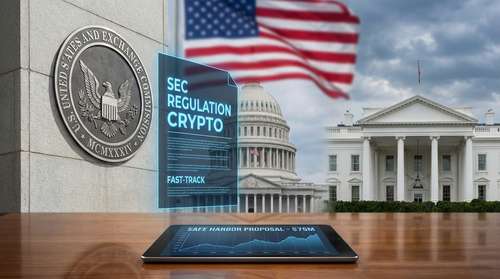

President Donald Trump has ignited a firestorm in Washington, publicly accusing the nation's largest banks of sabotaging the U.S. Crypto Agenda and undermining American financial innovation. In a blistering Truth Social post late Tuesday, Trump claimed traditional financial institutions are holding the landmark Clarity Act "hostage" to protect their record profits, warning that their obstructionism could gift the future of the digital asset economy to China. The conflict has reached a boiling point this week as negotiations over stablecoin yield regulation collapsed, leaving the highly anticipated bill stalled in the Senate just months before the midterm election season begins.
The Clarity Act Impasse: What Is at Stake?
At the heart of this legislative deadlock is a fierce battle over who gets to profit from the digital dollar. While the Genius Act, signed into law in July 2025, successfully established a federal framework for stablecoin issuers, it left a critical regulatory gap regarding third-party platforms. Currently, crypto exchanges like Coinbase can legally pass on yields—generated from reserve assets like U.S. Treasuries—to their customers. This has allowed everyday Americans to earn upwards of 3.5% APY on their digital holdings, significantly outperforming the near-zero interest rates offered by traditional savings accounts.
Traditional banks are lobbying aggressively to close this window. Industry giants argue that allowing unregulated tech firms to offer high-yield, deposit-like products creates an uneven playing field and threatens the stability of the fractional reserve banking system. The Clarity Act was intended to resolve these jurisdictional disputes between the SEC and CFTC, but it has now become the battleground for this yield war. "The Banks are hitting record profits, and we are not going to allow them to undermine our powerful Crypto Agenda," Trump wrote, signaling his administration's refusal to accept any bill that strips consumers of their ability to earn "more money on their money."
$500 Billion at Risk: The Fear of Deposit Flight
The banking lobby's aggressive stance is driven by existential arithmetic. A recent analysis by Standard Chartered estimates that if stablecoins are permitted to offer competitive yields freely, approximately $500 billion could exit the traditional banking system by 2028. More alarmist projections from the Bank Policy Institute warn that the figure could be as high as $6.6 trillion in a "mass migration" scenario, potentially forcing community banks to slash lending by hundreds of billions of dollars.
Bank of America CEO Brian Moynihan recently echoed these concerns, suggesting that yield-bearing stablecoins could drain 30% of commercial bank deposits. This fear of stablecoin deposit flight is what drove lobbyists to reject a White House-brokered compromise earlier this week. The proposal would have allowed yields on peer-to-peer payment balances but banned them on idle investment holdings—a middle ground that banks deemed insufficient to protect their low-cost funding model.
Trump vs. Banks: A New Populist Front
President Trump has framed this technical regulatory dispute as a populist issue, aligning himself with crypto innovators against "gatekeeper" institutions. By meeting with Coinbase CEO Brian Armstrong at the White House just hours before his social media barrage, Trump sent a clear signal: the Trump crypto agenda prioritizes consumer choice over legacy banking protections. This marks a significant shift in Republican financial policy, which has historically been aligned with Wall Street interests.
The Geopolitical Angle: Losing to China?
Beyond domestic economics, the administration is leveraging geopolitical fears to push the US crypto bill 2026 forward. Trump explicitly warned that continued gridlock would drive digital asset innovation—and capital—to China, which has been aggressively rolling out its own state-backed digital currency infrastructure. "If we don't get The Clarity Act taken care of, we lose," Trump stated, positioning the passage of the bill not just as economic policy, but as a national security imperative.
With the March 1 deadline for a compromise now passed, the pressure is on Senate leadership to break the stalemate. Market prediction platforms currently show a 72% chance of the Clarity Act passing this year, but that optimism is fragile. As the midterms approach, the window for bipartisan cooperation is closing, leaving the trillion-dollar question unanswered: Will America's financial future be built on blockchain rails, or will traditional banks succeed in walling off the garden?