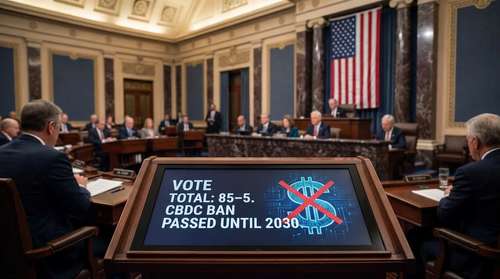
In a monumental shift for the future of digital finance, the U.S. Senate has voted overwhelmingly to halt the creation of a government-backed digital dollar. Passing the 21st Century ROAD to Housing Act by a landslide 85-5 margin on Monday evening, lawmakers officially triggered a temporary US Senate CBDC ban. This sweeping legislation directly prohibits the Federal Reserve from issuing a central bank digital currency until at least the end of the decade.
While the bill ostensibly targets housing supply and affordability, its crypto-related provisions represent a watershed moment for digital assets. By freezing the Federal Reserve digital dollar pipeline while explicitly exempting private stablecoins, Congress has signaled that the private sector will continue to drive American payment innovation. The measure now heads to the House of Representatives, where it is widely expected to secure fast-track approval before landing on President Donald Trump's desk for a final signature.
Inside the 21st Century ROAD to Housing Act
You might wonder how a restriction on digital currency found its way into a national housing package. The 21st Century ROAD to Housing Act (H.R. 6644) was primarily designed to combat the corporate domination of single-family homes and boost domestic housing supply. However, the inclusion of Title XI, Section 1101, demonstrates a classic legislative strategy of attaching vital regulatory pauses to must-pass, bipartisan bills.
This specific section cements the digital dollar ban 2030. According to the legislative text, the Board of Governors of the Federal Reserve System and all regional Fed banks are strictly barred from creating, issuing, or circulating a digital asset substantially similar to a CBDC until December 31, 2030. The restriction prevents the central bank from releasing a retail digital asset either directly to consumers or indirectly through financial intermediaries.
Why Lawmakers Paused the Fed Central Bank Digital Currency
The push to halt a state-sponsored digital currency stems largely from rising anxieties regarding financial privacy and government overreach. Republican legislators spearheaded the opposition, arguing that a Fed central bank digital currency could pave the way for a financial surveillance state akin to the system currently deployed in China with the digital yuan.
This legislative maneuvering aligns perfectly with the current administration's stance. In January 2025, President Trump signed an executive order outright banning his administration from pursuing CBDC development, citing severe risks to civil liberties and the stability of the traditional banking sector. The 85-5 Senate vote essentially codifies that executive directive into hard federal law, guaranteeing that future administrations cannot easily reverse course and quietly launch a digital token. Even after the 2030 expiration date, the central bank would require explicit authorization from Congress to resume any digital dollar initiatives.
A Major Victory for US Crypto Legislation and Stablecoins
Perhaps the most critical aspect of this US crypto legislation is what it actively protects. While the government cannot issue its own digital asset, the text contains a massive carve-out for private digital currencies. The bill explicitly exempts any dollar-denominated currency that remains open, permissionless, and private.
This creates a highly favorable environment for the current stablecoin market. With a government alternative sidelined for the next four years, private issuers will maintain their dominance over the digital dollar ecosystem. The current framework for stablecoin regulation US effectively shields dollar-pegged tokens from being squeezed out by a federal competitor. This allows the private market to fulfill the demand for faster, blockchain-based dollar transactions without putting user data directly into a centralized government ledger.
The Private Sector Takes the Lead
Companies managing fiat-collateralized stablecoins have long worried that a federally issued alternative could monopolize the digital payments sector. By firmly establishing the boundaries of stablecoin regulation US, lawmakers have removed a significant existential threat to decentralized finance. Advocates argue that private stablecoins, which currently facilitate billions of dollars in daily international trade, provide the same rapid settlement benefits as a CBDC without the inherent privacy trade-offs. The legislation basically crowns the private sector as the undisputed leader of blockchain-based dollar distribution until at least the end of the decade.
What Happens Next for the Federal Reserve Digital Dollar?
The fate of the Federal Reserve digital dollar is now essentially sealed for the foreseeable future. The House of Representatives has already demonstrated broad support for these policies, having passed a related anti-CBDC measure with overwhelming bipartisan backing earlier in the year. Lawmakers in the lower chamber are expected to expedite the vote following their return from recess on June 23, pushing the finalized housing bill straight to the White House.
As Europe preps to launch its digital euro pilot and China expands the reach of its digital yuan, the United States is officially charting a different course. By prioritizing a US Senate CBDC ban and leaning heavily on private stablecoins, America is betting that free-market innovation will outpace state-controlled ledgers. For the crypto industry, Monday's 85-5 vote provides clear, long-awaited regulatory breathing room and solidifies the role of decentralized finance in the next era of the global economy.