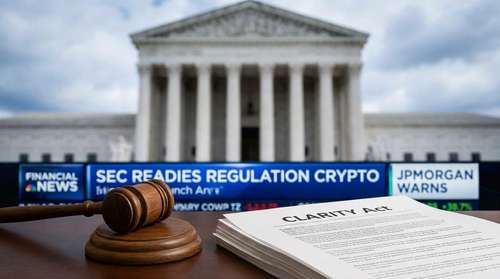
For over a decade, the digital asset industry operated under a cloud of jurisdictional turf wars and enforcement-first policies. That era abruptly ended this spring with the historic release of the SEC CFTC joint interpretation. Issued on March 17, 2026, this landmark guidance provides the definitive clarity market participants have desperately sought, firmly establishing a comprehensive US crypto legal framework. Led by SEC Chair Paul Atkins and CFTC Chair Selig, the coordinated agency effort marks a massive paradigm shift away from ambiguity and toward a structured, principles-based approach to digital finance.
A Unified Front: The SEC Crypto Task Force and Project Crypto
This regulatory milestone did not materialize overnight. It builds heavily on the groundwork laid by the SEC Crypto Task Force and "Project Crypto"—a cross-agency initiative formalized earlier this year to modernize federal securities laws for onchain markets. Following a historic Memorandum of Understanding signed between the two regulators, the agencies abandoned their previous siloed approaches to embrace a unified front.
The resulting guidance effectively supersedes years of contradictory staff statements and piecemeal enforcement actions. By aligning the Securities and Exchange Commission with the Commodity Futures Trading Commission, the federal government has eliminated the overlapping claims that historically plagued digital asset trading platforms. Exchanges and blockchain developers now have a unified, predictable playbook to determine exactly which regulatory body oversees their specific operations and token offerings.
Resolving the Digital Asset Security vs Commodity Debate
At the heart of the SEC CFTC joint interpretation is a novel five-category token taxonomy that directly answers the ongoing digital asset security vs commodity question. Rather than forcing all blockchain-based assets into the nearly century-old Howey Test, the agencies have classified digital assets into five distinct buckets based on their intrinsic characteristics and economic realities:
- Digital Commodities: Assets intrinsically linked to a functional network, driven by supply and demand rather than managerial efforts (e.g., Bitcoin, Ethereum, Solana).
- Digital Collectibles: Unique digital items, including non-fungible tokens, deriving value from their specific characteristics rather than financial utility.
- Digital Tools: Utility tokens designed for practical, operational network functions rather than investment purposes.
- Stablecoins: Fiat-pegged assets designed for commercial payments and stable value transfer across networks.
- Digital Securities: Traditional financial instruments, like equities or corporate bonds, that are explicitly represented onchain.
Under this new framework, major assets classified as digital commodities fall firmly under the purview of the Commodity Exchange Act, empowering the CFTC with primary oversight of their spot and derivatives markets.
The "Separation" Principle and Network Maturity
Perhaps the most vital legal clarification involves the lifecycle of a newly issued token. The interpretation formally recognizes that while a non-security crypto asset can initially be sold as part of an investment contract to raise capital, the underlying token itself does not permanently become a security. Once a network reaches sufficient decentralization and the issuer's initial promises are fulfilled, the asset "separates" from the investment contract. This dynamic analysis finally allows early-stage projects to mature and trade on secondary markets without carrying permanent regulatory baggage.
Greenlighting Decentralized Network Operations
The guidance extends far beyond simple asset classification. It explicitly states that fundamental decentralized network activities—specifically protocol mining, staking, wrapping, and airdrops—generally fall outside the scope of federal securities laws.
This specific clarification is an enormous victory for decentralized infrastructure providers who previously operated in fear of sudden subpoenas. Node operators, validators, and liquidity providers can now secure networks, process transactions, and facilitate cross-chain transfers without the looming threat of operating as unregistered securities brokers. It essentially legalizes the core mechanics of decentralized finance operating within the United States.
Paving the Way for Institutional Crypto Adoption
Regulatory clarity remains the ultimate catalyst for capital inflows. By removing the overarching threat of arbitrary enforcement, this unified guidance is already accelerating institutional crypto adoption. Asset managers, pension funds, family offices, and traditional banking institutions now possess a fully compliant roadmap to interact with digital assets. Chief compliance officers can confidently structure token portfolios, evaluate counterparty risks, and launch blockchain-based custody services with full knowledge of where the jurisdictional lines are drawn.
Furthermore, this joint interpretation serves as a vital regulatory bridge pending the passage of comprehensive crypto market structure legislation. With sweeping bills like the Digital Asset Market Clarity Act currently awaiting Senate action, the SEC and CFTC have ensured the capital markets will not operate in a vacuum while Congress finalizes statutory law.
The landscape of crypto regulation 2026 is no longer defined by lawsuits and regulatory uncertainty, but by a functional taxonomy that acknowledges the unique technological realities of blockchain networks. For industry veterans and institutional newcomers alike, the regulatory fog has finally lifted, opening the door for genuine innovation and market growth.