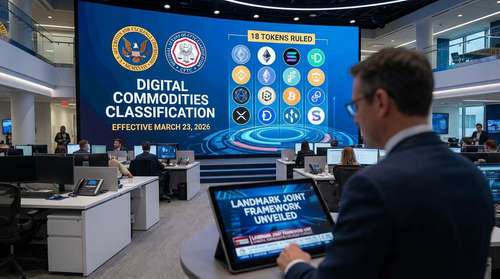
The regulatory gray area surrounding digital assets in the United States is officially shrinking. On Monday, March 23, 2026, the highly anticipated SEC CFTC joint crypto guidance formally takes effect. This landmark interpretation definitively answers the industry's longest-running question by officially classifying 18 major cryptocurrencies—including Bitcoin, Ethereum, Solana, and XRP—as digital commodities. For nearly a decade, builders and investors navigated a minefield of ad-hoc lawsuits and contradictory agency statements. By formally pivoting away from the regulation-by-enforcement approach that dominated previous administrations, federal regulators have established a cohesive US crypto taxonomy. This shift provides desperately needed clarity for developers, institutional investors, and retail traders who require predictable rules of the road to innovate safely.
The Five-Category US Crypto Taxonomy Explained
Issued jointly by SEC Chairman Paul S. Atkins and CFTC Chairman Michael S. Selig, Interpretive Release Nos. 33-11412 and 34-105020 introduce a definitive five-category framework for all digital assets. Rather than treating every token as a potential investment contract under outdated legal precedents, regulators will now evaluate assets based on their functional economic realities. The agencies spent months gathering public input to ensure the rules reflect the technological reality of blockchain networks. While the Supreme Court's decades-old Howey test remains binding legal precedent, this new interpretation provides a modern lens for applying those standards to decentralized ledgers.
The framework divides the market into five distinct classifications:
- Digital Commodities: Core cryptocurrencies utilized primarily for decentralized exchange, network operation, and base-layer consensus.
- Digital Collectibles: Non-fungible tokens (NFTs) and unique digital art that do not represent underlying financial enterprises.
- Digital Tools: Utility tokens strictly limited to providing access to specific software, digital ecosystems, or platforms.
- Stablecoins: Fiat-pegged payment instruments governed primarily under recent congressional legislation.
- Digital Securities: Tokenized equities, bonds, or assets that offer a direct share in a traditional enterprise and carry expectations of profit derived from managerial efforts.
This shared approach guarantees that the CFTC and SEC will apply the same standard to identical assets, ending an era of fragmented oversight.
Ethereum Commodity Status and the 18 Approved Tokens
For years, the industry operated under the threat that core infrastructure tokens could suddenly face hostile enforcement actions. The new digital commodity classification eliminates this existential risk for the market's heavyweights. The interpretation explicitly names 18 major tokens that fall squarely under the CFTC's jurisdiction as digital commodities, permanently shielding them from the SEC's stringent registration requirements.
Securing Ethereum commodity status is perhaps the most consequential outcome for decentralized finance (DeFi). Following massive institutional adoption and the launch of spot exchange-traded funds, any retroactive securities designation would have devastated the broader ecosystem. Alongside Ethereum, tokens like Solana and XRP have secured identical commodity protections. The agencies recognize that these decentralized networks operate independently of any central managerial efforts, meaning purchasers are relying on open-source code rather than a corporate promoter. This formal recognition marks a permanent departure from previous internal agency debates over whether the transition to proof-of-stake consensus mechanisms altered a token's regulatory status.
Solana Staking Legality, Mining, and Airdrops Cleared
Beyond token classification, the joint interpretation directly addresses how network participants secure these blockchains. In a massive victory for proof-of-work and proof-of-stake networks alike, the agencies confirmed that protocol-level staking and mining activities do not constitute securities offerings.
This definitively resolves questions regarding Solana staking legality and protects millions of users who lock up their digital assets to process transactions and secure the network. Regulators clarified that standard protocol staking is a technical mechanism for achieving consensus and securing a distributed ledger. It is not an investment contract promising passive returns from a third party. The agencies drew a sharp distinction between native protocol staking and third-party lending programs. While decentralized consensus participation is protected, centralized yield programs where user funds are pooled and lent out by a corporate entity may still face regulatory scrutiny.
Furthermore, the framework explicitly states that network airdrops conducted without requiring financial consideration fall outside the scope of federal securities laws. The routine wrapping of a non-security asset for use on a different blockchain also does not magically transform that asset into a security.
Building on the GENIUS Act Implementation
This sweeping crypto regulation 2026 milestone did not happen in a vacuum. The joint framework acts as a natural regulatory extension following the successful GENIUS Act implementation. Signed into law by President Donald Trump in July 2025, the Guiding and Establishing National Innovation for US Stablecoins Act (GENIUS Act) brought the first wave of comprehensive regulatory clarity by establishing strict 1-to-1 reserve requirements for dollar-backed stablecoins.
The GENIUS Act established that legitimate stablecoins are payment instruments, not national currencies or investment securities, paving the way for real-time, low-cost blockchain settlements. By resolving the stablecoin question legislatively and establishing a framework for national trust bank charters, Congress gave the SEC and CFTC the political and legal runway needed to coordinate on broader digital asset markets. Under the recent Memorandum of Understanding signed by Chairs Atkins and Selig, the agencies committed to ending duplicative examinations and sharing supervisory insights before launching parallel actions.
This collaborative approach effectively lowers the barrier to entry for traditional financial institutions. Wall Street banks and payment processors can now build compliant custody solutions and trading platforms without the paralyzing fear of sudden, conflicting agency lawsuits. Market participants must now review their portfolios and business models against the new five-category matrix. As the framework officially takes effect tomorrow, the United States is positioned to leverage this regulatory certainty to attract massive capital and technical talent that had previously fled offshore.